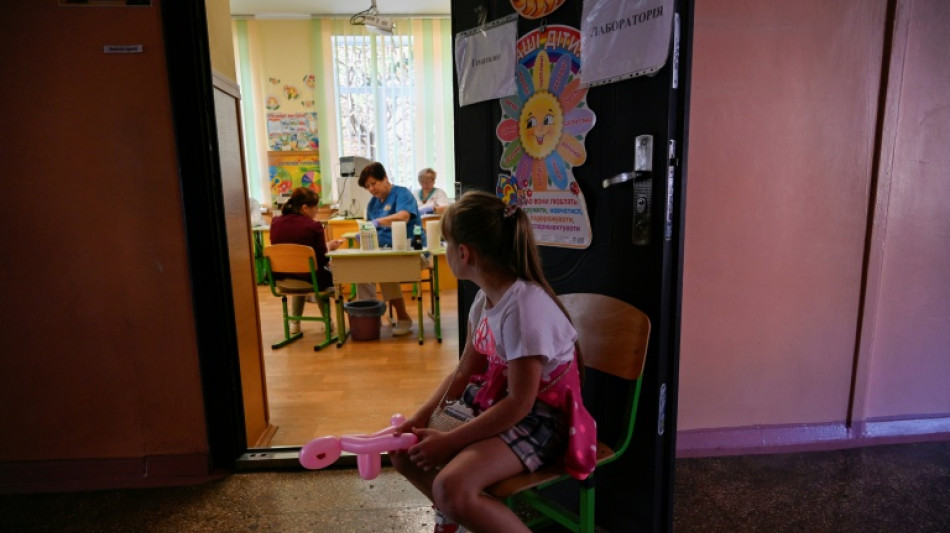
Mobile medical brigade seeks to bring solace to Ukrainian children / Photo: © AFP

 Dana White Confirms Flight to Washington for Trump Meeting on Press Secretary Role

 Dengue Fever Expands Into High Himalayas as Climate Change Warms Nepal

 IoT Refrigerator Hacks Disrupt Blood Labs and Supermarkets Across Europe and US

 Post-election pressures complicate US and Israeli decisions on Iran

 UN members approve talks on treaty protocol against environmental crime

 Family-run West Sussex beach café prepares for first winter season

 CT scans reveal health and burial clues from Egypt’s Braided Lady mummy

 Oxford faces complaints over lecturer’s classroom attire

 Kyren Wilson and John Higgins reach International Championship snooker final

 New Zealand and Tonga meet for place in Rugby League World Cup final

 Reports of unsafe AI-toy responses renew calls for child-safety rules

 Juneau food network combines difficult supply routes with deep sharing traditions

 India climbs green-transition ranking after first emissions decline in 25 years

 Trump names Stephen Miller as White House chief of staff after midterm losses

 Restored Albanian tower houses anchor new rural tourism trail

 Sonia Gandhi reflects on family tragedy and reluctant political career

 Pope Leo begins three-country South American tour in Uruguay

 Khawaja says entire Australia camp knew of 2018 ball-tampering plan
Two dozen doctors from a mobile medical brigade visiting children in rural Ukraine shuffled out of a bus parked next to the brick walls of a primary school.
In a well-rehearsed choreography led by doctor Olga Medvedeva, they set up equipment across the school in the village of Myrne, while singer Sofia Yegorova distracted the children before their medical check-up.
Access to specialist medical care is difficult in many parts of Ukraine, whose already overstretched healthcare system is now grappling with the devastating effects of Russia's war.
Stress is already taking a toll on children's mental and physical wellbeing, which is being made worse by a lack of access to care, the medical brigade from the Okhmatdyt Children's Hospital said.
"As we drove, we realised that we were seeing pretty much the same picture," Medvedeva, the 63-year-old head of a paediatrics department at Okhmatdyt, told AFP.
Medvedeva's brigade has carried out over 60 missions since May 2022, shortly after Ukrainian forces pushed Russian troops back from the area.
It has travelled both to recently de-occupied territories and areas that were relatively spared from Russia's assault -- like Myrne, about 40 kilometres (25 miles) from the capital, Kyiv.
"Most often there are eating and psycho-emotional disorders, which together leads to a series of further illnesses," said Medvedeva.
"It's like a trigger," she said.
- Eating issues –
Several parents told AFP that seeing specialised doctors was difficult, partly due to staff shortages in some hospitals, but also because of an influx of internally displaced people.
And some of the families who used to go to the capital's medical centres were discouraged by the threat of air raids.
Many parents were queueing outside classrooms, leaning against the corridor's peach-painted walls, to visit the doctors who made the trip.
Children meanwhile played on the hopscotch patterns painted on the ground or coloured in drawings.
Among the parents was 46-year-old Lyudmyla Lokha, who came with her seven-year-old son, Timofey.
Lokha said that her son stopped eating well when the family fled to Portugal at the beginning of the invasion.
"When he is worried, he has trouble eating," said Lokha.
When that happens, the family calls Timofey's older brother "who he loves very much and motivates him via video".
"His sister and dad help too," she said.
A nurse at the school, 37-year-old Inna Tashevska, noticed psychological issues affecting the pupils and her own children.
"At school, when they get nervous, their stomachs hurt. They come in with headaches or panic attacks."
- 'Until the air siren stops' -
Psychologist Olga Sudak, 29, said doctors first focus on working with families.
"When the family is calm, the children are much more comfortable and will recover better."
She also recommended that parents answer their children's questions about the invasion.
But when she hears her grandfather Sergiy Vida speak about the war, eight-year-old Milana buries her face in his chest.
"War means death. It means maiming. It means restrictions," said Vida, who fought during the first year of the invasion before being discharged.
"I feel half angry, half happy," Milana told AFP, clutching her pink bag.
"It's good that all is good with us. And bad that there is war, right?" Vida said, holding his granddaughter closer.
Milana agreed.
Medvedeva was optimistic that children could recover from the "huge stress" of the war.
"But we have to instil in them the confidence that everything will be okay," she cautioned.
And with the prospect of a long war setting in, she said medical staff had a long and difficult task ahead of them.
"As long as the war is going on, we'll see all these issues," she warned.
"Until the air sirens stop, until transport starts working normally, until people calm down."
G.Haefliger--VB