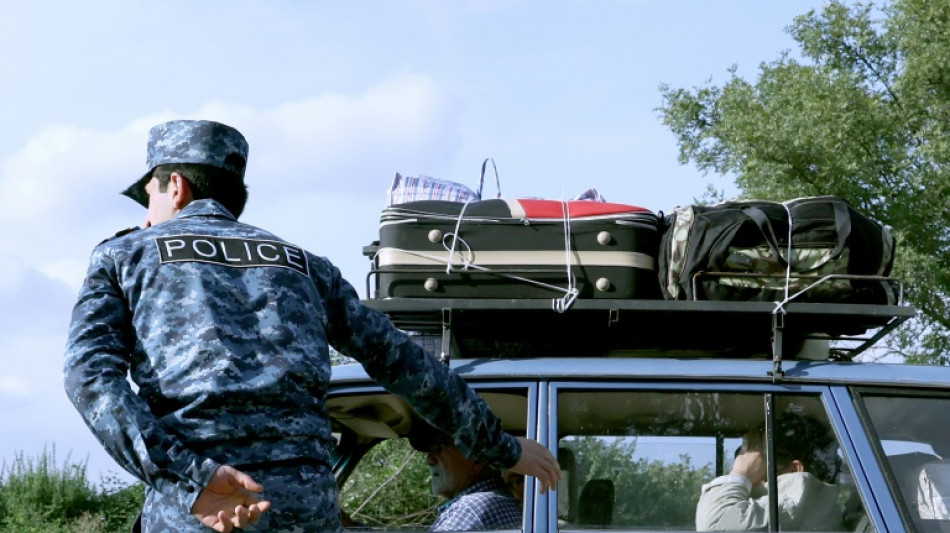
'I left everything': Karabakh refugees start from scratch in Armenia / Photo: © AFP

 Rene Eyre Revisits Autobiographical Performance 'Say A Little Prayer' in London

 UAE's HCT Holds Record Graduation and Announces Major Training Expansion

 NASA Awards $10B Lunar Contract Framework to SpaceX, Blue Origin

 Katy Perry Tells Fans Ex-Husband Russell Brand 'Should Be in Jail' During UK Concert

 South African election results renew debate over identity-based voting

 South African voters report smoother local election but declining IEC trust

 Dolly Parton museum and Nashville hotel open after singer’s death

 George and Amal Clooney attend New York political-comedy reading

 British buyers pay substantial premiums for period-home appearance

 Thomas Markle released to house arrest after child-abuse-image charge

 Dawn of War 4 developers chose Adeptus Mechanicus for tactical variety

 Italy face unbeaten South Africa in Turin Nations Championship match

 ChatGPT interactive interface feature tested across six custom tools

 Freshways milk-price cut deepens pressure on UK dairy farms

 Labour and National remain virtually tied as New Zealand vote count advances

 The Good Daughter adapts Karin Slaughter thriller with Rose Byrne and Meghann Fahy

 Heavy-lift drone evacuates wounded Ukrainian soldier from frontline kill zone

 Morrison says West Brom recovered after pressure from successive derby losses
Nagorno-Karabakh pensioner Svetlana Isakhanyan walked into her new life in Armenia wearing green slippers and carrying only a handbag with a passport.
The stooping 78-year-old had lived in the ethnically Armenian enclave until Azerbaijan launched a lightning and seemingly decisive offensive against the separatist region this week.
She said the shelling hit her hometown of Stepanakert while she was visiting the grave of her son -- himself killed when Armenian forces and Azerbaijan fought their first and most brutal Karabakh war in the 1990s.
Tens of thousands lost their lives then. Thousands more died when the sides fought again for six weeks three years ago.
Azerbaijan's latest offensive lasted just a day and appeared to break the rebels' will to fight anymore.
They have agreed to disarm and enter "reintegration" talks that could finally settle one of the volatile region's longest-festering conflicts.
But it also meant that Isakhanyan and a few dozen others, who became the first Nagorno-Karabakh refugees to enter Armenia since last year, needed to uproot their lives and start all over again.
"It would be impossible to return to live in Karabakh with the Turks," she said using the local euphemism for Azerbaijanis.
- 'I hope to come back' -
Isakhanyan and some of the others being processed by Armenian officials at the Kornidzor checkpoint on Sunday had spent the days since the latest Azerbaijani attack seeking shelter near a Russian military base.
"The Russian soldiers gave us food three times a day," she said. "At night, the younger people returned to the village to pick up a few things."
Nagorno-Karabakh is believed to hold up to 120,000 ethnic Armenians -- although the real figure might be smaller as some have gradually fled the region's poverty and unrest.
Azerbaijan's nine-month blockage of the only road between the region and Armenia preceded the latest offensive and added to Isakhanyan's misery.
"People are forced to cook outdoors because there is no more electricity. They are cooking over wood fires," she said. "People who come from the villages and who have taken refuge in Stepanakert are sleeping outside."
Members of the Armenian Red Cross started an improvised volleyball game for the children with a red plastic ball to relieve some of the stress at the checkpoint processing centre.
A group of volunteers took down the refugees' names and offered them biscuits and drinks.
The plan was for everyone without their own vehicles to board a bus and head off to Goris -- an ancient town high up in the south Armenian mountains.
"I left everything behind me, my animals, everything," 28-year-old farmer Shamir said without disclosing his last name citing security fears.
Shamir said he was not sure at first whether he would be given permission to leave because "the village was surrounded by the Azerbaijani army".
He only had a few minutes to pack some basics once he realised that he could go.
"The moment I realised that Artsakh was Azerbaijani, we decided to leave because no Armenian can live on Azerbaijani land," he said.
Armenians refer to Nagorno-Karabakh as Artsakh.
And Azerbaijanis refer to its capital city as Khankendi instead of Stepanakert.
But Shamir refused to believe that he would never be able to see his ancestral village of Mets Shen again.
"My daughter passed away at the age of three and her grave is in Mets Shen," he said. "I didn't say goodbye to her because I hope to come back."
D.Bachmann--VB