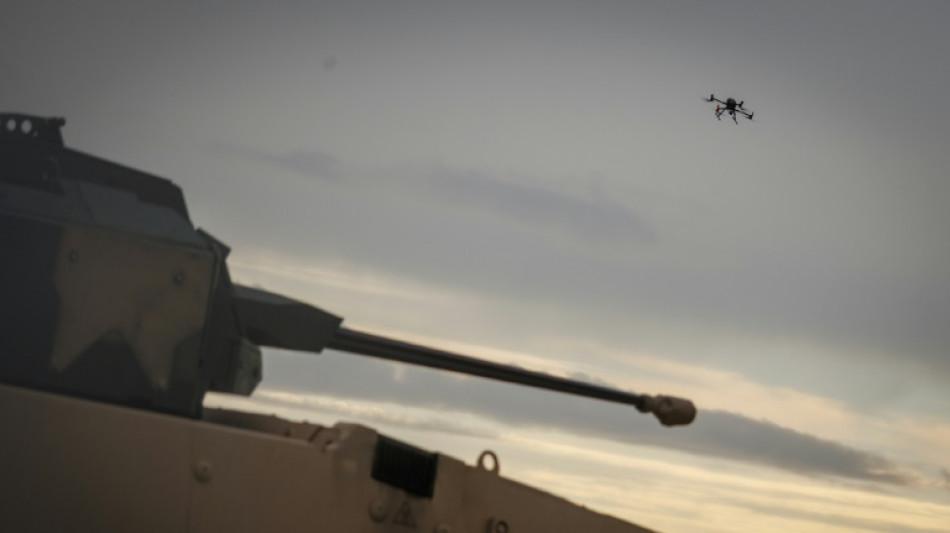
Ukraine war pushes NATO to bolster drone-tackling expertise / Photo: © AFP

 Chinese chipmaker CXMT soars more than 500% on debut

 Japan's 'King Kazu', 59, scores his first goal for four years

 Film recounting bloody Punjab crackdown caught in India's crosshairs

 Make smoking cool again? Pop culture reboots the vice

 New AI tools let readers talk to books

 New Zealand's Mooar appointed Fijian Drua head coach

 Lyles not concerned after cramp halts 200m US title bid

 France, Spain battle 'monster' wildfires with more heat on the way

 Lyles 'fine' after failing to finish 200m at US championships
 Aussie great McEvoy masters Commonwealth gold, Ramsay-Peaty hatches battle plan to bounce back
 Brazil recalls ambassador to Argentina over Milei's Bolsonaro rally speech

 'Monster' wildfires force 350,000 from homes in France, Spain
 Nolan's 'Odyssey' shows staying power at N. America box office

 'Incredibly proud' Pogacar wins record-equalling fifth Tour de France

 How does Pogacar compare to other five-time Tour de France winners
 Berlin police shoot dead chief suspect in deadly Islamist Pride attack

 'Fire calling the shots': France's blaze pushes crews to the brink

 Proud Antonelli salvages third as Mercedes limit damage
 Iran halts strikes as Trump gives space to talks
 Berlin mourns deadly Islamist Pride attack as police hunt for suspect

 Ex-president Hernandez returns to Honduras after Trump pardon

 Norris grabs first race win of season in Hungary

 Sooryavanshi's 81 steers India to Zimbabwe T20 series sweep
 Spanish wildfires intrude on holidaying foreign visitors
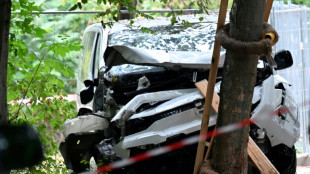
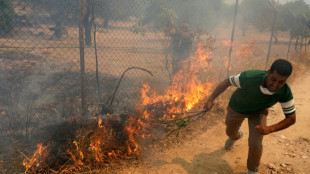
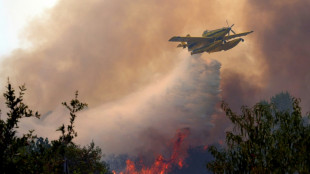 France and Spain battle 'unpredictable' wildfires as 300,000 evacuated
A small drone flits over opened earth, and an explosion appears on the video feed.
The drone has just dropped a grenade into a trench in Ukraine. The images were being projected on a giant screen in the Netherlands, in front of NATO military officers and defence company executives.
These drones being used against Ukrainian forces are "small, fast" and finding a way to defend against them is "complex", says Willem Koedam, a former Dutch air force officer turned expert for NATO's C-UAS unit, which looks at anti-drone defences.
The solution may be complex, but it's not impossible.
Representatives from 57 companies visited a military base in the Dutch town of Vredepeel to present their systems to the NATO brass.
The systems they offer are designed to counter threats ranging from off-the-shelf drones available to the public to the Iranian Shahed drones used by Russia's forces.
- Using nets -
"The best way to kill a Shahed is a jet" -- meaning a jet-propelled drone -- said Ludwig Fruhauf, head of DDTS, a German firm specialised in anti-drone defences.
A jet-powered drone flying at 500 kilometres (310 miles) per hour would be able to intercept a propellor-driven Shahed-136 travelling at 180 kilometres per hour, he explained. And jet devices are cheaper than the rocket-type defences usually employed.
But threats persist from much smaller drones, which can be deadly or destructive for critical infrastructure such as power stations, said Matt Roper of the NATO Communications and Information (NCI) Agency, the alliance's tech and cyber hub.
In some cases, the best method is not to blow a drone out of the sky, which could cause collateral damage, but to catch or redirect it.
Argus Interception, another German company, has developed a sort of "fishing net" to be used against enemy devices
The target first has to be detected by radar, camera or by monitoring frequencies used to guide it.
Once located, an interceptor drone is launched that fires the net over the hostile drone, allowing it to be captured. It is especially useful in protecting airports, Argus Interception boss Christian Schoening said.
For Romanian air force captain Ionut-Vlad Cozmuta, however, that method may not be best against drones deployed by the Russian military close to Romanian airspace -- Debris from some of them has been found in Romanian territory in recent weeks.
Romania, a NATO member, is keen to find ways to protect itself against possible drone attacks, and Cozmuta was carefully following the drone-defence exercises at the Vredepeel base.
He said signal "jamming" would be a solution, sending the device off-course rather than capturing it.
- 'Big benefits' -
More aggressive than jamming is technology to seize control of an enemy drone and guide it to a new target or another destination.
But for that, NATO needs to establish a common standard allowing different anti-drone defence systems to speak to each other. That looks to now be in place with the adoption of a British system called Sapient.
Its use will bring "big benefits" to the alliance, a senior NATO officer in the NCI Agency, General Hans Folmer, told reporters.
No Ukrainian officer was present for the anti-drone exercises.
But NATO has "ongoing discussions" with the besieged country on these issues, said Claudio Palestini, a NATO science expert.
And the Ukrainians themselves "innovate on the ground all the time," he said.
R.Buehler--VB