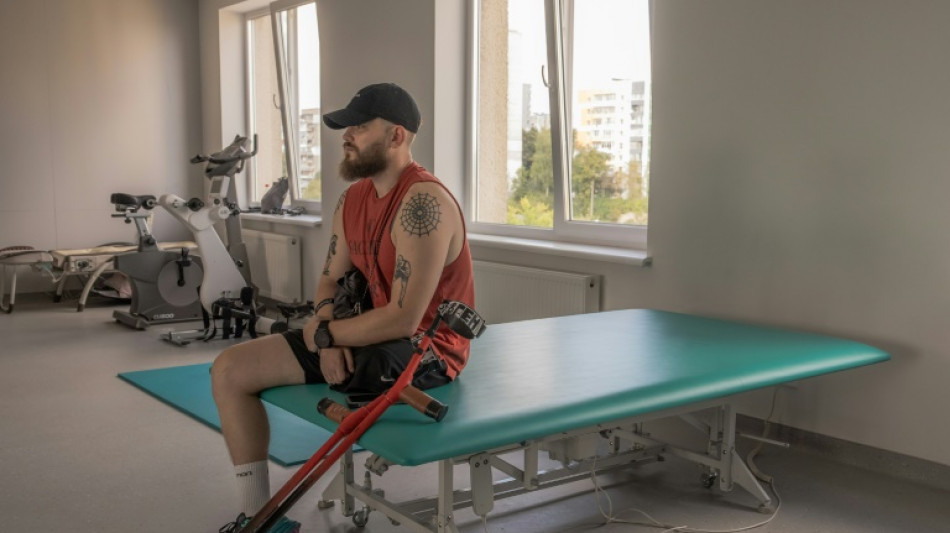
Clinic helping Ukraine's wounded soldiers walk again / Photo: © AFP

 Rene Eyre Revisits Autobiographical Performance 'Say A Little Prayer' in London

 UAE's HCT Holds Record Graduation and Announces Major Training Expansion

 NASA Awards $10B Lunar Contract Framework to SpaceX, Blue Origin

 Katy Perry Tells Fans Ex-Husband Russell Brand 'Should Be in Jail' During UK Concert

 South African election results renew debate over identity-based voting

 South African voters report smoother local election but declining IEC trust

 Dolly Parton museum and Nashville hotel open after singer’s death

 George and Amal Clooney attend New York political-comedy reading

 British buyers pay substantial premiums for period-home appearance

 Thomas Markle released to house arrest after child-abuse-image charge

 Dawn of War 4 developers chose Adeptus Mechanicus for tactical variety

 Italy face unbeaten South Africa in Turin Nations Championship match

 ChatGPT interactive interface feature tested across six custom tools

 Freshways milk-price cut deepens pressure on UK dairy farms

 Labour and National remain virtually tied as New Zealand vote count advances

 The Good Daughter adapts Karin Slaughter thriller with Rose Byrne and Meghann Fahy

 Heavy-lift drone evacuates wounded Ukrainian soldier from frontline kill zone

 Morrison says West Brom recovered after pressure from successive derby losses
Ukrainian soldier Vasyl Grytsenko was energetically doing sit-ups on a mat, building his body back up after losing a leg in the war.
He was one of around 50 inpatients undergoing complex rehabilitation at Nezlamny (Unbroken) clinic in the western city of Lviv.
The 29-year-old was injured in a counterattack near Kupyansk in the east after joining up at the start of the war.
He applied two tourniquets but his evacuation under fire took too long -- almost three and a half hours -- and medics could not save the limb.
With its white paint, clean design and physiotherapists in T-shirts and tracksuit bottoms, Nezlamny looks like a pricey private clinic, but it offers state health care, albeit with donations from sponsors.
Since the start of the war, the clinic has treated 80,000 patients, including civilians, a spokeswoman said.
The sheer number of injured underlines how the war of heavy artillery has left many with life-changing injuries including amputations and brain damage.
Grytsenko praised the staff, saying he had arrived three weeks ago in a very bad state after eight operations.
He had been unable to balance on one leg, but swiftly learnt how to hop around and even skip.
"I now feel wonderful," he said.
He added he was focusing on healing his scars and building up his core muscles before learning to walk again with a prosthetic limb.
Amputees form a large contingent of the patients at Nezlamny, many of whom have lost limbs above the knee or elbow.
The clinic also treats those with brain injuries, with cupboards full of games and toys marked "cognitive" and "fine motor skills".
A man in a wheelchair worked on turning and straightening his fingers with a physiotherapist, while another played a computer game where you had to correctly name colours.
Physiotherapist Roksolana Shmilo worked with patients awaiting prosthetics, including Grytsenko, encouraging them to exercise their shoulders and backs, do swimming motions, pull-ups and press-ups.
"Maybe the hardest is when a patient has lost two legs or two arms. It's really hard physical therapy for the patient, but all my patients are very motivated," she said.
The 25-year-old physiotherapist strapped a patient into a machine donated by Germany called "Walkabot," which is the only such apparatus in Ukraine.
It helps amputees learn to walk with a prosthetic leg while being held upright by a corset and Velcro straps.
"I know how uncomfortable it is," she reassured the patient.
Grytsenko was already in very good shape from boxing and said he was spurred on by the memory of two close friends who were killed in the fighting.
"I'm sure they would have worked (on rehabilitation) 10 times harder than me," he said. "I don't have the right to get downhearted."
Grytsenko, who wore a red vest with the slogan "No sacrifice, no victory", said his aim was to "stand on two legs, take my son in my two arms and hold him. That's all for now."
His four-year-old son, Oleg, told him he was not afraid of him lacking a leg, only of scars and pain.
"I told him that dad will have a metal leg now, like a superhero," Grytsenko said.
"I've accepted it. You can't live in the past. You have to live for the future," he said, adding he may return to serve if his friends are still there.
He was waiting for his stump scar to heal and expected to get a modern prosthetic limb within a week and a half.
When soldiers receive serious injuries they are treated in hospitals nearer the frontlines before being transferred to Lviv.
Many need additional reconstructive surgery at Lviv Emergency Clinical Hospital, which is connected with Nezlamny via a walkway.
The head of surgery for Nezlamny, Gnat Gerych, 33, said he had just operated on a soldier with a shrapnel wound to his arm that had damaged a vein and partly paralysed him.
The surgeon performed reconstructive surgery that aimed to fully restore use of the hand.
Fifty percent of his surgery is war-related, he said, listing injuries from rockets, cruise missiles, mines and shrapnel, as well as bullet wounds among special forces.
"The problem is that this type of war... both sides use very modern weapons and that's why the injuries are very difficult and the injuries are also multiple," said Gerych.
"So in most patients we have most parts of the body damaged by shrapnel," he said.
C.Koch--VB