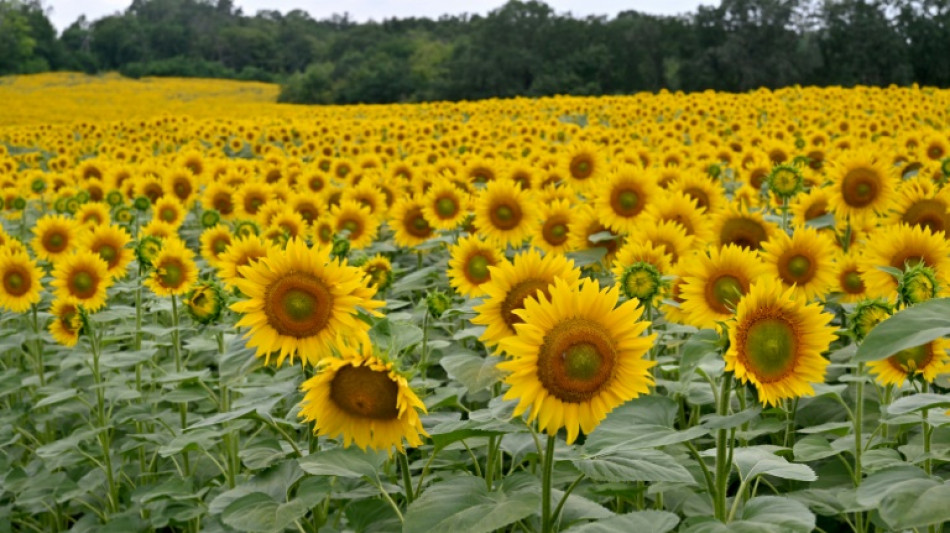
'Just can't sell': Ukraine harvests sunflowers as war blocks ports / Photo: © AFP

 'Grumpy' Pallas kittens on display at Japan zoo
 Far-right Australian politician loses appeal in racism case
 De Zerbi wants 'soul and passion' from new-look Tottenham
 'Good energy' at Chelsea as Alonso kickstarts reign in Sydney
 Laxman hails 'very mature' Sooryavanshi, 15, after series win
 Chinese chipmaker CXMT soars more than 500% on debut
 Japan's 'King Kazu', 59, scores his first goal for four years
 Film recounting bloody Punjab crackdown caught in India's crosshairs

 Make smoking cool again? Pop culture reboots the vice
 New AI tools let readers talk to books
 New Zealand's Mooar appointed Fijian Drua head coach

 Lyles not concerned after cramp halts 200m US title bid

 France, Spain battle 'monster' wildfires with more heat on the way

 Lyles 'fine' after failing to finish 200m at US championships

 Aussie great McEvoy masters Commonwealth gold, Ramsay-Peaty hatches battle plan to bounce back
 Brazil recalls ambassador to Argentina over Milei's Bolsonaro rally speech

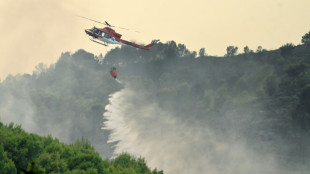 'Monster' wildfires force 350,000 from homes in France, Spain

 Nolan's 'Odyssey' shows staying power at N. America box office

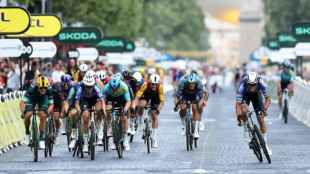
 'Incredibly proud' Pogacar wins record-equalling fifth Tour de France

 How does Pogacar compare to other five-time Tour de France winners
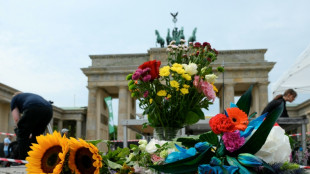 Berlin police shoot dead chief suspect in deadly Islamist Pride attack

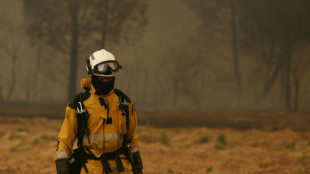 'Fire calling the shots': France's blaze pushes crews to the brink

 Proud Antonelli salvages third as Mercedes limit damage

 Iran halts strikes as Trump gives space to talks
 Berlin mourns deadly Islamist Pride attack as police hunt for suspect
A truck dumps another load of black sunflower seeds into the barn of Ukrainian farmer Oleksandr Ryabinin, where they scatter over the floor, releasing a nutty aroma when crunched underfoot.
It is sunflower harvest time in Ukraine and Ryabinin has gathered in more than half his crop.
But with repeated Russian attacks on ports, and Black Sea shipping routes closed, exporting has become more difficult.
"At the moment we haven't sold a single kilogramme (pound) of sunflower seeds," the 52-year-old farm director tells AFP.
Sunflower seeds and their oil are core exports for Ukraine, which in 2020/2021 produced 31 percent of all global sunflower oil, according to the United States Department of Agriculture.
These exports were massively disrupted by the war, as farmers were forced to abandon their land and seek alternative routes to deliver their goods.
"People are afraid to transport oil," says Ryabinin, who manages fields in the southeastern Dnipropetrovsk and Kherson regions.
"No-one wants to risk it," he says, explaining that ships are afraid to travel to Ukrainian ports due to Russian shelling.
The lack of demand means traders are offering prices for seeds that are too low, he complains.
"There's no point in selling now."
"We'll wait for the price to go up, for some grain corridor to open."
Sunflowers grow over much of Ukraine. In summer the mass of golden flowers against a blue sky is reminiscent of the country's flag.
But the crop is harvested when the beautiful petals have fallen off and a blackened, shrivelled seed head remains.
- 'We just can't sell it' -
Under the hot sun, combine harvesters methodically quarter a field on Ryabinin's farm, cutting off seed heads and shaking out the seeds, before funnelling them into trucks.
Ryabinin expects the harvest will be over within 10 days.
The seeds still in their black protective husks can be stored for up to a year, he said, after which they start acidifying.
At the moment his farm's barns are also filled with wheat grain. They are only selling their rapeseed, he says.
The metal sides of the sunflower seed barn are pierced with tiny holes from shrapnel and a concrete wall outside is pockmarked with impacts from a cluster bomb.
A farm worker was killed on this spot as he tried to run for cover, struck in his heart by a piece of shrapnel. He was 26 and had just become a father, Ryabinin says.
The farmer of 30 years says he had been making a good living before the war.
He and other farmers were investing in new equipment, such as imported combine harvesters.
But then came the Russian occupation of Kherson region, which left his farm unable to cultivate 40 percent of its 10,000 hectares (25,000 acres) of land last year.
After the Russians were driven out of Kherson, the farm workers spent the winter clearing weeds and getting sappers to clear unexploded ordnance.
With Russian troops now on the other side of the Dnipro river, the situation is calmer and this summer 100 percent of the farm's land has been planted.
Now "we have some production but we just can't sell it", he says with frustration.
D.Bachmann--VB