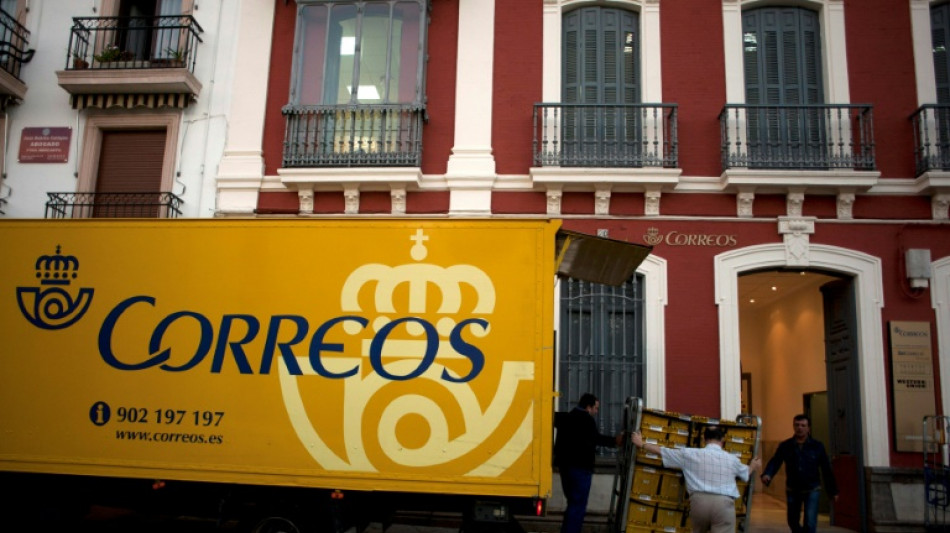
Far right push fraud fears over Spain postal votes / Photo: © AFP/File

 Eseme, Hobbs shine in Glasgow rain to win 100m Commonwealth gold

 Netanyahu holds first White House talks with Trump since Iran war began

 Warriors re-sign Green after LeBron James shun

 Cameroon's Eseme storms to 100m Commonwealth gold

 AIDS activists slam 'pharma greed' over breakthrough drug

 France needs more Canadair water bombers but building them is painfully slow

 In devastated south Lebanon village, residents count on army deployment

 Keiko Fujimori sworn in as president of Peru

 GSJJ Launches ESG-Certified Custom Challenge Coins and Pin Badges

 Airbus completes record 24-hour flight with plane to be used by Qantas

 FIFA says it hopes to sell $4.2bn stake in its tournaments
 Zelensky hails 'good' Trump talks on Patriot air defenses

 Spain allows wildfire evacuees to return but France fears flames spreading

 'Not out of danger': Residents return to scorched French village
 Zelensky holds White House talks with Trump on Ukraine war

 US Fed begins meeting with markets expecting steady interest rates

 Ukraine's Zelensky arrives for Trump talks at White House

 Dozens feared trapped in quake-hit Japan mall

 Diaz and Olise set to stay at Bayern, says CEO

 British drugs group GSK targets savings after profits slide

 France evacuates thousands as Spain PM says tide turning in wildfire fight

 Boeing reports loss on Air Force One but sees progress in turnaround

 First image taken of Betelgeuse's elusive companion star

 Man City's Rodri sidelined for 'short period' following back surgery

 Pedro bags three as Alonso starts Chelsea reign with 6-4 win over Western Sydney Wanderers

With Spain's election on Sunday taking place at the height of summer, some 2.6 million voters have opted to vote by post, fuelling fears about possible fraud which have been amplified by the far right.
Holidaymakers who didn't want to miss out had to register early to secure a postal vote, with the authorities receiving 2.6 million such requests -- an unprecedented figure, equating to nearly 7.0 percent of the 37.7 million people eligible to vote.
Such has been the demand that the electoral board said Thursday it had decided "to extend the deadline for voters to hand in their ballot papers to post offices until Friday" in order to make voting "as easy as possible".
The deadline had initially been at the close of play on Thursday.
Since the start of the campaign, the opposition has raised doubts about the ability of Correos, Spain's postal service, to ensure all the ballot papers were counted in time.
"I ask Spain's postal staff to give their utmost.. they are protecting something sacred to the Spanish people: their vote," said opposition leader Alberto Nunez Feijoo last week.
Polls suggest his right-wing Popular Party (PP) will win but without getting an absolute majority.
Santiago Abascal, leader of the far-right Vox which could end up as kingmaker, said Tuesday he was "extremely worried" that Correos "did not have the necessary means" to fulfil the task, denouncing the date of the vote as being chosen "in very bad faith during Spain's holiday period".
- An unknown quantity -
In recent weeks, there has been a flurry of disinformation about postal voting, including suggestions it was expressly chosen to perpetrate "electoral fraud".
"There has never been a (national) vote in summer," said Giselle Garcia Hipola, a political scientist at Granada University who said the unprecedented situation was ripe for disinformation.
"It is easy to spread misinformation because voters have no real perception about how it should work," she told AFP.
In mid-July, Socialist Prime Minister Pedro Sanchez hit out at right-wing insinuations, accusing the opposition of following a strategy "that aimed to create distrust so people won't vote or will be suspicious of the electoral process."
And Correos issued a statement rejecting "all insinuations or reports casting doubt on the work of its professional staff" which "weaken our democracy".
With most voters unfamiliar with the process, some like 51-year-old estate agent Enriqueta Gonzalez struggled with the paperwork.
"The day they announced it on TV, I applied for a postal vote," she told AFP.
But for her it was "very complicated, with too much paperwork", admitting she didn't realise she needed to go into a post office to validate her registration and had simply waited for the papers to arrive -- which they never did.
For others, it was easier than they expected, with 48-year-old Cristina Garcia Loygorri surprised to find she wasn't "waiting in a queue for an hour or two" as she'd feared.
Even so, she had doubts about how it would work.
"I don't really trust it, will my vote really be counted? I'd much prefer to do it in person," she said.
- 'A dangerous strategy' -
According to Astrid Barrio, a political scientist at Valencia University, the main "risk" would be if there was a big difference in the numbers of people who requested a postal vote and the number of those who actually used it.
"That could be interpreted by some as an attempt at electoral manipulation," she said.
International observers have confidence in Spain's voting and postal voting system which is considered as "one of the most solid and reliable in existence", said Joan Botella, a political scientist at Barcelona's Autonomous University.
But when political parties choose to sow doubt, they are following "a dangerous strategy", warned Granada University's Garcia Hipola.
"Once you've sowed doubt about a public body, it doesn't go away," she said.
"It's a typical populist strategy we're seeing all over the world, not just in Spain."
E.Schubert--BTB