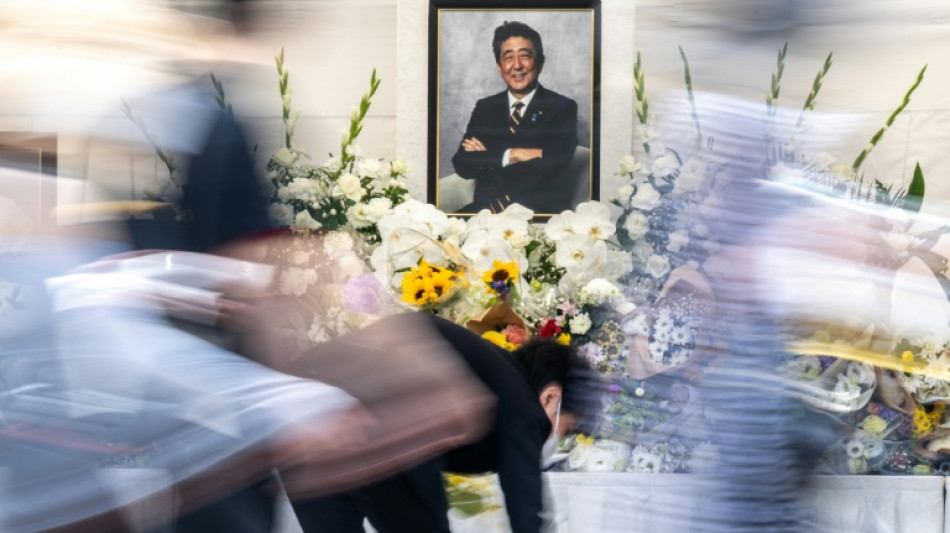
Japan marks one year since former leader Abe's killing / Photo: © AFP

 Bangladesh ex-premier Hasina vows to return despite fearing for life
 Senate confirms Clayton as Trump intelligence chief

 South Korean stocks collapse amid Asian tech rout

 Search for survivors after powerful Japan quake kills 13

 Shelton fends off Damm at Washington as veteran Venus ousted

 Indian hockey back on 'road to gold' after years in the wilderness
 Rescuers search for survivors after powerful Japan quake kills 13

 Five dead after powerful Japan quake, others missing

 Senate advances sweeping Russia sanctions bill

 Two dead in shopping mall hit by Japan quake

 UN sounds alarm on politicisation of refugees and asylum
 Aussie teen Hewitt wins first ATP match in Washington where dad won title
 New Zealand's Hobbs surges to women's 100m Commonwealth gold

 West Indies beat Pakistan by 90 runs in first Test
 UN sounds warning as refugee convention turns 75
 Keiko Fujimori becomes Peru's ninth president in a decade
 Jalen Carter signs record $152m extension with Eagles
 AI glasses help propel EssilorLuxottica sales growth

 Many feared trapped in quake-hit Japan mall
 Kering sales begin to recover as Gucci improves
 Netanyahu visits White House for first Trump talks during Iran war

 France pressures Suriname as illegal mining plagues border
 Cucurella keeps De la Fuente tattoo pledge after Spain World Cup win
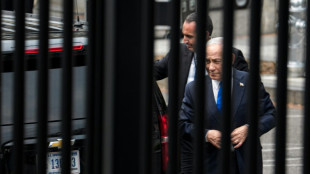 Netanyahu at White House for first Trump talks during Iran war

 Korda, Ryu eye history at Women's British Open
Japan on Saturday marked a year since the shock assassination of former prime minister Shinzo Abe, the country's longest-serving leader and a towering political figure.
Abe was gunned down in broad daylight while giving a campaign speech in western Japan, targeted by a man allegedly angry over the former leader's links to the Unification Church.
The suspect, Tetsuya Yamagami, was apprehended on the spot and is said to have resented the sect over large donations that his mother made that bankrupted his family.
Gun violence is extremely rare in Japan which has strict gun laws. Yamagami is believed to have used a homemade weapon.
On Saturday, visitors from all walks of life formed a long queue outside Tokyo's Zojoji Buddhist temple, offering flowers before framed pictures of a smiling Abe.
"I think he was the icon of Japanese people. He was the icon of the conservatives," said mourner Tomoko Shimoda, 57.
She said "the way he communicated with other people, what he said publicly, and the way he behaved" made a lasting impression on her.
Hiroyuki Kumagi, 69, said he was "a real worshipper of Mr. Abe".
"I participated in the prayer at the last year's national funeral, and of course I am here today," he told AFP.
In the western Nara region, people brought flowers and prayed outside Yamato-Saidaiji Station -- the site of Abe's shooting.
Abe's death prompted a flood of condolences from international leaders, many of whom met the former prime minister as he worked to raise Japan's diplomatic profile.
But at home, the assassination caused waves of political upheaval.
First, the renewed attention on the Unification Church -- whose members are sometimes called "Moonies" -- prompted revelations of deep ties between Japan's conservative lawmakers and the sect.
Prime Minister Fumio Kishida, who saw his approval ratings tumble as the revelations emerged, was forced to first investigate the ties and then announce his party would sever any relations with the church.
Abe's murder also prompted soul-searching over Japan's security arrangements, with pledges to improve the protection of politicians.
Less than a year later, an attacker was able to approach Kishida at a campaign event and throw a homemade explosive. The prime minister was unharmed in the April event, and his attacker was detained at the scene.
- 'A real patriot' -
An outspoken scion of a political dynasty, Abe invigorated socially conservative movements through his push to amend the post-war pacifist constitution.
He attempted to move Japan's regional relations past the bitter memories of World War II, stressing the nation's history of pacifism since the war.
While he was perhaps Japan's best-known leader overseas, at home, Abe was a divisive figure whose conservative values and high-handed ways alienated liberal voters.
His "Abenomics" economic programme, which promoted easy monetary policies and huge government spending, achieved uneven results, and his administration was linked to several political scandals.
He first came to power in 2006 but left after a year following turmoil in his cabinet, a huge election loss, and health problems.
He returned in 2012 and went on to become the longest-serving leader in Japan's modern history.
"Mr. Abe alone had worked so hard to defend the country from crises, and everyone was relying on him. He was a real patriot," said a 58-year-old visitor to Abe's memorial at Zojoji temple.
"To be honest, I have never been so devastated even when a family member passed away. It's been a year, but I still get teary."
T.Bondarenko--BTB