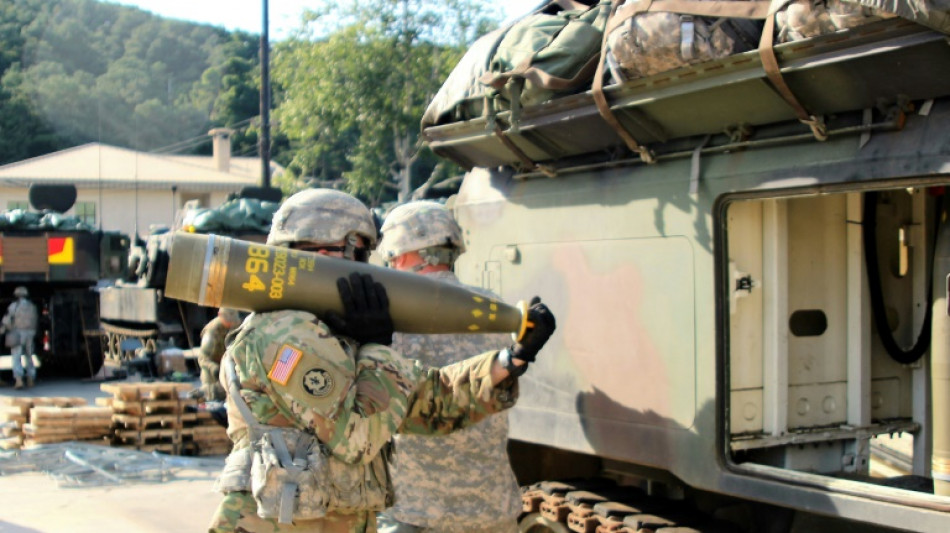
US to send cluster bombs to Ukraine, drawing criticism / Photo: © DVIDS/AFP

 Rene Eyre Revisits Autobiographical Performance 'Say A Little Prayer' in London

 UAE's HCT Holds Record Graduation and Announces Major Training Expansion

 NASA Awards $10B Lunar Contract Framework to SpaceX, Blue Origin

 Katy Perry Tells Fans Ex-Husband Russell Brand 'Should Be in Jail' During UK Concert

 South African election results renew debate over identity-based voting

 South African voters report smoother local election but declining IEC trust

 Dolly Parton museum and Nashville hotel open after singer’s death

 George and Amal Clooney attend New York political-comedy reading

 British buyers pay substantial premiums for period-home appearance

 Thomas Markle released to house arrest after child-abuse-image charge

 Dawn of War 4 developers chose Adeptus Mechanicus for tactical variety

 Italy face unbeaten South Africa in Turin Nations Championship match

 ChatGPT interactive interface feature tested across six custom tools

 Freshways milk-price cut deepens pressure on UK dairy farms

 Labour and National remain virtually tied as New Zealand vote count advances

 The Good Daughter adapts Karin Slaughter thriller with Rose Byrne and Meghann Fahy

 Heavy-lift drone evacuates wounded Ukrainian soldier from frontline kill zone

 Morrison says West Brom recovered after pressure from successive derby losses
The United States announced Friday it will provide cluster munitions to Ukraine for the first time as Kyiv's forces face tough fighting in their counteroffensive against invading Russian troops.
The move drew sharp criticism from rights groups due to the danger unexploded bomblets pose, but Washington said it has received assurances from Kyiv that it would minimize risk to civilians, including by not using the munitions in populated areas.
President Joe Biden told CNN that the decision to provide the munitions was "very difficult," but that Ukrainian forces were "running out of ammunition."
"They either have the weapons to stop the Russians now -- keep them from stopping the Ukrainian offensive through these areas -- or they don't. And I think they needed them," he said.
A new military aid package announced Friday includes "dual-purpose improved conventional munitions," the Pentagon said in a statement, referring to cluster bombs.
Ukrainian President Volodymyr Zelensky rapidly expressed gratitude for the "much-needed" aid, tweeting that "the expansion of Ukraine's defense capabilities will provide new tools for the de-occupation of our land and bringing peace closer."
US National Security Advisor Jake Sullivan explained the decision by saying there is "a massive risk of civilian harm if Russian troops and tanks roll over Ukrainian positions and take more Ukrainian territory and subjugate more Ukrainian civilians because Ukraine does not have enough artillery."
Kyiv "has provided written assurances that it is going to use these in a very careful way," he said, noting that Ukraine's government "has every incentive to minimize risk to civilians, because it's their citizens."
Ukraine pledged that it would not use the rounds in civilian-populated areas, and would record where they use them to assist demining efforts after the war, added US Undersecretary of Defense Colin Kahl.
- 'Keep them in the fight' -
The United States would also not provide cluster munitions with a "dud rate" of more than 2.35 percent, Kahl said, contrasting this with 30-40 percent rate of such weapons used by Russia in Ukraine.
Referring to the Ukrainian counteroffensive, he said "it's been hard sledding, because the Russians had... six months to dig in. And so those defensive belts that the Russians have put in place in the east and in the south are hard -- they'd be hard for any military to punch through."
"We want to make sure that the Ukrainians have sufficient artillery to keep them in the fight in the context of the current counteroffensive, and because things are going a little slower than some had hoped, there are very high expenditures of artillery."
But rights groups have come out strongly against the United States providing the munitions.
Human Rights Watch said that "transferring these weapons would inevitably cause long-term suffering for civilians and undermine the international opprobrium of their use opposes."
And Amnesty International said Biden's administration "must understand that any decision enabling the broader use of cluster bombs in this war will likely lead to one predictable outcome: the further death of civilians."
"Cluster munitions are an indiscriminate weapon that presents a grave threat to civilian lives, even long after a conflict has ended. Their transfer and use by any country under any circumstances is incompatible with international law," it added.
UN Secretary-General Antonio Guterres also opposed the move, with a spokesperson saying he "does not want there to be continued use of cluster munitions on the battlefield."
The United States has spearheaded the push for international support for Ukraine, quickly forging an international coalition to back Kyiv after Russia invaded and coordinating aid from dozens of countries.
Washington has agreed to provide more than $42 billion in military aid to Kyiv since the February 2022 Russian invasion.
F.Pavlenko--BTB