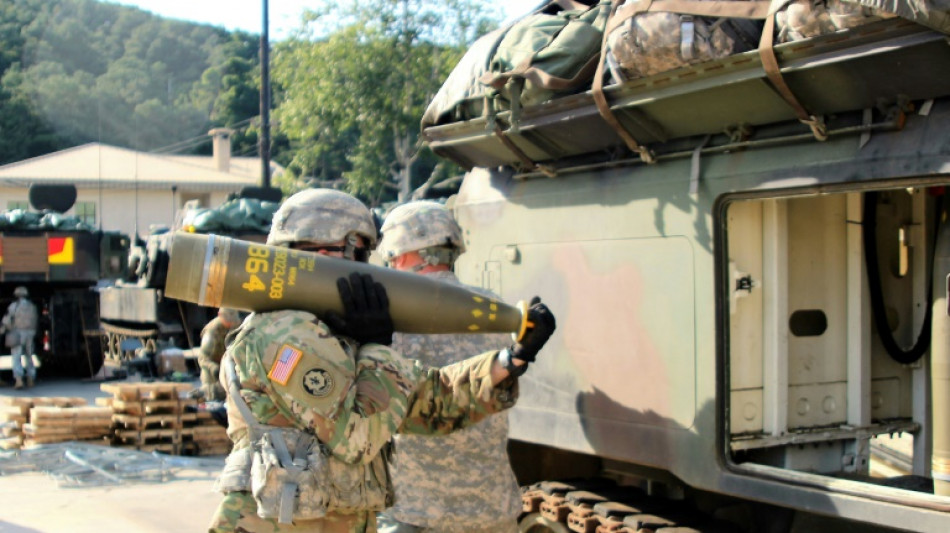
US says it will send cluster munitions to Ukraine / Photo: © DVIDS/AFP

 Bangladesh ex-premier Hasina vows to return despite fearing for life

 Senate confirms Clayton as Trump intelligence chief

 South Korean stocks collapse amid Asian tech rout

 Search for survivors after powerful Japan quake kills 13

 Shelton fends off Damm at Washington as veteran Venus ousted

 Indian hockey back on 'road to gold' after years in the wilderness

 Rescuers search for survivors after powerful Japan quake kills 13

 Five dead after powerful Japan quake, others missing

 Senate advances sweeping Russia sanctions bill

 Two dead in shopping mall hit by Japan quake

 UN sounds alarm on politicisation of refugees and asylum

 Aussie teen Hewitt wins first ATP match in Washington where dad won title

 New Zealand's Hobbs surges to women's 100m Commonwealth gold

 West Indies beat Pakistan by 90 runs in first Test

 UN sounds warning as refugee convention turns 75

 Keiko Fujimori becomes Peru's ninth president in a decade

 Jalen Carter signs record $152m extension with Eagles

 AI glasses help propel EssilorLuxottica sales growth

 Many feared trapped in quake-hit Japan mall

 Kering sales begin to recover as Gucci improves

 Netanyahu visits White House for first Trump talks during Iran war

 France pressures Suriname as illegal mining plagues border

 Cucurella keeps De la Fuente tattoo pledge after Spain World Cup win

 Netanyahu at White House for first Trump talks during Iran war

 Korda, Ryu eye history at Women's British Open
The United States announced Friday it will provide cluster munitions to Ukraine for the first time as Kyiv's forces face tough fighting in their counteroffensive against invading Russian troops.
The move drew sharp criticism from rights groups due to the danger unexploded bomblets pose, but Washington says it has received assurances from Kyiv that it would minimize risk to civilians, including by not using the munitions in populated areas.
President Joe Biden told CNN that the decision to provide the munitions was "very difficult," but that Ukrainian forces were "running out of ammunition."
"They either have the weapons to stop the Russians now -- keep them from stopping the Ukrainian offensive through these areas -- or they don't. And I think they needed them," he said.
A new military aid package announced Friday included "dual-purpose improved conventional munitions," the Pentagon said in a statement, referring to cluster munitions.
Ukrainian President Volodymyr Zelensky expressed gratitude for the "much-needed" aid, tweeting that "the expansion of Ukraine's defense capabilities will provide new tools for the de-occupation of our land and bringing peace closer."
US National Security Advisor Jake Sullivan sought to justify the decision, saying there was "a massive risk of civilian harm if Russian troops and tanks roll over Ukrainian positions and take more Ukrainian territory and subjugate more Ukrainian civilians."
Kyiv "has provided written assurances that it is going to use these in a very careful way," he said, noting that Ukraine's government "has every incentive to minimize risk to civilians, because it's their citizens."
US Undersecretary of Defense Colin Kahl said Ukraine pledged that it would not use the rounds in civilian-populated areas, and would record where they use them to assist demining efforts after the war.
- 'Keep them in the fight' -
The United States would also not provide cluster munitions with a "dud rate" of more than 2.35 percent, contrasting this with 30-40 percent rate of such weapons used by Russia in Ukraine, Kahl said.
Referring to the Ukraine push, he said that "it's been hard sledding, because the Russians had... six months to dig in. And so those defensive belts that the Russians have put in place in the east and in the south are hard -- they'd be hard for any military to punch through."
"We want to make sure that the Ukrainians have sufficient artillery to keep them in the fight in the context of the current counteroffensive, and because things are going a little slower than some had hoped, there are very high expenditures of artillery."
Rights groups have come out strongly against the United States providing the munitions.
Human Rights Watch said that "transferring these weapons would inevitably cause long-term suffering for civilians and undermine the international opprobrium of their use opposes."
And Amnesty International said Biden's administration "must understand that any decision enabling the broader use of cluster bombs in this war will likely lead to one predictable outcome: the further death of civilians."
"Cluster munitions are an indiscriminate weapon that presents a grave threat to civilian lives, even long after a conflict has ended. Their transfer and use by any country under any circumstances is incompatible with international law," it added.
The United States has spearheaded the push for international support for Ukraine, quickly forging an international coalition to back Kyiv after Russia invaded and coordinating aid from dozens of countries.
Washington has agreed to provide more than $42 billion in military aid to Kyiv since the February 2022 Russian invasion.
Y.Bouchard--BTB