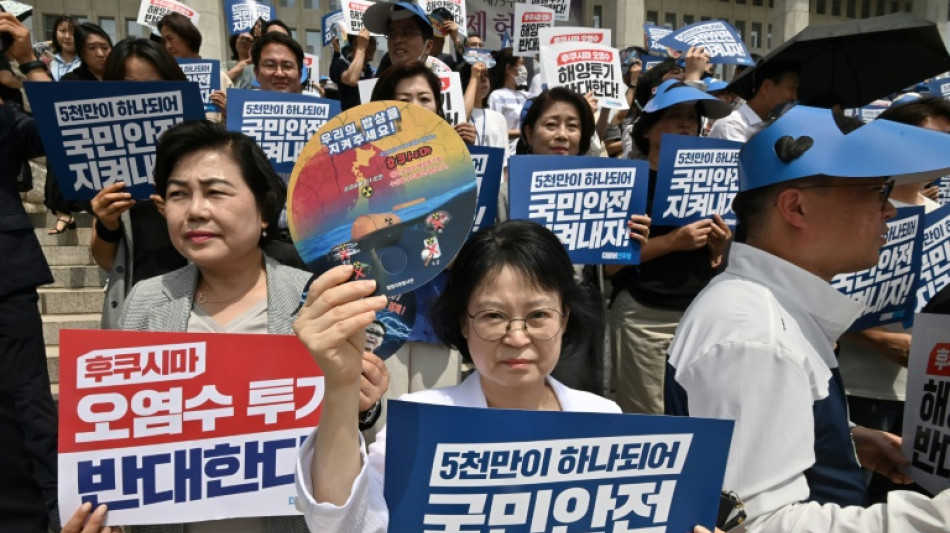
'Negligible' impact of Fukushima water release on South Korea: Seoul / Photo: © AFP

 Rene Eyre Revisits Autobiographical Performance 'Say A Little Prayer' in London

 UAE's HCT Holds Record Graduation and Announces Major Training Expansion

 NASA Awards $10B Lunar Contract Framework to SpaceX, Blue Origin

 Katy Perry Tells Fans Ex-Husband Russell Brand 'Should Be in Jail' During UK Concert

 South African election results renew debate over identity-based voting

 South African voters report smoother local election but declining IEC trust

 Dolly Parton museum and Nashville hotel open after singer’s death

 George and Amal Clooney attend New York political-comedy reading

 British buyers pay substantial premiums for period-home appearance

 Thomas Markle released to house arrest after child-abuse-image charge

 Dawn of War 4 developers chose Adeptus Mechanicus for tactical variety

 Italy face unbeaten South Africa in Turin Nations Championship match

 ChatGPT interactive interface feature tested across six custom tools

 Freshways milk-price cut deepens pressure on UK dairy farms

 Labour and National remain virtually tied as New Zealand vote count advances

 The Good Daughter adapts Karin Slaughter thriller with Rose Byrne and Meghann Fahy

 Heavy-lift drone evacuates wounded Ukrainian soldier from frontline kill zone

 Morrison says West Brom recovered after pressure from successive derby losses
Japan's plan to release treated water from the Fukushima nuclear plant would have "negligible consequences" for South Korea, Seoul said Friday as it tries to assuage rising public concern.
The International Atomic Energy Agency (IAEA) this week gave the green light for a decades-long project to discharge accumulated water from the plant, which was devastated by an earthquake and a tsunami that hit the eastern coast of Japan in 2011.
But the plan has encountered widespread public opposition and protests in South Korea, and even panic-buying of salt based on fears that the Fukushima water would pollute the ocean and the salt sourced from seawater.
South Korea conducted its own separate review of Tokyo's plan, which found Japan will meet or exceed key international standards, policy coordination minister Bang Moon-kyu told reporters at a press conference Friday.
The study, which focused on whether the discharge would affect South Korean waters, found it would have "negligible consequences", the minister said.
It would take up to 10 years for the treated water released from Fukushima into the Pacific Ocean to circulate back near the Korean peninsula, Bang said.
"It is projected to have a radiation level approximately 1/100,000 of the average level during normal times" when the treated waters come back near the Korean waters, he added.
IAEA head Rafael Grossi will visit Seoul from Friday, but the agency's review has not alleviated strong opposition in South Korea over the discharge plan, with some opposition lawmakers even going on hunger strike in protest.
"Japan wants to release the wastewater into the sea because it's the easiest and cheapest way to do so," Woo Won-shik, an MP who has been on hunger strike at the parliament in Seoul since June 26, told AFP.
- Decommissioning over decades -
Several of the reactors at the Fukushima Daiichi plant went into meltdown after cooling systems were overwhelmed by a massive 2011 tsunami.
The resulting nuclear accident was the worst since Chernobyl, and the clean-up has lasted more than a decade, with most areas declared off-limits due to radiation now reopened.
Decommissioning the plant itself will take decades more, but the facility's operator TEPCO faces the immediate problem of more than 1.33 million cubic metres of water accumulated on the site.
The water is a mixture of groundwater, rain that seeps into the area, and water used for cooling.
TEPCO and Japan's government want to release the treated liquid, diluted with seawater, via a pipe extending a kilometre from the coast where the plant sits.
But South Korean MPs and civic groups claim there are multiple alternatives that are safer but more expensive, such as burying the treated water deep underground or vaporising it.
Since taking power last year, South Korean President Yoon Suk Yeol has sought to bury the historical hatchet with Japan on issues including wartime forced labour as he seeks closer regional security cooperation in the face of rising nuclear threats from North Korea.
K.Brown--BTB