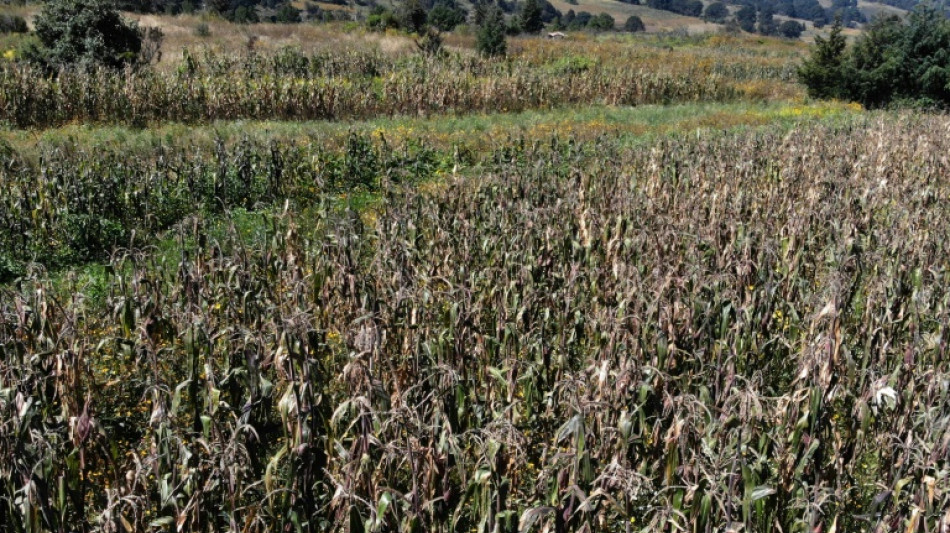
Report paves way for EU to renew glyphosate use / Photo: © AFP/File

 South Korean stocks plunge as tech rout deepens, oil rises

 On London streets, homeless wary at PM's vow to end rough sleeping
 Bangladesh ex-premier Hasina vows to return despite fearing for life

 Senate confirms Clayton as Trump intelligence chief

 South Korean stocks collapse amid Asian tech rout

 Search for survivors after powerful Japan quake kills 13

 Shelton fends off Damm at Washington as veteran Venus ousted
 Indian hockey back on 'road to gold' after years in the wilderness
 Rescuers search for survivors after powerful Japan quake kills 13
 Five dead after powerful Japan quake, others missing

 Senate advances sweeping Russia sanctions bill

 Two dead in shopping mall hit by Japan quake

 UN sounds alarm on politicisation of refugees and asylum

 Aussie teen Hewitt wins first ATP match in Washington where dad won title

 New Zealand's Hobbs surges to women's 100m Commonwealth gold

 West Indies beat Pakistan by 90 runs in first Test
 UN sounds warning as refugee convention turns 75
 Keiko Fujimori becomes Peru's ninth president in a decade
 Jalen Carter signs record $152m extension with Eagles

 AI glasses help propel EssilorLuxottica sales growth

 Many feared trapped in quake-hit Japan mall

 Kering sales begin to recover as Gucci improves

 Netanyahu visits White House for first Trump talks during Iran war
 France pressures Suriname as illegal mining plagues border

 Cucurella keeps De la Fuente tattoo pledge after Spain World Cup win
The European Food Safety Authority said on Thursday it had not found "any critical areas of concern" preventing the controversial and widely used herbicide glyphosate from being reauthorised for use in the EU.
Environmental groups lashed out at the announcement, saying there was scientific evidence that glyphosate may cause cancer, poison aquatic life and can be fatal to key pollinators like bees.
The European Union agency's long-awaited assessment report noted that there were gaps in the data in some areas, and that it had "identified a high long-term risk to mammals in 12 out of 23 proposed uses of glyphosate".
But the EFSA said that it only considered a concern "critical" when it affected all proposed uses of the substance, which would prevent it from being renewed.
The study, which was submitted to the European Commission and member states, will serve as a basis for the EU's upcoming decision on whether to renew the use of glyphosate in the bloc for another five years.
The current authorisation runs out on December 15.
The full report, which is expected to be released by the end of the month, is based on some 24,000 studies, as well as responses from 90 experts from member states, the EFSA said.
The agency said that because of a lack of data it had not finalised its risk assessment of glyphosate's impact on aquatic plants.
It also did not give advice on the risks of food consumption, "due to incomplete data about the amount of glyphosate residues in rotational crops such as carrots, lettuce and wheat".
- 'Toxic for people and the environment' -
But it added that this was not expected to lead to toxicological safety levels being exceeded, "so no critical concern was identified".
Environmental campaign group Greenpeace reacted with dismay to the news.
"For years the evidence of glyphosate's toxicity for people and the environment has been stacking up but the European Food Safety Authority has once again decided to sweep it under the carpet," said Greenpeace EU pesticides campaigner Eva Corral.
Another campaign group, Corporate Europe Observatory, said the EFSA's advice "is a slap in the face".
"How could EFSA give glyphosate a thumbs-up based on primarily shoddy, corporate-led scientific studies?" the group said.
Glyphosate is the main ingredient in the widely used Roundup weedkiller from US agrochemical firm Monsanto, which was bought by German chemicals giant Bayer in 2018.
Bayer has since faced a wave of lawsuits in the United States over claims that glyphosate causes cancer. The firm denies such claims, but has paid out billions of dollars to settle legal disputes.
The World Health Organization's International Agency for Research on Cancer said in 2015 that glyphosate was "probably carcinogenic".
France's medical research institute INSERM said in 2021 that glyphosate has a "moderate presumed link" with the cancer non-Hodgkin lymphoma.
Despite that, the European Chemicals Agency said last year the available evidence did not justify classifying the substance as a carcinogen.
The EFSA had originally planned to release its study in the second half of 2022, but said it delayed publication due to an "unprecedented" number of comments on the issue.
F.Müller--BTB