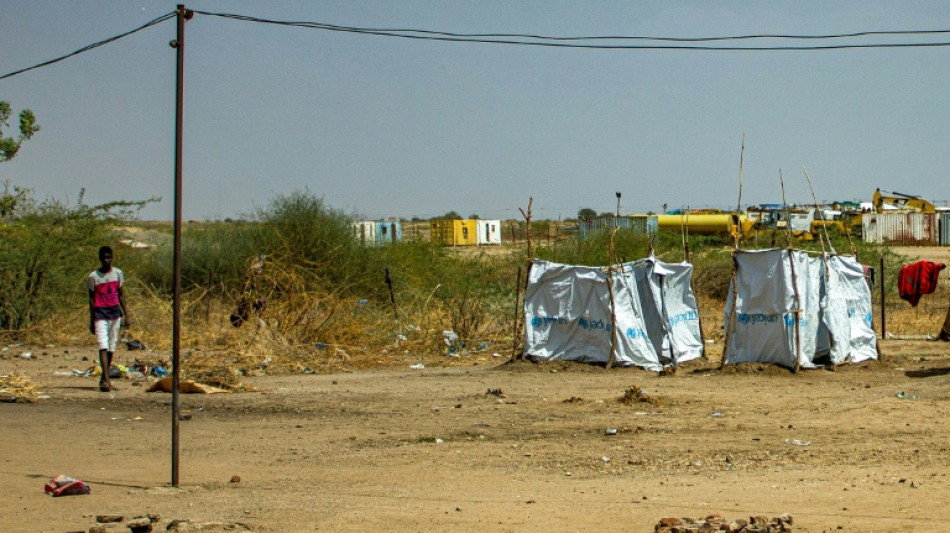
Fighting shakes Khartoum as displaced battle disease / Photo: © AFP

 Rene Eyre Revisits Autobiographical Performance 'Say A Little Prayer' in London

 UAE's HCT Holds Record Graduation and Announces Major Training Expansion

 NASA Awards $10B Lunar Contract Framework to SpaceX, Blue Origin

 Katy Perry Tells Fans Ex-Husband Russell Brand 'Should Be in Jail' During UK Concert

 South African election results renew debate over identity-based voting

 South African voters report smoother local election but declining IEC trust

 Dolly Parton museum and Nashville hotel open after singer’s death

 George and Amal Clooney attend New York political-comedy reading

 British buyers pay substantial premiums for period-home appearance

 Thomas Markle released to house arrest after child-abuse-image charge

 Dawn of War 4 developers chose Adeptus Mechanicus for tactical variety

 Italy face unbeaten South Africa in Turin Nations Championship match

 ChatGPT interactive interface feature tested across six custom tools

 Freshways milk-price cut deepens pressure on UK dairy farms

 Labour and National remain virtually tied as New Zealand vote count advances

 The Good Daughter adapts Karin Slaughter thriller with Rose Byrne and Meghann Fahy

 Heavy-lift drone evacuates wounded Ukrainian soldier from frontline kill zone

 Morrison says West Brom recovered after pressure from successive derby losses
Fierce fighting between the forces of rival generals shook the Sudanese capital Khartoum on Sunday as disease and malnutrition threatened the rising number of displaced.
A Khartoum resident said he was shaken from sleep by "violent fighting in which various weapons were used". Another said he was awakened by warplanes.
Battles since mid-April between forces loyal to army chief Abdel Fattah al-Burhan and the paramilitary Rapid Support Forces (RSF) have killed nearly 3,000 people.
Another 2.2 million have been forced from their homes inside the country while almost 645,000 have fled across borders for safety, according to the International Organization for Migration.
"The situation is grave," the medical charity Doctors Without Borders (MSF) said in a statement detailing the hardships of displaced Sudanese stuck in nine camps in White Nile State which borders South Sudan.
In addition to the capital, the worst fighting has been in the western region of Darfur where residents, as well as the United Nations, United States and others, say civilians have been targeted and killed for their ethnicity by the RSF and allied Arab militias.
The death toll is believed to be much higher than recorded, as the World Health Organization says about two-thirds of health facilities are "out of service" in combat-affected areas.
Many injured are unable to reach hospitals and bodies lie rotting in the streets of Khartoum and Darfur.
A record 25 million people in Sudan need humanitarian aid and protection, the UN says.
"Hundreds of thousands of people, most of them women and children" pack those camps that stretch out from the south of Khartoum all the way to the border with South Sudan, MSF said.
"There are suspected cases of measles, and malnutrition among children has become a vital health emergency.
"From June 6 to 7 we treated 223 children with suspected measles, 72 were hospitalised and 13 have died," MSF said.
The war has smashed the country's already fragile infrastructure, leaving residents short of water and electricity in the oppressive heat.
Numerous ceasefires, including some negotiated by the United States and Saudi Arabia, have failed to hold.
Fighting continued during the just-ended Eid al-Adha holiday for which the warring sides announced separate unilateral truces.
- Sexual abuse -
The worsening situation in Darfur is a bleak reminder of the region's painful history.
In 2003, former strongman Omar al-Bashir armed and unleashed the RSF's predecessor, the Janjaweed militia, against Darfur's non-Arab ethnic minorities in violence that killed more than 300,000 and displaced 2.5 million.
The International Criminal Court charged Bashir and others with genocide, crimes against humanity and war crimes.
A UN official has warned of possible new "crimes against humanity" from the current fighting in Darfur.
Dozens of women have been sexually abused in Darfur and elsewhere, a government unit monitoring such offences has said.
In Nyala, capital of South Darfur, at least 25 "conflict-related sexual assaults" were recorded, in addition to 21 in El Geneina, capital of West Darfur, and 42 in Khartoum.
Most survivors in Khartoum, and "all in Nyala and Geneina" identified perpetrators as RSF fighters, the unit said.
In early June, Darfur governor and ex-rebel leader Mini Minawi, who is now close to the army, declared Darfur a "disaster zone".
Aid organisations are repeating their appeals to the warring sides to open up secure corridors to allow them to reach the injured and those displaced by the fighting.
These appeals have taken on increased urgency with the start of the rainy season in Sudan, usually accompanied by floods that bring water-borne disease.
B.Shevchenko--BTB