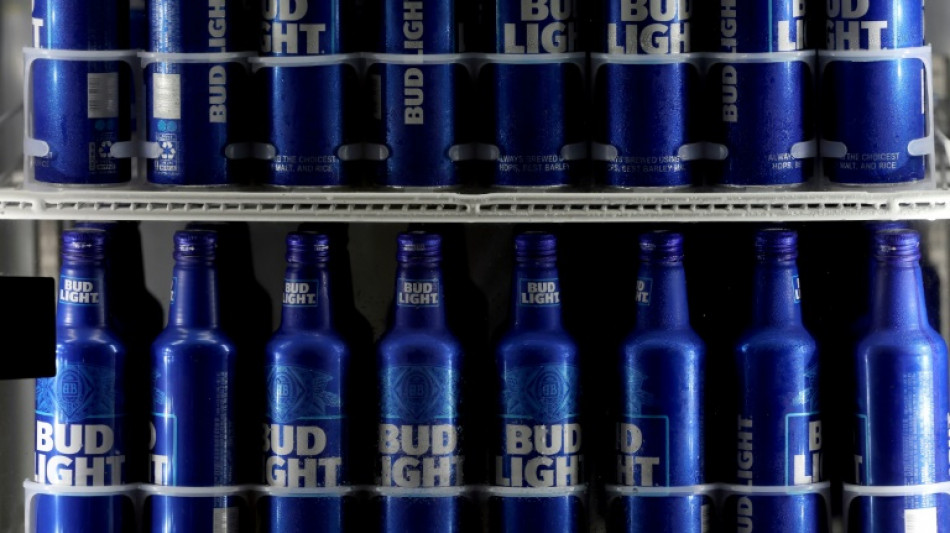
Culture wars put American companies on the defensive / Photo: © GETTY IMAGES NORTH AMERICA/AFP

 Rene Eyre Revisits Autobiographical Performance 'Say A Little Prayer' in London

 UAE's HCT Holds Record Graduation and Announces Major Training Expansion

 NASA Awards $10B Lunar Contract Framework to SpaceX, Blue Origin

 Katy Perry Tells Fans Ex-Husband Russell Brand 'Should Be in Jail' During UK Concert

 South African election results renew debate over identity-based voting

 South African voters report smoother local election but declining IEC trust

 Dolly Parton museum and Nashville hotel open after singer’s death

 George and Amal Clooney attend New York political-comedy reading

 British buyers pay substantial premiums for period-home appearance

 Thomas Markle released to house arrest after child-abuse-image charge

 Dawn of War 4 developers chose Adeptus Mechanicus for tactical variety

 Italy face unbeaten South Africa in Turin Nations Championship match

 ChatGPT interactive interface feature tested across six custom tools

 Freshways milk-price cut deepens pressure on UK dairy farms

 Labour and National remain virtually tied as New Zealand vote count advances

 The Good Daughter adapts Karin Slaughter thriller with Rose Byrne and Meghann Fahy

 Heavy-lift drone evacuates wounded Ukrainian soldier from frontline kill zone

 Morrison says West Brom recovered after pressure from successive derby losses
Boycotting a beer, attacking products celebrating the LGBTQ community, and criticizing shareholders for promoting diversity: In the face of growing criticism from conservatives, American companies are backtracking on progressive corporate initiatives.
For Bud Light beer, it was a partnership with a transgender influencer that triggered the ire of right-wing consumers, and calls for a boycott.
Typically, such a protest has little impact, but this time in-store sales have seen a slump, with Bud Light even losing its position as the best-selling beer in the United States to Modelo Especial in recent weeks, according to Bump Williams Consulting.
Anheuser-Busch InBev, Bud Light's parent company, quickly launched a marketing counteroffensive with a more typically patriotic ad featuring American landscapes, followed on Wednesday by a campaign highlighting its employees.
The Target discount retailer, for its part, chose to withdraw certain items marketed for Pride Month due to threats against employees.
And at annual shareholder meetings, the number of resolutions opposing companies' inclusion of environmental, social and governance (ESG) criteria -- particularly on diversity -- has more than doubled in the past three years, according to the Sustainable Investment Institute (SII).
- Reaction to Trump -
While such resolutions usually garner very few votes, they are nevertheless having an impact.
Larry Fink, the head of asset manager BlackRock, which has promoted sustainable investments in recent years, recently told a conference in Colorado that he has stopped using the term "ESG" because it has become too politicized.
This new vigilance extends to the world of sport: after some players voiced reluctance over wearing rainbow symbols, the National Hockey League decided that teams should no longer wear special jerseys supporting LGBTQ rights because they had become a "distraction."
"The tension of navigating between groups of people that think very, very differently has always been there," said Alison Taylor, a specialist in corporate ethics at New York University.
But the situation has changed as political life has become increasingly polarized, she added.
Corporations "got involved in controversial questions in 2017-2018, when there was a lot of organized resistance to Trump -- this seemed like a really good way to attract young people and generate shareholder value," she said.
While the prospect of affecting real change on issues like abortion and gun control no longer seems possible in the political arena, young people have come to believe they can bring pressure to bear via business, according to Taylor.
- Lobbyists at work -
Unlike their elders, for whom political involvement boils down to the ballot box or party donations, younger people "are more inclined to bring their politics into how you invest, into how you shop, even into your office," said David Webber, a specialist in investor activism at Boston University.
The sharp reactions to some company initiatives have been amplified by political leaders including Florida governor and 2024 presidential candidate Ron DeSantis, who targeted Disney over some of its progressive positions.
And DeSantis is not alone.
"Conservative organizations," financed in part by companies in the oil and gas sector, "started a campaign to pass legislation in different states to target ESG practices," Webber said.
So far, the results have been mixed.
"Some companies may, at least, back away from some of the rhetoric on ESG. But we've seen very little serious reallocation of assets," he said.
Driven by customers, shareholders and employees, companies have no choice "but to be involved in some political issues," Daniel Korschun, a marketing specialist at Drexel University, told AFP.
However, "people really start to react negatively when they feel like they're being pushed too far," as was the case in the Bud Light controversy, he added.
"There's a very delicate balance between advocating and pushing too hard," he said.
In response, "many managers are pulling back for the moment until they can figure out this new terrain that they're in," he added.
M.Odermatt--BTB