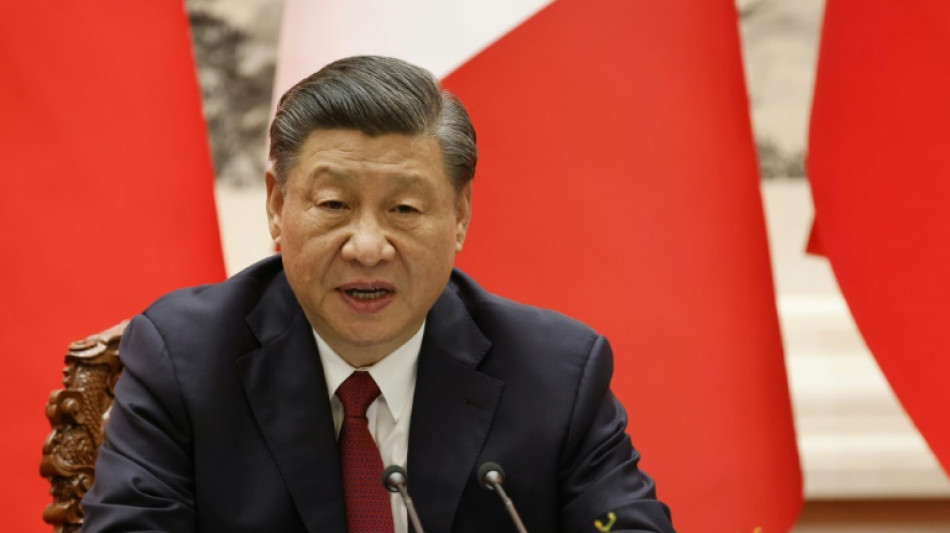
China's sweeping new anti-espionage law comes into effect / Photo: © AFP/File

 Germany's Merz under fire over chaotic reshuffle

 US, Saudi strike Iraq alliance in expanding war

 FIFA's plans to sell $4.2bn stake in its tournaments widely criticised

 Russia seeks arrest of Telegram chief Durov

 South Korean stocks plunge as tech rout deepens, oil rises

 On London streets, homeless wary at PM's vow to end rough sleeping

 Bangladesh ex-premier Hasina vows to return despite fearing for life

 Senate confirms Clayton as Trump intelligence chief

 South Korean stocks collapse amid Asian tech rout

 Search for survivors after powerful Japan quake kills 13

 Shelton fends off Damm at Washington as veteran Venus ousted

 Indian hockey back on 'road to gold' after years in the wilderness

 Rescuers search for survivors after powerful Japan quake kills 13

 Five dead after powerful Japan quake, others missing

 Senate advances sweeping Russia sanctions bill

 Two dead in shopping mall hit by Japan quake

 UN sounds alarm on politicisation of refugees and asylum

 Aussie teen Hewitt wins first ATP match in Washington where dad won title

 New Zealand's Hobbs surges to women's 100m Commonwealth gold

 West Indies beat Pakistan by 90 runs in first Test

 UN sounds warning as refugee convention turns 75

 Keiko Fujimori becomes Peru's ninth president in a decade

 Jalen Carter signs record $152m extension with Eagles

 AI glasses help propel EssilorLuxottica sales growth

 Many feared trapped in quake-hit Japan mall

A revised law dramatically expanding China's definition of espionage came into force on Saturday, giving Beijing more power than ever to punish what it deems threats to national security.
The United States government, analysts, and lawyers say that the revisions to Beijing's anti-espionage law are vague and will give authorities more leeway in implementing already opaque national security legislation.
Originally released for public comment in December 2022, the revisions were formally approved by China's top legislative body in April.
Chinese law already meted out harsh punishment for those involved in alleged espionage, from life in prison to execution in extreme cases.
In May, a 78-year-old US citizen was sentenced to life in prison on spying charges.
Under the revised law, "relying on espionage organisations and their agents" as well as the unauthorised obtaining of "documents, data, materials, and items related to national security and interests" can constitute a spying offence.
Beijing insists it has the right to "safeguard its national security through legislation" and says it will "uphold the rule of law".
But experts have warned that the changes could sweep up those with even tenuous links to organisations accused of spying.
They come in the face of an already tense environment for foreign businesses in China, following raids on and questioning of staff at due diligence company Mintz Group and consulting giant Bain and Company this year.
The new law embodies a "whole-of-society approach to dealing with anything that is a risk to this broad definition of national security", Jeremy Daum, senior research fellow at Yale's Paul Tsai China Center, told AFP.
Daum said the law builds on a broader trend of tightening control since 2014, after President Xi Jinping took power.
But its vague definition of espionage and national security gives authorities a wider berth, he added, and will likely have a "chilling effect on Chinese citizens who have contact with foreigners and foreign organisations"
The new revisions have ruffled feathers among the business community, with companies fearing even tighter scrutiny.
The changes "have raised legitimate concerns about conducting certain routine business activities, which now risk being considered espionage", Craig Allen, President of the US-China Business Council, wrote in a recent blog.
"Confidence in China's market will suffer further if the law is applied frequently and without a clear, narrow and direct link to activities universally recognized as espionage," wrote Allen.
Diplomatic officials from several countries have also sounded alarm bells ahead of the legal changes, urging citizens in China to be vigilant.
The US State Department said the law will "greatly expand the scope of what (Beijing) considers espionage activities".
Deputy spokesman Vedant Patel said Washington would "continue to speak out for human rights and rule of law issues and promote accountability for (China's) repressive activities, which this of course would be one".
And the US National Counterintelligence and Security Center (NCSC) warned Friday that the law gives Beijing "expanded legal grounds for accessing and controlling data held by US firms in China".
H.Seidel--BTB