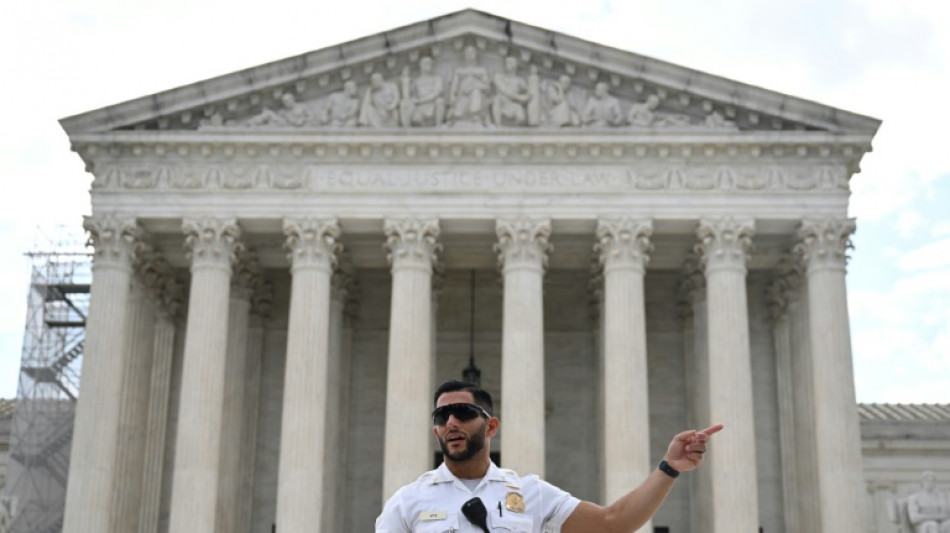
Supreme Court backs free speech rules in online stalking case / Photo: © AFP

 More than half of England 'officially in drought': UK govt

 MEXC Integrates World-Check to Fortify Institutional Grade Compliance Architecture

 Tech stocks plunge further but London market hits record high

 Spain's three worst wildfires since 1961 happened in last two years

 FIFA proposal 'an outright attack on football', says DFB vice-president

 Principal reaction to FIFA's private investor plan

 Ireland's Harrington named as vice-captain for 2027 Ryder Cup

 Spain returns wildfire evacuees as France braces for worsening weather

 Neuer 'very likely' to retire at end of season

 BMW aims to cut 8,000 jobs by end 2027: company source

 Chawinga sisters sparkle as Malawi stun WAFCON holders Nigeria

 India's youth protests puncture Modi's aura of invincibility

 UBS says second-quarter net profit up 17% to $2.8 billion
 Hong Kong independent bookstores to close after police raid

 US, Saudi forces strike Iran-backed groups in Iraq

 Crude jumps on fresh Mideast flare-up, tech rout deepens

 Japan coral protectors race to save reefs from heat 'bomb'

 US Fed expected to hold rates steady as inflation hawks circle

 SK hynix posts 1,200% net profit boost on AI chip boom

 'Very hungry' Joao Pedro impresses new Chelsea manager Alonso

 US government bans humanoid robots manufactured abroad

 Eseme, Hobbs shine in Glasgow rain to win 100m Commonwealth gold

 Netanyahu holds first White House talks with Trump since Iran war began

 Warriors re-sign Green after LeBron James shun

 Cameroon's Eseme storms to 100m Commonwealth gold

The US Supreme Court sided with free speech advocates Tuesday in ruling that a man's online harassment of a country singer could only be deemed illegally threatening if he knew it could be understood as such.
The high court overruled the Colorado conviction of Billy Counterman for making what the western US state deemed threats among the thousands of unwelcome Facebook messages he sent to country singer Coles Whalen from 2014 to 2016.
True threats are not protected by the US Constitution's guarantee of free speech rights.
The Colorado court found based on state laws that Counterman's messages to Whalen -- such as writing "die, don't need you" and "staying in cyber life is going to kill you" -- could be objectively considered threats.
Counterman's attorney turned to the Supreme Court arguing that the only way of determining whether a message is a threat should be subjective: what was the sender's intent?
The case drew the interest of free speech advocates who worried that upholding Counterman's conviction would chill free speech protections by permitting the prosecution of anyone whose speech is perceived as threatening by another person, without proof of intent.
But Colorado had argued that requiring a subjective determination of the sender's intent would enable abuse of free speech rights, and specifically immunize stalkers "who are untethered from reality."
"Ninety percent of actual or attempted domestic violence murder cases begin with stalking," Colorado Attorney General Phil Weiser had told the court.
But in their 7-2 opinion, the justices rejected Colorado's arguments.
They said it needed to prove Counterman had at least some awareness that his messages could be perceived as threats.
Writing for the majority, Justice Elena Kagan did not completely bow to Counterman's argument that Colorado needed to prove he made a conscious threat against Whalen.
Instead, she said, the state only needed to prove that Counterman was being reckless.
"The state must show that the defendant consciously disregarded a substantial risk that his communications would be viewed as threatening violence," she wrote.
Based on legal precedents, according to Kagan, "we hold that a recklessness standard is enough" to convict.
The recklessness standard offers enough "breathing space" for protected speech without sacrificing the ability to enforce laws against true threats, she wrote.
In dissent, Justice Amy Coney Barret, backed by Clarence Thomas, said objective standards of what is threatening are supported by established law and enforced in many states.
She said the majority decision would make it harder to prosecute real threats, and that "recklessness" was a flimsy standard.
"The reality is that recklessness is not grounded in law, but in a Goldilocks judgement: Recklessness is not too much, not too little, but instead 'just right.'"
In response, Kagan wrote: "In law, as in life, there are worse things than being 'just right.'"
A.Gasser--BTB