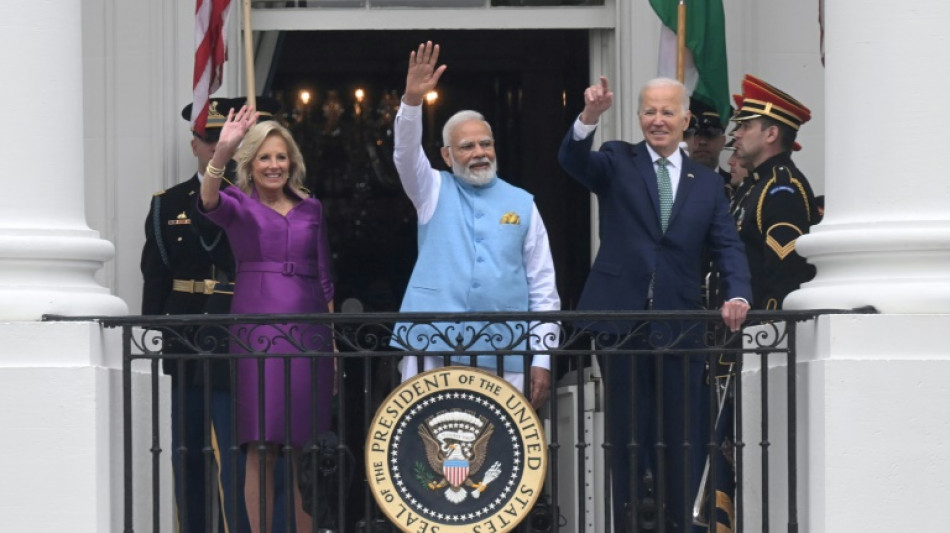
With an eye toward China, Biden goes all-in for Modi / Photo: © AFP

 Judge orders Amy Winehouse's father to pay nearly £1mn to her friends
 Crisis-hit Cuba opens pharmacies, gas stations to private firms
 Pro-Kremlin TV commentator ordered to leave France, under house arrest
 'I started crying': Battle to tame fresh blaze near French seaside
 Former top US Covid expert Fauci declines to answer hostile Senate questioning
 Neymar says his time playing for Brazil 'is over'
 F1 boss says season to finish in Europe if Gulf races cancelled
 Spanish wildfire evacuees go home as France hit by new heat alert

 French DJ Kavinsky, famed for 'Nightcall', found dead in Paris
 How an AFP beach snap became emblem of Europe's wildfire summer
 More than half of England 'officially in drought': UK govt

 MEXC Integrates World-Check to Fortify Institutional Grade Compliance Architecture
 Tech stocks plunge further but London market hits record high
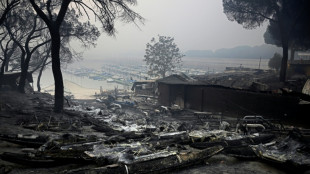 Spain's three worst wildfires since 1961 happened in last two years
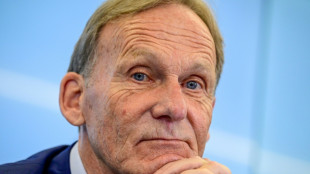 FIFA proposal 'an outright attack on football', says DFB vice-president
 Principal reaction to FIFA's private investor plan
 Ireland's Harrington named as vice-captain for 2027 Ryder Cup

 Spain returns wildfire evacuees as France braces for worsening weather
 Neuer 'very likely' to retire at end of season
 BMW aims to cut 8,000 jobs by end 2027: company source
 Chawinga sisters sparkle as Malawi stun WAFCON holders Nigeria
 India's youth protests puncture Modi's aura of invincibility
 UBS says second-quarter net profit up 17% to $2.8 billion
 Hong Kong independent bookstores to close after police raid
 US, Saudi forces strike Iran-backed groups in Iraq
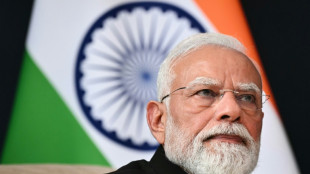
Laser-focused on countering China, US President Joe Biden has embraced Indian Prime Minister Narendra Modi as he has few other world leaders, casting aside any concerns about the Hindu nationalist's authoritarian streak.
Biden offered Modi the full pomp of a state visit with two dinners -- one intimate and one gala -- a meeting with top CEOs, and a long list of concrete takeaways including agreements on US engines for India's new home-grown fighter-jets and a major semiconductor factory.
Biden is "trying to tell the world that America is back. We've got partners and allies and we've got India on our side of the ledger," said Aparna Pande, a South Asia expert at the Hudson Institute.
Biden hopes to "send a message to China -- you have your people and I have my people and India is among mine," she said.
Tamanna Salikuddin, a former State Department official, called the joint statement for Modi's visit "remarkable" in its scope with the defense deliverables on par with what the United States would give a NATO or other treaty ally.
"The depth and breadth of what we're committing to with India is really putting them in a totally different basket. And I think that is what Modi wanted," said Salikuddin, now director of South Asia programs at the US Institute of Peace.
The Biden administration considers China the most serious long-term challenger to the United States, despite renewed efforts to manage tensions.
Both Biden and Modi publicly played down the China factor but Modi made a clear allusion in his address to the US Congress where he backed a "free, open and inclusive Indo-Pacific," winning knowing applause from lawmakers.
India, a fast-growing economy which has surpassed China as the world's most populous country, has a long-running territorial dispute with China, which the Indian public widely sees negatively.
- Sidestepping rights concerns -
Modi enjoyed more obvious kinship with fellow right-wing populist Donald Trump, for whom the prime minister arranged a packed stadium rally in his home state of Gujarat, a scene hard to imagine with Biden, who is not known for exciting the masses.
But US presidents across party lines have been seeking a closer relationship with India since Bill Clinton in the late 1990s, seeing alignment between the world's largest democracies after Cold War estrangement.
Modi, the most powerful Indian leader in decades, comes with particular baggage. Before he became prime minister in 2014, the United States refused to issue him a visa due to his alleged role in anti-Muslim riots as leader of Gujarat.
The US State Department in its latest religious freedom report spoke of vigilante violence against minorities after incitement from Modi's base. Indian authorities have also raided media offices and parliament expelled the opposition leader.
At least six lawmakers boycotted Modi's speech but Biden made clear that rights concerns would not impede ties with India and offered carefully chosen words about both countries facing challenges to democracy.
Modi, who has not held an open press conference at home in his nine years in power, was coaxed to take two questions as part of the state visit and denied discrimination against minorities.
"There's an irony in that the Biden administration seeks to contrast democratic India with authoritarian China," said Michael Kugelman, director of the South Asia Institute at the Wilson Center.
But Biden "doesn't appear to worry too much" about accusations he is ignoring democratic backsliding in India, Kugelman said.
"The two leaders definitely got what they wanted: They brought the most prestige possible to a partnership they're keen to showcase," he said.
- Still nonaligned? -
Ashley Tellis, a prominent India scholar at the Carnegie Endowment for International Peace, offered a contrarian view in a recent essay in Foreign Affairs.
He pointed to India's refusal to join the West in isolating Russia over Ukraine and doubted that India, hesitant at formal alliances, would provide any meaningful support in a US conflict with China.
But paradoxically, even as Modi faces criticism on rights, his anti-elite pedigree has led him to reject some vestiges of the proud nonalignment of India's post-independence leaders and to work more closely with the United States.
Salikuddin said that Modi, with his enthusiastic domestic base, was not seeking personal "validation" in Washington on his record -- but that he was seeking results, which he received aplenty.
"He's going to go back and say -- look, I have delivered. I have put India on the world stage and made India an indispensable partner in the Indo-Pacific," she said.
C.Kovalenko--BTB