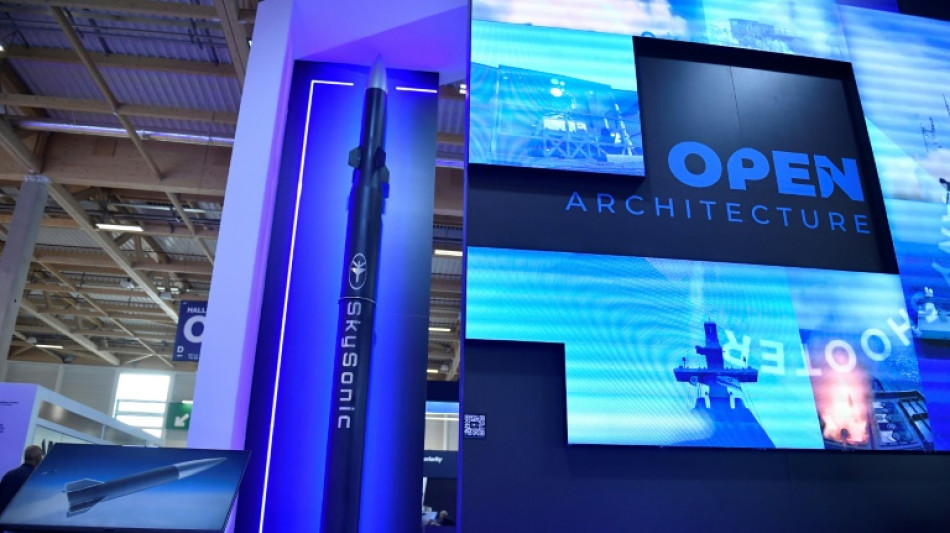
Race on for protection against hypersonic missiles / Photo: © AFP

 Rene Eyre Revisits Autobiographical Performance 'Say A Little Prayer' in London

 UAE's HCT Holds Record Graduation and Announces Major Training Expansion

 NASA Awards $10B Lunar Contract Framework to SpaceX, Blue Origin

 Katy Perry Tells Fans Ex-Husband Russell Brand 'Should Be in Jail' During UK Concert

 South African election results renew debate over identity-based voting

 South African voters report smoother local election but declining IEC trust

 Dolly Parton museum and Nashville hotel open after singer’s death

 George and Amal Clooney attend New York political-comedy reading

 British buyers pay substantial premiums for period-home appearance

 Thomas Markle released to house arrest after child-abuse-image charge

 Dawn of War 4 developers chose Adeptus Mechanicus for tactical variety

 Italy face unbeaten South Africa in Turin Nations Championship match

 ChatGPT interactive interface feature tested across six custom tools

 Freshways milk-price cut deepens pressure on UK dairy farms

 Labour and National remain virtually tied as New Zealand vote count advances

 The Good Daughter adapts Karin Slaughter thriller with Rose Byrne and Meghann Fahy

 Heavy-lift drone evacuates wounded Ukrainian soldier from frontline kill zone

 Morrison says West Brom recovered after pressure from successive derby losses
Defence firms are racing to meet demand for systems to protect against attacks using tricky-to-intercept hypersonic missiles, with several on display at this week's Paris Air Show.
Flying at multiples of the speed of sound, "everything's going faster, that's what changes the game," said Lionel Mazenq, of European missile maker MBDA's Future Systems division.
"They change course. It's hard to know whether they're coming towards you, it's challenging to predict their behaviour," he added -- although the new missiles "can be intercepted, especially in the terminal stage" of their flight.
MBDA said Tuesday it had launched a three-year programme to develop an interceptor dubbed Aquila, with 19 partner firms from five EU nations -- France, Germany, Italy, the Netherlands and Spain.
Brussels is expected to chip in with 80 million euros ($87 million) from the European Commission.
But no MBDA interceptors are expected to fly before 2030.
- Next generation -
Some of the first trials by fire of hypersonic systems have come in Ukraine, where Kyiv said in May it was able to shoot down a Russian Kinzhal missile flying at over five times the speed of sound (6,000 kilometres or 3,730 miles per hour).
Russian President Vladimir Putin had previously described the weapons as "invincible" -- although Kyiv has since claimed more shootdowns.
At Paris' Le Bourget airport this week, defence manufacturers are more focused on upcoming generations of hypersonic missiles that combine extreme speed with the ability to manouvre throughout their flight.
Flying on almost horizontal trajectories between the ranges covered by existing low- and high-altitude anti-air systems, these include China's DF-ZF hypersonic glider and Russia's Zircon hypersonic cruise missile.
Countering such attacks means combining a detection system with a interceptor missile that can itself reach hypersonic speeds.
"We have to be more manoeuverable than them, with gigantic speeds at the moment of intercept, more than 12,000 km/h," MBDA's Mazenq said.
"The challenge is to defeat the threat in the altitude between 25 to 75 or 80 km, the environment is totally different and most of the systems that exist today feel uncomfortable" so high up, said Pini Yungman, head of air defence at Israeli group Rafael.
That leaves a gap tens of kilometres high in which hypersonic missiles can do "all sorts of manoeuvres," he added.
The Israeli firm's unveiling of its Sky Sonic hypersonic interceptor Monday drew huge crowds to its Le Bouget stand -- as well as Israeli Defence Minister Yoav Gallant.
The missile boasts "a very unique seeker to detect and track the threat" that can react in "milliseconds, nanoseconds or even less," Yungman said.
Rafael says that development of the Sky Sonic has already cost tens of millions of dollars and that it is now looking for states willing to join the programme.
Its unveiling comes just after Israel's arch-enemy Iran announced it had developed a hypersonic ballistic missile.
- Playing catch-up -
As well as MBDA -- who are displaying a mockup of their Aquila interceptor out on the tarmac at the airshow -- a consortium led by Spanish firm Sener that includes Germany's Diehl Defense has received 100 million euros for their own project.
While both Russia and China have showed off their hypersonic weapons, European countries and the United States are still working on theirs.
American defence research agency DARPA says it has successfully tested a missile called HAWC that uses atmospheric oxygen to fuel its engine.
O.Bulka--BTB