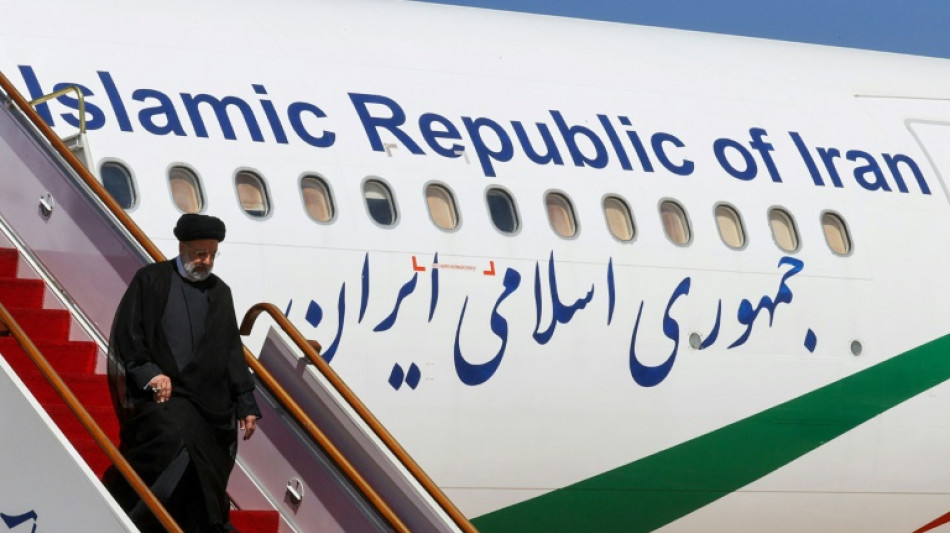
Iran ups diplomacy to ease isolation and project strength / Photo: © Iranian Presidency/AFP

 Dana White Confirms Flight to Washington for Trump Meeting on Press Secretary Role

 Dengue Fever Expands Into High Himalayas as Climate Change Warms Nepal

 IoT Refrigerator Hacks Disrupt Blood Labs and Supermarkets Across Europe and US

 Post-election pressures complicate US and Israeli decisions on Iran

 UN members approve talks on treaty protocol against environmental crime

 Family-run West Sussex beach café prepares for first winter season

 CT scans reveal health and burial clues from Egypt’s Braided Lady mummy

 Oxford faces complaints over lecturer’s classroom attire

 Kyren Wilson and John Higgins reach International Championship snooker final

 New Zealand and Tonga meet for place in Rugby League World Cup final

 Reports of unsafe AI-toy responses renew calls for child-safety rules

 Juneau food network combines difficult supply routes with deep sharing traditions

 India climbs green-transition ranking after first emissions decline in 25 years

 Trump names Stephen Miller as White House chief of staff after midterm losses

 Restored Albanian tower houses anchor new rural tourism trail

 Sonia Gandhi reflects on family tragedy and reluctant political career

 Pope Leo begins three-country South American tour in Uruguay

 Khawaja says entire Australia camp knew of 2018 ball-tampering plan
Since the start of the year, Iran has intensified its diplomatic activity, engaging with friends and foes alike as it seeks to reduce its isolation, improve its economy and project strength.
Iran's ultraconservative President Ebrahim Raisi has led the way, swinging through China, Syria and Venezuela, hosting Saudi Arabia's top diplomat, and reaching out to other long-time regional rivals such as Egypt.
And this week his foreign minister, Hossein Amir-Abdollahian, has travelled to Oman, the mediator in indirect talks between Iran and its sworn enemy the United States over its suspect nuclear programme and a possible prisoner swap.
Sanam Vakil, director of Chatham House's Middle East and North Africa programme, said Iran was seeking to show it can overcome its adversaries.
Iran is "looking to show that despite sanctions and domestic protests it continues to weather the storm by bolstering stronger international economic and foreign ties", she said.
"These links... aim to increase economic connectivity and boost internal morale."
At stake are "agreements focused on easing tensions through the de-escalation of Iran's nuclear programme and release of US prisoners" held in Iran, said Diako Hosseini, a Tehran-based foreign policy analyst.
Iran hopes such agreements would allow it to revive an economy battered by sanctions, rampant inflation and record depreciation of the rial against the dollar.
- 'Policy of openness' -
In 2018 under then president Donald Trump, the United States unilaterally withdrew from the landmark Iran nuclear deal and imposed waves of sanctions on the Islamic republic.
The punitive measures remain in place and are considered a strong deterrent for any foreign companies weighing up investments in Iran, regardless of their nationality.
Any indication of a thaw in relations would therefore be viewed favourably by Arab countries, especially those of the Gulf, which are seeking to ease tensions fuelled in recent years by the conflicts in Yemen and Syria.
This desire was one of the main drivers of the China-brokered normalisation of relations in March between Iran and Saudi Arabia after seven years of hostility.
Since then, Iran has sought to cement or restore ties with other Arab countries including Egypt and the United Arab Emirates.
Tehran says its "policy of openness" has contributed to a de-escalation of tensions in the Middle East, even if the risk of an armed confrontation is still high with Israel, the Islamic republic's arch-enemy.
"Only the enemies of Islam, led by the Zionist regime (Israel), are upset by the progress of cooperation between Iran and Saudi Arabia," Raisi said last week when he received the Saudi foreign minister, Prince Faisal bin Farhan.
- 'New world order' -
At the same time, a certain detente is emerging with European countries after months of simmering tensions since nationwide protests erupted in Iran over the September death in custody of Mahsa Amini, a 22-year-old Iranian Kurd, after her arrest for an alleged breach of the Islamic republic's strict dress code for women.
In recent weeks, Iran has released six Europeans it was holding and has held nuclear talks with Britain, France and Germany, the three European signatories to the landmark 2015 agreement.
But a bone of contention remains between Iran and Western countries that accuse Tehran of supplying drones to Moscow and helping it build a factory to manufacture them, which the Islamic republic denies.
Iran is also courting China, which Raisi visited in February for the first such trip in 20 years. Tehran expects to attract significant Chinese investment, the level of which remains low despite promises made in recent years.
Presenting itself as one of the pillars of the "new world order", the Islamic republic also wants to extend its influence into Southeast Asia, Africa and Central America.
Following a trip to Indonesia, Raisi last week visited Venezuela, Nicaragua and Cuba -- where he denounced "the imperialist powers" led by the United States.
The analyst Hosseini believes Iran "is turning to countries that are not considered in the western bloc... to show that the West's influence on Iran and its economy is not major".
Iran also hopes to be quickly accepted into two organisations that exclude Western countries: the BRICS grouping of Brazil, Russia, India, China and South Africa; and the Shanghai Cooperation Organisation, which brings together China, Russia and several Central Asian countries.
S.Keller--BTB