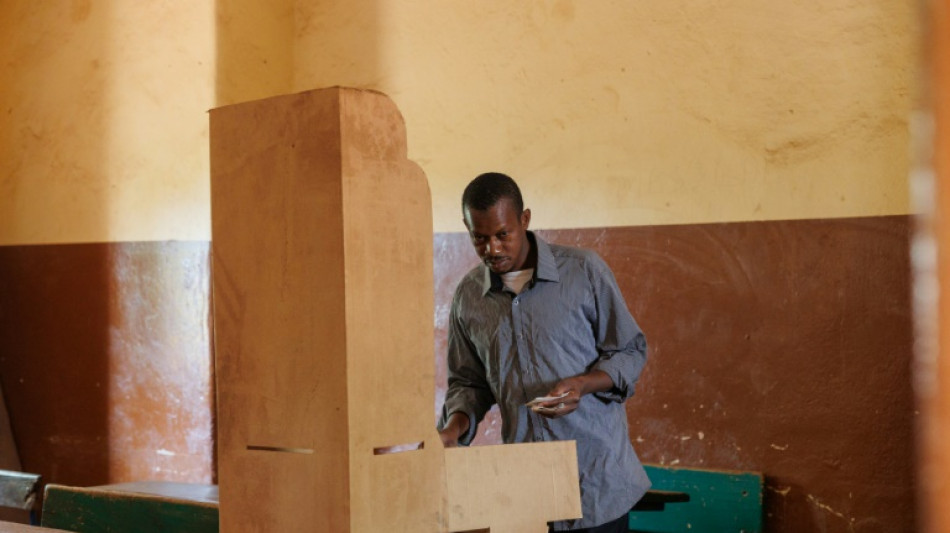
Malians vote on junta's new constitution / Photo: © AFP

 Dana White Confirms Flight to Washington for Trump Meeting on Press Secretary Role

 Dengue Fever Expands Into High Himalayas as Climate Change Warms Nepal

 IoT Refrigerator Hacks Disrupt Blood Labs and Supermarkets Across Europe and US

 Post-election pressures complicate US and Israeli decisions on Iran

 UN members approve talks on treaty protocol against environmental crime

 Family-run West Sussex beach café prepares for first winter season

 CT scans reveal health and burial clues from Egypt’s Braided Lady mummy

 Oxford faces complaints over lecturer’s classroom attire

 Kyren Wilson and John Higgins reach International Championship snooker final

 New Zealand and Tonga meet for place in Rugby League World Cup final

 Reports of unsafe AI-toy responses renew calls for child-safety rules

 Juneau food network combines difficult supply routes with deep sharing traditions

 India climbs green-transition ranking after first emissions decline in 25 years

 Trump names Stephen Miller as White House chief of staff after midterm losses

 Restored Albanian tower houses anchor new rural tourism trail

 Sonia Gandhi reflects on family tragedy and reluctant political career

 Pope Leo begins three-country South American tour in Uruguay

 Khawaja says entire Australia camp knew of 2018 ball-tampering plan
Malians voted Sunday on whether to back a new constitution in a first electoral test for the ruling junta but fears of jihadist attacks and political disagreements prevented voting in some areas.
The west African nation has been under military rule since an August 2020 coup but strongman leader Colonel Assimi Goita, 40, has vowed to return the country to civilian rule in 2024.
Some 8.4 million citizens are eligible to vote in the referendum on the new text which has fuelled speculation that Goita will seek election.
He was among the first to cast his ballot, while voters flocked to polling stations in the capital, Bamako, an AFP journalist saw.
"Today is a historic day. This vote will change many things... That's why I voted 'yes', for a new Mali," said civil servant Boulan Barro.
The danger of jihadist attacks looms over central and northern regions, meaning the vote is not being held in some parts of the country, including the town of Kidal, a stronghold of former rebels.
Despite concerns, no major incident was reported.
A team of observers from civil society groups backed by the European Union reported that there were only a small number of voting issues in the polling stations to which they were deployed.
In Menaka, a northern region contending with rebels linked to the Islamic State group, voting was limited to its capital due to insecurity, local elected officials said.
Turnout -- typically low in the country of 21 million -- will be seen as an indicator of the junta's ability to restore stability and generate popular enthusiasm for its agenda.
- Chronic instability -
The junta has advertised the new constitution as the answer to Mali's inability to tackle its multiple crises.
Mali's recent woes began in 2012, when separatist insurgents in the north -- long seen as marginalised by the southern government -- aligned with Al-Qaeda-linked Islamists to seize vast swathes of territory.
Former colonial power France stepped in and helped push back the Islamists, but attacks have continued, and Bamako has since broken its alliance with Paris in favour of Russia.
Disputed parliamentary elections in March 2020, followed by mass protests against a government unable to rein in the insurgency, corruption and economic crisis, ended in a coup.
Goita initially appointed an interim president but kicked him out in a second coup in 2021 and stepped into the top job himself.
Now doubts are swirling over his commitment to step down after elections planned for next year.
The junta called on Friday for the immediate departure of the country's UN peacekeeping mission, a central and controversial actor in a security crisis that has claimed the lives of nearly 200 peacekeepers in the last decade.
- A stronger presidency -
The new constitution will strengthen the role of the president, who will have the right to hire and fire the prime minister and cabinet members.
The government will answer to the president, and not parliament as the current 1992 document states.
It will also give an amnesty to those behind prior coups, reform the regulation of public finances and force MPs and senators to declare their wealth in a bid to clamp down on corruption.
A politician, speaking on condition of anonymity, said some in the military were hoping a new constitution would "reset the clock" -- erasing a previous commitment that Goita would not take part in the 2024 election.
- 'People want something else' -
Observers say a vote for "yes" is almost certain.
"Malians say that presidents from democratic regimes did not necessarily shine. Corruption has reached a certain level. People want to see something else," Bamako University sociologist Brema Ely Dicko said.
However, the reform has drawn vocal opposition, from former rebels and imams as well as political opponents.
Influential religious organisations oppose the continuation of secularism enshrined in the current constitution.
"The concerns of the Muslim faith aren't taken into account at all, that's why I voted 'no'," said 30-year-old Mariam Diop.
"Mali needs a system built around institutions and not a system built around a man," said Makan Mary, a member of the Yelema party.
"The problem with the 1992 constitution is that it was never really applied... it cannot be the cause of the crisis," the researcher said.
M.Odermatt--BTB