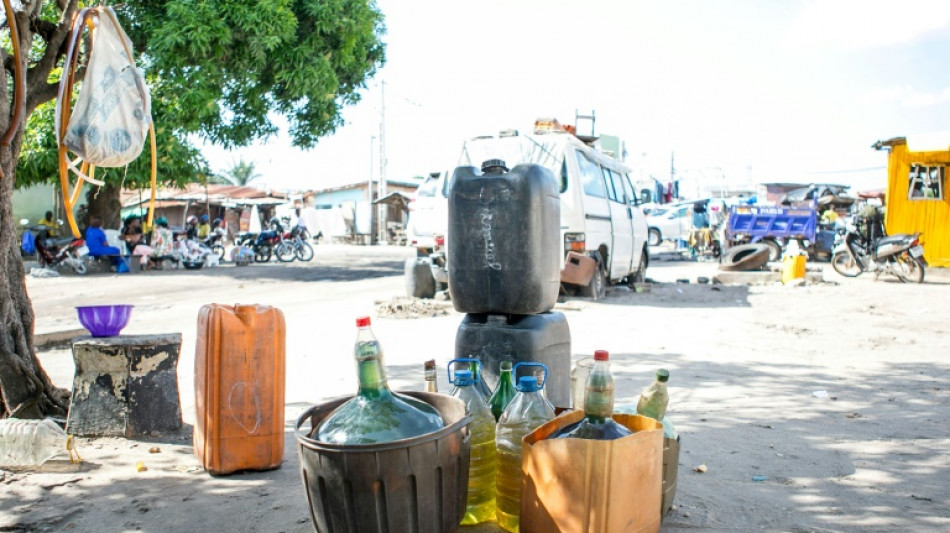
Benin feels the pinch as neighbouring Nigeria ends fuel subsidies / Photo: © AFP

 Meta misses profit expectations, sticks to massive AI spending

 Inequality best predicts how nations handle pandemics: study

 Brazil's Jair Bolsonaro denies authorizing deepfake for election message
 Boaduwaa strikes as Ghana beat WAFCON debutants Cape Verde

 US actor Jared Leto denies latest accusations of sexual assault
 Danube drops to 'historic lows' as fresh heatwave hits

 US Federal Reserve holds rates steady as inflation hawks call for hike

 Eala beats defending champ Fernandez in Washington

 US man accused of destroying evidence by wiping phone at airport

 BTS pulls out of Grammys after Asian pop category introduction
 Judge orders Amy Winehouse's father to pay nearly £1mn to her friends
 Crisis-hit Cuba opens pharmacies, gas stations to private firms

 Pro-Kremlin TV commentator ordered to leave France, under house arrest

 'I started crying': Battle to tame fresh blaze near French seaside

 Former top US Covid expert Fauci declines to answer hostile Senate questioning

 Neymar says his time playing for Brazil 'is over'

 F1 boss says season to finish in Europe if Gulf races cancelled
 Spanish wildfire evacuees go home as France hit by new heat alert
 French DJ Kavinsky, famed for 'Nightcall', found dead in Paris

 How an AFP beach snap became emblem of Europe's wildfire summer

 More than half of England 'officially in drought': UK govt

 MEXC Integrates World-Check to Fortify Institutional Grade Compliance Architecture

 Tech stocks plunge further but London market hits record high

 Spain's three worst wildfires since 1961 happened in last two years
 FIFA proposal 'an outright attack on football', says DFB vice-president

Sitting on top of a yellow jerry can of fuel, Jeannine waits for customers on a sidewalk in Benin's economic capital Cotonou, but business is slow.
The motorbikes and cars she normally supplies are no longer stopping to stock up on her cheap gasoline, which is smuggled in from neighbouring Nigeria.
Since Nigeria's new president Bola Ahmed Tinubu abruptly ended his country's long-standing subsidy on petrol two weeks ago, prices of black market fuel over the border in Benin have also doubled.
"Since this morning, barely five people have stopped," said Jeanine. "Everyone prefers to go to the petrol station now."
Two weeks ago, a litre of "Kpayo", the smuggled gasoline sold on the side of Beninese roads, doubled from 350 to 700 CFA francs (0.5 to 1 euro). That is now higher than the petrol in service stations at the market price of around 650 CFA a litre.
In Nigeria, fuel prices have also tripled since Tinubu ended the subsidies, with food, transport and power prices feeling the knock-on effect.
Ending the subsidy was the first measure taken by Tinubu, who sees the subsidies as unsustainable financial waste costing the state billions of dollars a year, and allowing massive smuggling of subsidised gasoline to neighbouring countries.
"Why should we (...) feed the smugglers and be the Santa Claus of neighbouring countries," Tinubu said last week, justifying the decision, which has been unpopular in Nigeria.
For decades, Nigeria's low-cost gasoline has been transported illegally by road to its neighbours, primarily Benin, where it is resold on the black market by a multitude of informal sellers.
"You know, this fuel helps feed thousands of people in Benin," said Jeannine, a 48-year-old widow with five children, who says she does not have savings "to start a new business".
The scale of the trafficking is such that the price of taxi fares has almost doubled in Cotonou. In Cameroon, another neighbour of Nigeria, several motorcycle taxi unions have gone on strike in protest.
- 'Pray to God' -
Victorien Assogba Kossi, wearing a yellow shirt like all the zemidjans (motorbike taxis) of Cotonou, wonders "what is wrong with Nigeria...?"
"Is it because the border is closed?" asks the driver who has never heard of Nigerian subsidies.
"We're going to pray to God that it goes down," said the 46-year-old man, who says he was forced to cut corn rations for his children when business slowed.
A few kilometres away, Nicolas Evedjere is happy enough. The gas station manager has never sold as much as in recent days.
"We had to close this morning, because we had nothing left to sell, our clients have multiplied by ten," he said smiling while adding he is sad "to see brothers suffer".
Suppliers had not anticipated such an explosion in demand, he said.
In front of gas stations that still have fuel to sell, long queues are now visible at peak times.
This is good news for the Beninese State, which hopes to increase its tax revenue, as informal sellers do not pay tax.
"In recent years, the Beninese government has encouraged the development of service stations in the country to reduce the importance of contraband gasoline on the market," Beninese government spokesman Wilfried Houngbedji told AFP.
"If we hadn't done this, we would currently be facing serious shortages," he said.
- Border closure -
The subsidy episode has once again illustrated Benin's steep dependence on its Nigerian neighbour, a West African giant with 215 million inhabitants, the continent's largest economy and one of Africa’s top oil producers.
Nigeria's border with Benin was closed off overnight in 2019 by former Nigerian President Muhammadu Buhari, a shutdown which lasted 18 months and asphyxiated the Beninese economy.
Whether coincidence or not, Beninese President Patrice Talon recently dismissed his foreign affairs minister, replacing him with Shegun Bakari, a Beninese entrepreneur who is of the same Yoruba ethnicity as Tinubu, and who observers say is "close" to his inner circle.
At the Benin border post of Seme-Krake, on the Atlantic coast, the usual hustle of currency traders, sellers, transporters and small traders involved in gasoline trafficking may have slowed, but another activity persists.
Rice imports are officially banned in Nigeria, which is trying to encourage local production.
But on the Nigerian side, past the customs checkpoints, a multitude of cars, their trunks filled with bags of rice arriving from the port of Cotonou in Benin, are unloaded in plain sight and passed into new vehicles for transport into Nigeria.
J.Horn--BTB