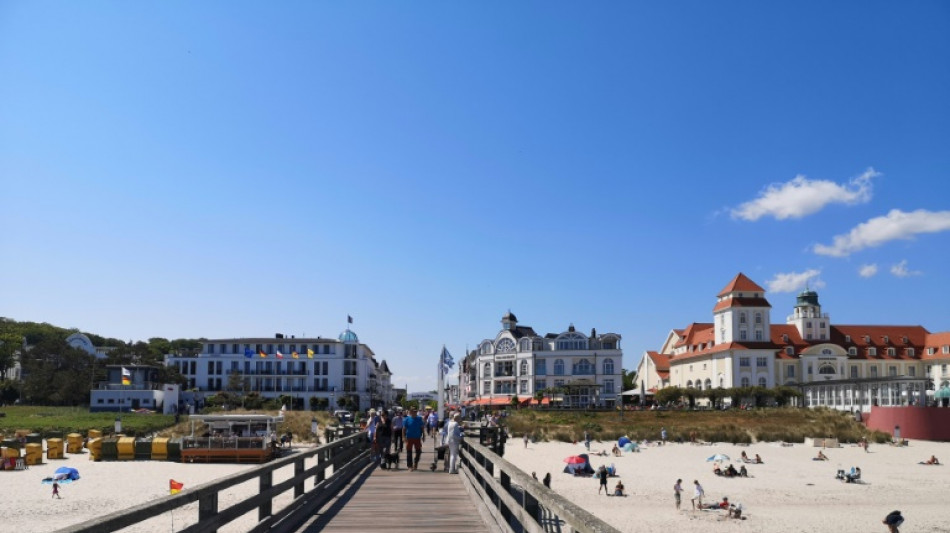
Storm at Baltic beauty spot over Germany's gas plans / Photo: © AFP

 Dana White Confirms Flight to Washington for Trump Meeting on Press Secretary Role

 Dengue Fever Expands Into High Himalayas as Climate Change Warms Nepal

 IoT Refrigerator Hacks Disrupt Blood Labs and Supermarkets Across Europe and US

 Post-election pressures complicate US and Israeli decisions on Iran

 UN members approve talks on treaty protocol against environmental crime

 Family-run West Sussex beach café prepares for first winter season

 CT scans reveal health and burial clues from Egypt’s Braided Lady mummy

 Oxford faces complaints over lecturer’s classroom attire

 Kyren Wilson and John Higgins reach International Championship snooker final

 New Zealand and Tonga meet for place in Rugby League World Cup final

 Reports of unsafe AI-toy responses renew calls for child-safety rules

 Juneau food network combines difficult supply routes with deep sharing traditions

 India climbs green-transition ranking after first emissions decline in 25 years

 Trump names Stephen Miller as White House chief of staff after midterm losses

 Restored Albanian tower houses anchor new rural tourism trail

 Sonia Gandhi reflects on family tragedy and reluctant political career

 Pope Leo begins three-country South American tour in Uruguay

 Khawaja says entire Australia camp knew of 2018 ball-tampering plan
Melanie Schmid grows walnuts and keeps sheep at her organic farm by the cliff's edge above the port of Mukran on the German island of Ruegen in the Baltic Sea.
The view across the bay to the resort town of Binz brought her here, but Germany's plan to park two ships at the port for the import of liquefied natural gas may drive her away from the popular beauty spot.
To replace lost Russian supplies, the German government has been frantically installing LNG terminals along its coast. Over the last months, Berlin has inaugurated several with fanfare, and is planning for Mukran to be the next.
Berlin sees the new terminal as insurance against the risk of a potential gas shortage but residents remain unconvinced.
Due to the thrum of machines turning LNG back into gas, 59-year-old Schmid says she fears she "simply won't be able to sleep here anymore".
Noise pollution is however only one concern for the organic farmer, who has joined a campaign to stop the project that brings together environmental groups and local politicians worried about the effect on the destination's health and prosperity.
"Are there not other locations on the Baltic coast or the North Sea that would have less of an impact on nature, on people, on tourism as the island of Ruegen?" Binz mayor Karsten Schneider tells AFP.
- 'Security buffer' -
Piled up next to the port, the pipes that would connect Mukran to the gas network are leftovers from the construction of Nord Stream 2.
The controversial pipeline, which would have relayed gas from Russia to Germany, was mysteriously sabotaged last year before it was ever put into use.
Approval for the energy link was blocked by Berlin amid tensions over Russia’s invasion of Ukraine, while Moscow slowly dwindled gas deliveries to Europe, plunging the continent into an energy crisis.
To make up for the drop in Russian supplies, Germany quickly began to develop the capacity to import LNG.
Government-backed floating terminals are already in operation in ports on the North and Baltic Seas, with a total of five planned -- including in Mukran.
The drastic expansion is a necessary "security buffer" and a safeguard against the risk of import drops "due to accidents, sabotage or other exogenous events", according to the economy ministry.
To placate residents, Economy Minister Robert Habeck travelled to Ruegen in May for discussions, following which he agreed to almost halve the capacity of the terminal at the site.
A swift decision must be made on the site if LNG is to arrive via Ruegen in the winter, he wrote in a letter in May to the region's economy minister following the visit.
But after Germany steered clear of its worst-case shortage scenario earlier this year, locals are questioning whether the Mukran installation is really necessary.
"It really looks like we will get through the next winter without any big problems," says Binz mayor Schneider.
- Local challenge -
Unmoved by the government's arguments, resistance continue to build up. Residents have petitioned parliament, while the local government has filed an injunction against the terminal's accelerated planning approval.
Arguments for surplus capacity are "incomprehensible and not at all acceptable", says Thomas Kunstmann, 64, one of the organisers behind the local campaign group "Liveable Ruegen".
Opponents of the planned terminal are concerned about the environmental impact of building new gas infrastructure.
"Most of us are against LNG because it is a fossil fuel that is harmful to the climate," says Kunstmann.
Concerns for nature abound, too. A new pipeline around the island could likewise disrupt wildlife, running straight through spawning grounds for herring, Kunstmann says.
"An industrial port simply does not belong here."
The area's natural bounty is why Binz attracts so many tourists. Increased shipping traffic and noise disruption "doesn't fit with the reasons why people come here on holiday", says the resort's tourism director Kai Gardeja.
Already gas import vessels are anchored just off the coast and in sight of the beachfront.
The sight of the new terminal across the bay could "scare some tourists away", says 25-year-old Kai Birkholz from Mannheim, out for a walk on the Binz pier.
Other visitors are less troubled. Pensioner Manfred Steiner, 88, says he would come again. "It's just tremendous here."
O.Krause--BTB