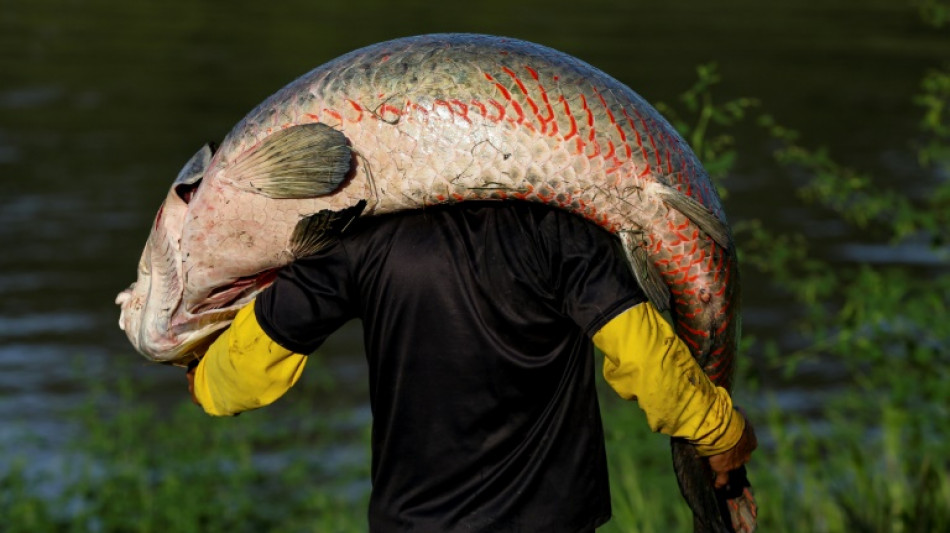
Pirarucu: Amazon's giant air-breathing fish in poachers' sights / Photo: © AFP

 Ngumoha scores as Liverpool beat Wrexham 1-0 in New York friendly

 Up to 23 feared dead in Japan quake

 Samsung operating profit up 1,800% in second quarter on AI boom

 De Zerbi wants Bergvall at Spurs, but can't promise starting role

 De Minaur tops Tsitsipas to set up Hewitt clash in Washington

 Japanese population below 120 million for first time in decades

 Meta misses profit expectations, sticks to massive AI spending

 Inequality best predicts how nations handle pandemics: study

 Brazil's Jair Bolsonaro denies authorizing deepfake for election message

 Boaduwaa strikes as Ghana beat WAFCON debutants Cape Verde

 US actor Jared Leto denies latest accusations of sexual assault

 Danube drops to 'historic lows' as fresh heatwave hits

 US Federal Reserve holds rates steady as inflation hawks call for hike

 Eala beats defending champ Fernandez in Washington

 US man accused of destroying evidence by wiping phone at airport

 BTS pulls out of Grammys after Asian pop category introduction

 Judge orders Amy Winehouse's father to pay nearly £1mn to her friends

 Crisis-hit Cuba opens pharmacies, gas stations to private firms

 Pro-Kremlin TV commentator ordered to leave France, under house arrest

 'I started crying': Battle to tame fresh blaze near French seaside

 Former top US Covid expert Fauci declines to answer hostile Senate questioning

 Neymar says his time playing for Brazil 'is over'

 F1 boss says season to finish in Europe if Gulf races cancelled

 Spanish wildfire evacuees go home as France hit by new heat alert

 French DJ Kavinsky, famed for 'Nightcall', found dead in Paris

A fish larger than a man, tasty as well as beautiful, the freshwater pirarucu is a favorite with poachers in a lawless part of the Amazon jungle where Brazil, Peru and Colombia meet.
Prized for its skin as much as its flesh, the pirarucu has long been a staple for Indigenous people who hunt the air-breathing fish in lakes in the Javari Valley.
But it has also become a much sought-after protein on the menus of gastronomic and fusion restaurants in Rio, Bogota and Lima -- its rising popularity pushing up prices and raising the stakes for Amazon dwellers.
The growing appetite for pirarucu is blamed for the deaths last year of Indigenous rights defender Bruno Pereira and British journalist Dom Phillips at the hands of fish poachers who hacked up the pair's bodies and hid the remains in the jungle.
In Brazil's Amazonas province, pirarucu harvesting is strictly regulated.
In the Javari Valley which holds the country's second-largest protected Indigenous reserve -- home to seven tribes including the Kanamari -- only residents may hunt it.
Yet, "they are stealing from us!" said Joao Filho Kanamari, an Amazon resident who takes his last name from his tribe which comes into regular conflict with intruders in pursuit of the prized fish.
- 'Cow of the Amazon' -
For the Kanamari, the story of the pirarucu is that of "a tree leaf that fell into the water and became a giant fish," tribal chief Mauro da Silva Kanamari told AFP.
"Arapaima gigas" by its scientific name, the pirarucu is one of the largest freshwater fish on the planet.
It is a weird-looking creature with a pink, tapered tail, awkwardly-flattened head and globular eyes reminiscent of a prehistoric monster.
An omnivore, the pirarucu can grow up to three meters (9.8 feet) long and weigh over 200 kilograms (440 pounds.)
Caught with nets and harpoons, the giant fish is relatively easy to spot and kill as it needs to surface to breathe about every 20 minutes.
Known lovingly to locals as "the cow of the Amazon," presumably for its ability to feed many at a time, the pirarucu is also versatile: its skin is used for exotic leather products -- shoes, bags or wallets.
Pirarucu scales, reputedly resistant to piranha teeth, are sold to tourists as key chains.
Subject to overfishing in the Brazilian Amazon, the pirarucu all but disappeared in the 1990s until the government introduced fishing restrictions.
- 'Fished like crazy' -
In 2017, a project was started in the Javari Valley with the help of an Indigenous NGO called CTI to ensure the community will be able to continue harvesting pirarucu for a long time to come. Sustainably.
The project is managed by the Kanamari themselves, who have voluntarily limited their own catches of pirarucu and agreed not to sell any for five years.
"The idea is that the natives can feed themselves, provide for their needs, all while protecting their territory," said CTI spokesman Thiago Arruda.
The project also involves patrols to spot and report poachers -- a risky endeavor that can bring the tribespeople in contact with illegal fishermen, often armed.
"The project is very important for us," said Bushe Matis, coordinator of the Union of Indigenous Peoples of the Javari Valley (Univaja.)
"Before people fished like crazy. From now on we will take care of the lakes and fishing areas, so that we will always have fish in the future."
A stocktake will occur within weeks, and if fish numbers have recovered sufficiently, the Kanamari will be able to start selling again.
But there are obstacles ahead: the community still has to set up a cold chain to get the fish safely to clients from all the way inside the bowels of the jungle, and decide how to split the proceeds.
Some fear the opening to sales could expose the Indigenous jungle dwellers to a whole new kind of risk.
According to one project promoter, who asked not to be named, there is a danger of local politicians or businessmen "not necessarily well-intentioned and probably involved in illegal fishing networks" working their way into the system.
J.Fankhauser--BTB