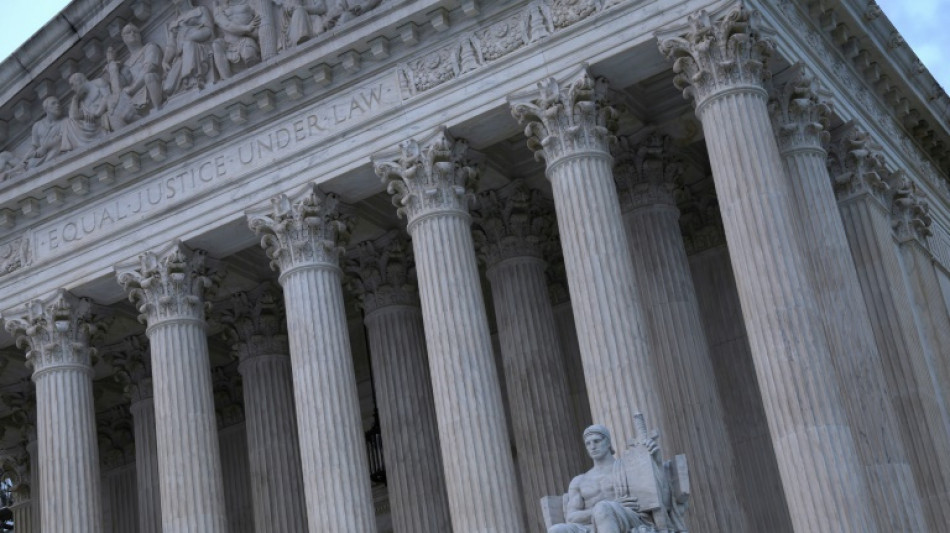
Alabama electoral map discriminated against Black voters: court / Photo: © GETTY IMAGES/AFP

 Japan quake toll hits 28 as survivors struggle in heat

 AI data centre supplier Zhongji InnoLight tumbles on Hong Kong debut

 Drones and blackouts inflict a tense summer on Russia-annexed Crimea

 Australia ask for more information on FIFA sell-off plan

 South Korean stocks bounce after rout, oil holds gains on Mideast woes

 Stokes should return for 'one more Ashes': Australia coach McDonald

 Ngumoha scores as Liverpool beat Wrexham 1-0 in New York friendly

 Up to 23 feared dead in Japan quake

 Samsung operating profit up 1,800% in second quarter on AI boom

 De Zerbi wants Bergvall at Spurs, but can't promise starting role
 De Minaur tops Tsitsipas to set up Hewitt clash in Washington

 Japanese population below 120 million for first time in decades

 Meta misses profit expectations, sticks to massive AI spending

 Inequality best predicts how nations handle pandemics: study

 Brazil's Jair Bolsonaro denies authorizing deepfake for election message

 Boaduwaa strikes as Ghana beat WAFCON debutants Cape Verde

 US actor Jared Leto denies latest accusations of sexual assault

 Danube drops to 'historic lows' as fresh heatwave hits

 US Federal Reserve holds rates steady as inflation hawks call for hike

 Eala beats defending champ Fernandez in Washington

 US man accused of destroying evidence by wiping phone at airport

 BTS pulls out of Grammys after Asian pop category introduction

 Judge orders Amy Winehouse's father to pay nearly £1mn to her friends

 Crisis-hit Cuba opens pharmacies, gas stations to private firms

 Pro-Kremlin TV commentator ordered to leave France, under house arrest

The US Supreme Court ruled on Thursday that a congressional electoral map drawn in the southern state of Alabama discriminated against Black voters.
The 5-4 decision by the conservative-majority court is a surprise victory for the Voting Rights Act, which was passed by Congress during the civil rights movement in 1965 to prevent racial discrimination against minorities in elections.
The Alabama case concerns a map that was redrawn in 2021 by Alabama's Republican majority legislature to allocate seats in the US House of Representatives.
Under the map, Black voters -- who represent around a quarter of registered voters statewide -- are in a majority in only one of Alabama's seven US House districts.
African Americans in Alabama tend to vote Democratic while white voters in the state mostly support Republicans.
Citizens and rights groups took the Alabama redistricting map to court, accusing legislators of violating the Voting Rights Act which prohibits diluting the Black vote.
Chief Justice John Roberts and another conservative, Brett Kavanaugh, sided with the three liberal justices in upholding a lower court ruling ordering Alabama to redraw the congressional map to include a second district with a large African American population.
Republican officials in Alabama had appealed the lower court ruling to the Supreme Court, where conservatives hold a 6-3 majority, and the nation's highest court heard the case in October.
President Joe Biden welcomed the decision, saying it "confirms the basic principle that voting practices should not discriminate on account of race."
"The right to vote and have that vote counted is sacred and fundamental -- it is the right from which all of our other rights spring," Biden said in a statement.
Attorney General Merrick Garland said the ruling "preserves the principle that in the United States, all eligible voters must be able to exercise their constitutional right to vote free from discrimination based on their race."
- 'Crucial win' -
Deuel Ross, senior counsel at the Legal Defense Fund, also praised the decision, calling it a "crucial win against the continued onslaught of attacks on voting rights."
"Alabama attempted to rewrite federal law by saying race had no place in redistricting," said Ross, who argued the case before the court.
"But because of the state's sordid and well-documented history of racial discrimination, race must be used to remedy that past and ensure communities of color are not boxed out of the electoral process," he said.
Davin Rosborough, senior staff attorney with the American Civil Liberties Union's Voting Rights Project, called the ruling a "huge victory for Black Alabamians."
"The Supreme Court rejected the Orwellian idea that it's inappropriate to consider race in determining whether racial discrimination led to the creation of illegal maps," Rosborough said.
The Alabama case is one of several the court heard this term revolving around race.
The justices are set to rule shortly in a case involving the use of race in deciding who gets to attend Harvard University and the University of North Carolina.
Harvard and UNC, like many other US institutions of higher education, use race as a factor in trying to ensure a diverse student body and to make up for a legacy of discrimination against African Americans and Hispanics.
I.Meyer--BTB