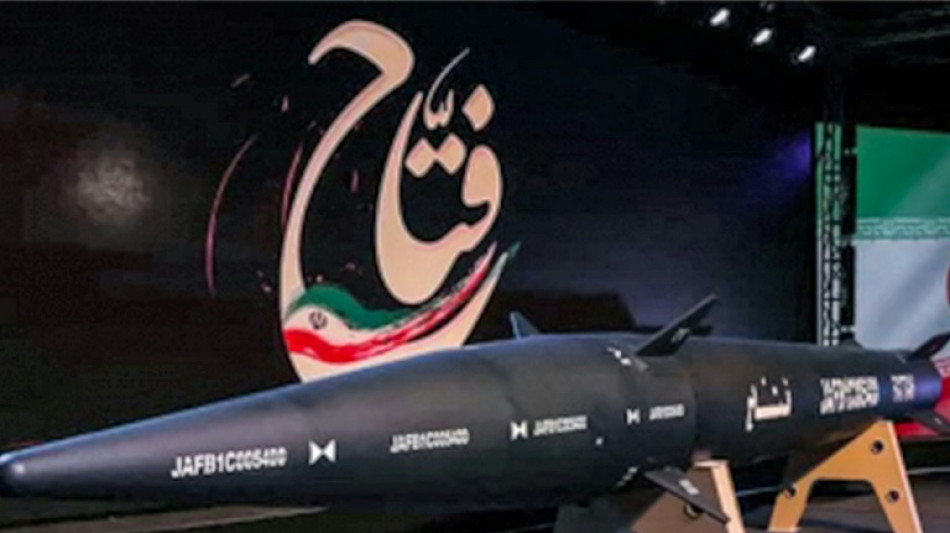
Iran unveils hypersonic missile hailing deterrent boost / Photo: © SEPAH NEWS/AFP

 Dana White Confirms Flight to Washington for Trump Meeting on Press Secretary Role

 Dengue Fever Expands Into High Himalayas as Climate Change Warms Nepal

 IoT Refrigerator Hacks Disrupt Blood Labs and Supermarkets Across Europe and US

 Post-election pressures complicate US and Israeli decisions on Iran

 UN members approve talks on treaty protocol against environmental crime

 Family-run West Sussex beach café prepares for first winter season

 CT scans reveal health and burial clues from Egypt’s Braided Lady mummy

 Oxford faces complaints over lecturer’s classroom attire

 Kyren Wilson and John Higgins reach International Championship snooker final

 New Zealand and Tonga meet for place in Rugby League World Cup final

 Reports of unsafe AI-toy responses renew calls for child-safety rules

 Juneau food network combines difficult supply routes with deep sharing traditions

 India climbs green-transition ranking after first emissions decline in 25 years

 Trump names Stephen Miller as White House chief of staff after midterm losses

 Restored Albanian tower houses anchor new rural tourism trail

 Sonia Gandhi reflects on family tragedy and reluctant political career

 Pope Leo begins three-country South American tour in Uruguay

 Khawaja says entire Australia camp knew of 2018 ball-tampering plan
Iran's Revolutionary Guards unveiled an intermediate range ballistic missile Tuesday capable of travelling at hypersonic speeds of up to 15 times the speed of sound, state television reported.
President Ebrahim Raisi hailed the new missile's hypersonic capability, saying it would boost Iran's "power of deterrence" and "bring peace and stability to the countries of the region".
The official IRNA news agency published photographs of the ceremony in a closed area it did not identify. Several top military commanders were present, including Guards chief General Hossein Salami.
"The range of the Fattah missile is 1,400 kilometres (870 miles) and its speed before hitting its target" is between 13 and 15 times the speed of sound, IRNA said.
Like slower ballistic missiles, hypersonic missiles can be equipped with nuclear warheads and Iran's announcement it was producing one in November prompted International Atomic Energy Agency chief Rafael Grossi to express concern.
But Grossi added he did not see the new missile "having any influence" on negotiations with Iran over its nuclear activities.
Talks between Tehran and major powers on reviving a 2015 nuclear deal that was left in tatters when Washington unilaterally abandoned it in 2018 and imposed renewed sanctions are currently stalled.
Iran has since suspended its implementation of the strict limits it agreed to on its nuclear activities and restricted IAEA monitoring in a policy it is only slowly reversing.
Unlike conventional ballistic missiles, hypersonic ones fly on a trajectory low in the atmosphere, enabling them to reach their targets more quickly and with less chance of being intercepted by modern air defences.
When the programme was announced last year, Guards aerospace chief General Amirali Hajizadeh said the system was developed to "counter air defence shields", adding that he believed it would take decades before a system capable of intercepting it is developed.
Iran's arch foe Israel, which is widely believe to have its own undeclared nuclear arsenal, has multiple air defence shields for countering subsonic and supersonic missiles.
North Korea's test of a hypersonic missile last year sparked concerns about the race to acquire the technology, which is currently led by Russia, followed by China and the United States.
Since March last year, Russia's Kinzhal hypersonic missile has been used multiple times in its war against Ukraine.
F.Müller--BTB