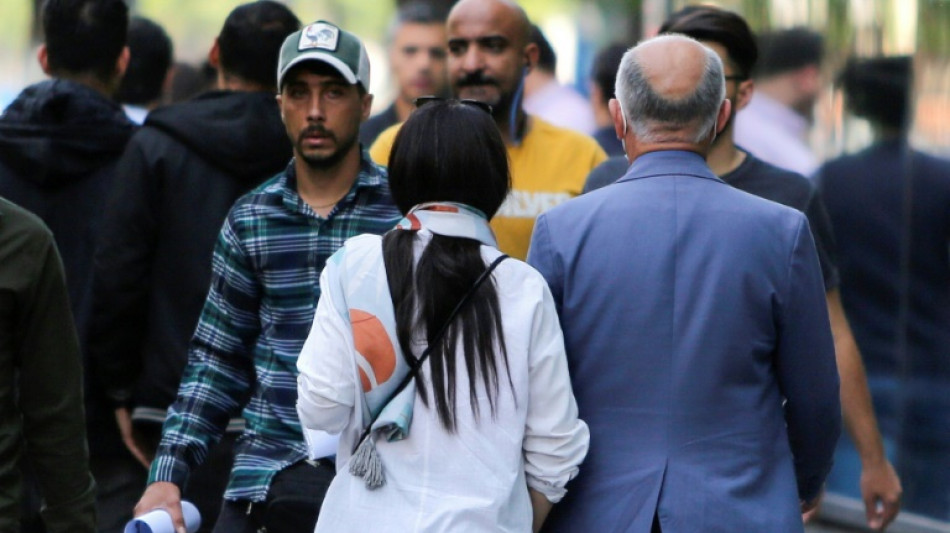
Iran debates new penalties for veil violations / Photo: © AFP/File

 Japanese survivors deal with second quake disaster in 10 years

 Stranded boats, out-of-work fishermen as Danube hits record lows

 South Korea Hong coach grilled by MPs over World Cup flop

 Japan quake toll hits 30 as survivors struggle in heat
 Japan quake toll hits 28 as survivors struggle in heat

 AI data centre supplier Zhongji InnoLight tumbles on Hong Kong debut

 Drones and blackouts inflict a tense summer on Russia-annexed Crimea

 Australia ask for more information on FIFA sell-off plan

 South Korean stocks bounce after rout, oil holds gains on Mideast woes

 Stokes should return for 'one more Ashes': Australia coach McDonald

 Ngumoha scores as Liverpool beat Wrexham 1-0 in New York friendly

 Up to 23 feared dead in Japan quake
 Samsung operating profit up 1,800% in second quarter on AI boom

 De Zerbi wants Bergvall at Spurs, but can't promise starting role
 De Minaur tops Tsitsipas to set up Hewitt clash in Washington

 Japanese population below 120 million for first time in decades

 Meta misses profit expectations, sticks to massive AI spending

 Inequality best predicts how nations handle pandemics: study

 Brazil's Jair Bolsonaro denies authorizing deepfake for election message

 Boaduwaa strikes as Ghana beat WAFCON debutants Cape Verde

 US actor Jared Leto denies latest accusations of sexual assault

 Danube drops to 'historic lows' as fresh heatwave hits

 US Federal Reserve holds rates steady as inflation hawks call for hike

 Eala beats defending champ Fernandez in Washington

 US man accused of destroying evidence by wiping phone at airport

An Iranian draft law that would set new penalties for women not wearing a headscarf in public has sparked heated debate within the Islamic republic's leadership as more women flout the country's strict dress code.
Since the aftermath of the Islamic revolution of 1979, women have been required to cover their hair and neck in public places, with offenders facing fines or prison terms of up to two months.
But a growing number are defying the law and appearing bareheaded in the streets.
The trend accelerated during the nationwide protests sparked by the September death in custody of Mahsa Amini, a 22-year-old Iranian Kurdish woman arrested for allegedly violating the law.
The protests rocked Iran, provoking a crackdown by authorities that claimed the lives of hundreds of people, including dozens of security personnel, and saw thousands more arrested.
Iran's conservatives, who dominate the country's parliament and leadership, have passionately defended the dress code and believe relaxing rules would begin a process leading to profound shifts in "social norms".
But with many Iranians demanding change, in May the judiciary and the government proposed a "Support for the Culture of Hijab and Chastity" bill, to "protect society" and "strengthen family life".
The text proposes increased fines for "any person removing their veil in public places or on the internet" but withdraws the threat of a prison sentence.
"This bill reduces the removal of the hijab from a felony to a misdemeanour, similar to a traffic violation but with heavier fines," sociologist Abbas Abdi told AFP.
After Amini's death and the subsequent protests, society "no longer accepts that we imprison a woman because she does not wear the veil", he said.
Since the protests, authorities have imposed a series of measures to enforce Iran's strict dress code, including the closure of businesses whose staff do not conform with the rules and installing cameras in public places to track down offenders.
In recent days, at least three officials have been sacked or arrested for failing to prevent unveiled women from entering historic sites.
- 'Not dissuasive enough' -
Under the proposed law, the text of which has been published in government-affiliated media, offenders will first receive a warning text message from the police.
A second breach will incur fines of between five million and 60 million rials (around $10 to $120), a large sum for many Iranians. The law would also provide for other penalities, including the confiscation of a woman's vehicle for up to 10 days.
Defending the bill, judiciary chief Gholamhossein Mohseni Ejei stressed the need to avoid polarising society, saying he understood the "concerns of believers" supportive of the dress code.
As the bill awaits examination by lawmakers, it faces accusations of not being tough enough from ultra-conservatives, an influential bloc in the current parliament.
Relaxing punishments for violations will see "the expansion of a repugnant phenomenon" by "removing legal barriers" for women not wearing a veil, the ultra-conservative newspaper Kayhan said.
Those supporting the law "do not know that the enemy" seeks to "destroy the family as an institution and ultimately, to attack the foundations of the Islamic system" by removing headscarves, the newspaper said.
Social networks and foreign media, particularly television channels broadcasting in Persian, are calling for "social disobedience", according to some ultra-conservatives.
Within Iran's leadership "there is no consensus on the hijab", as some favour repression, while others "believe that other means must be tried", the sociologist Abdi said.
"The bill satisfies neither the supporters of compulsory hijab nor, of course, the supporters of the freedom to cover up or not."
A similar situation developed in the 1990s with a law prohibiting the use of satellite dishes, he said.
"It was only implemented for a while before it was dropped."
F.Pavlenko--BTB