US urges keeping Russia nuclear arms limits, eyes China / Photo: © AFP/File

 Shell profit surges as Mideast war fuels oil prices

 Russian strikes kill 8 across Ukraine, including 6 from one family
 Rain dampens France fire, as Spain reports 'almost no flames'
 India's history-making stand-in cricket captain Rahane retires
 Car maker Stellantis says back in profit in second quarter

 Japanese survivors deal with second quake disaster in 10 years

 Stranded boats, out-of-work fishermen as Danube hits record lows
 South Korea Hong coach grilled by MPs over World Cup flop

 Japan quake toll hits 30 as survivors struggle in heat

 Japan quake toll hits 28 as survivors struggle in heat

 AI data centre supplier Zhongji InnoLight tumbles on Hong Kong debut

 Drones and blackouts inflict a tense summer on Russia-annexed Crimea

 Australia ask for more information on FIFA sell-off plan

 South Korean stocks bounce after rout, oil holds gains on Mideast woes

 Stokes should return for 'one more Ashes': Australia coach McDonald

 Ngumoha scores as Liverpool beat Wrexham 1-0 in New York friendly

 Up to 23 feared dead in Japan quake

 Samsung operating profit up 1,800% in second quarter on AI boom

 De Zerbi wants Bergvall at Spurs, but can't promise starting role
 De Minaur tops Tsitsipas to set up Hewitt clash in Washington

 Messi returns to Miami training after World Cup break

 Idi Amin's grandson disqualified from Commonwealth boxing bout

 O'Connor wins Commonwealth heptathlon as Australia set new record for swimming golds

 De Minaur beats Tsitsipas to set up Hewitt clash in Washington

 Nigeria dismantles meth lab, but fears of Mexican cartel links linger

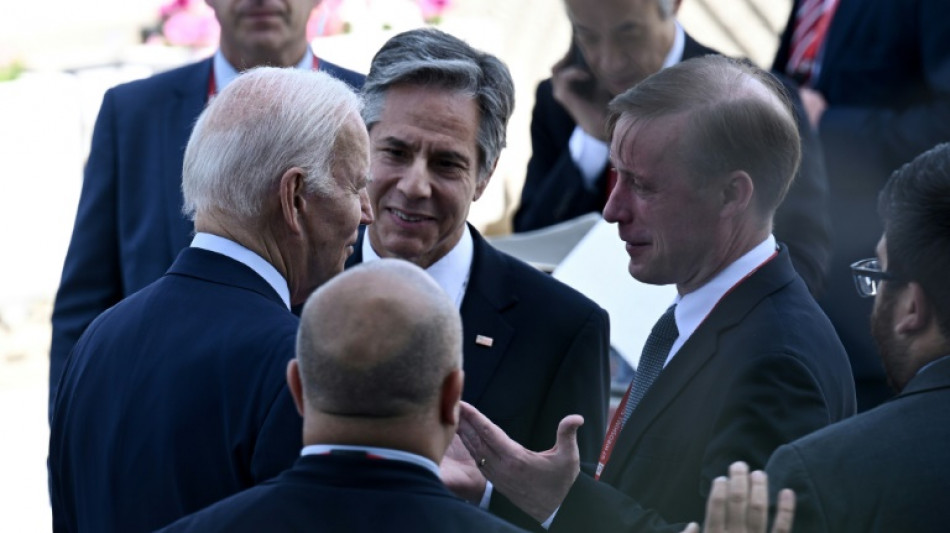
A top White House official on Friday offered to maintain current nuclear warhead limits with Russia, while making the case for putting rising power China at the center of future arms control efforts.
National Security Advisor Jake Sullivan made the comments in a speech at the annual National Arms Control Association meeting in Washington, as he outlined the attempt by Joe Biden administration to confront what he called "substantial" and "deep" cracks in the post-Cold War nuclear landscape.
With the last US-Russia arms control treaty -- New START -- largely moribund and due to expire in 2026, Sullivan said the United States is keen to forge a new treaty.
In the meantime, however, Washington wants the world's two leading nuclear powers to preserve the core of that treaty -- a limit for each of 1,550 warheads.
"We're prepared to stick to the central limits as long as Russia does," Sullivan said.
He also called on Moscow to start new talks for a post-2026 framework, saying "rather than waiting to resolve all of our bilateral differences, the United States is ready to engage Russia now to manage nuclear risks."
Unlike during the Cold War, when there were only two global nuclear powers, the future of arms control will revolve around China's rapidly expanding arsenal and global presence, Sullivan said.
"By 2035, (China) is on track to have as many as 1,500 nuclear warheads -- one of the largest peacetime nuclear buildups in history," Sullivan said, meaning that "the United States will need to deter two near-peer nuclear powers for the first time in its history."
"We're also ready to engage China without preconditions," he said.
A senior US official told reporters that the China factor not only involves the need for Washington to manage the threat directly but to consider the ripple effects created for US nuclear allies Britain and France, whose own smaller arsenals are largely directed at countering Russia.
Agreements with China "of course will affect our ability to come to some sort of accord with the Russians," the official said.
- Difficult path -
With relations at rock bottom with President Vladimir Putin's Russia and currently at a near standstill with Beijing, a difficult path lies ahead.
China "has thus far opted not to come to the table for substantive dialogue on arms control. It has declined to share the size and scope of its nuclear forces or to provide launch notifications. And it has not shown much interest in discussions regarding the changes to its nuclear forces," Sullivan said.
In February this year, Putin announced that Russia was suspending participation in New START, a Cold War-era treaty which limits warheads and allows verification by both sides.
The State Department said Thursday that it has made reciprocal "countermeasures" by suspending various aspects of the treaty, including on-site inspections and exchange of data.
While offering to rebuild arms control treaties, Sullivan stressed that the United States will simultaneously improve its nuclear forces.
"Responsibly enhancing our deterrent capabilities allows us to negotiate arms control from a position of strength," he said.
C.Kovalenko--BTB