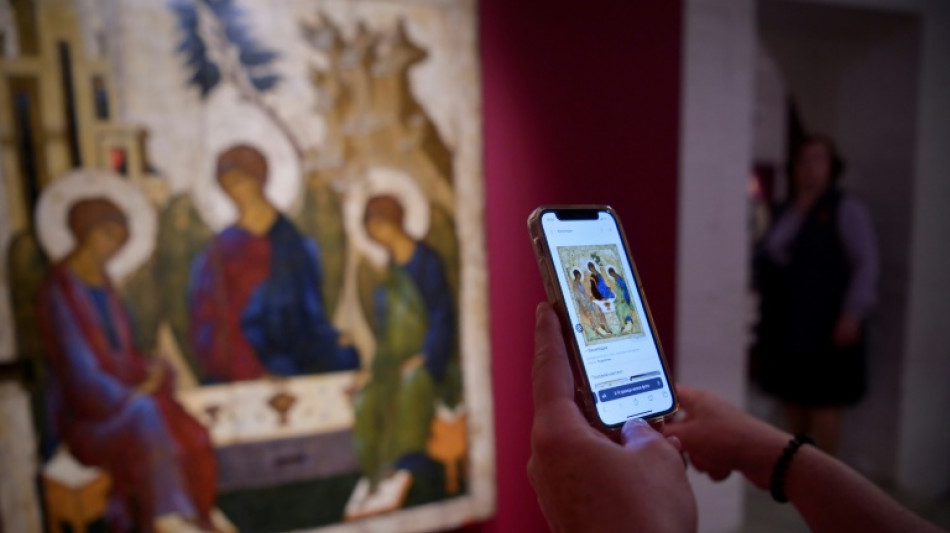
Putin gifts historic treasures to church amid Ukraine campaign / Photo: © AFP

 South African election results renew debate over identity-based voting

 South African voters report smoother local election but declining IEC trust

 Dolly Parton museum and Nashville hotel open after singer’s death

 George and Amal Clooney attend New York political-comedy reading

 British buyers pay substantial premiums for period-home appearance

 Thomas Markle released to house arrest after child-abuse-image charge

 Dawn of War 4 developers chose Adeptus Mechanicus for tactical variety

 Italy face unbeaten South Africa in Turin Nations Championship match

 ChatGPT interactive interface feature tested across six custom tools

 Freshways milk-price cut deepens pressure on UK dairy farms

 Labour and National remain virtually tied as New Zealand vote count advances

 The Good Daughter adapts Karin Slaughter thriller with Rose Byrne and Meghann Fahy

 Heavy-lift drone evacuates wounded Ukrainian soldier from frontline kill zone

 Morrison says West Brom recovered after pressure from successive derby losses

 Britain considers 2027 state visit for Ukraine’s Zelensky

For nearly a century, visitors came to Moscow's Tretyakov Gallery to admire the perfect harmony of Russia's most famous icon: the "Trinity", painted by Andrei Rublev in the Middle Ages.
The almost 600-year-old artwork depicting three angels is one of the most recognisable Russian masterpieces in the world.
Last month, however, President Vladimir Putin handed over the historic icon to the Russian Orthodox Church, the latest sign of the tightening alliance between the Kremlin and religious leaders.
The handover has sparked an outcry from restorers and art historians, who warn the extremely fragile mediaeval icon might not survive outside the Tretyakov Gallery's walls.
It comes as Russia's offensive in Ukraine stretches into its second year, with Patriarch Kirill throwing his support behind the assault and saying that dying in Ukraine "washes away all sins".
Lev Lifshits, one of the country's leading art historians, warned that the "Trinity" could be destroyed and said he believed the decision to give it to the church was political.
He compared its state to an ailing person.
"If you suddenly take a critically ill person out of an intensive care unit, what do you think would happen?"
Some political observers say Putin's move is a spiritual decision dictated by the difficult situation on the front line in Ukraine.
"Still no victory," said political analyst Georgy Bovt. "All that remains is for Putin to ask God for help."
With Moscow's military campaign in Ukraine stalling, Russian authorities have been increasingly willing to depict the offensive in religious terms.
The masterpiece was painted for what is now the Trinity Lavra of St. Sergius located in the town of Sergiyev Posad outside Moscow.
After the 1917 Bolshevik revolution, the Soviet authorities transferred the artwork to the Tretyakov Gallery in 1929.
The church said the icon would be first exhibited at the Christ the Saviour Cathedral in Moscow before returning to the historic monastery in Sergiyev Posad. Religious leaders insist they have every means at their disposal to preserve the precious icon.
It is the second transfer of a national treasure to the church in recent weeks.
The Saint Petersburg-based Hermitage Museum said another Russian monastery would receive the silver sarcophagus of Alexander Nevsky, a medieval prince and national hero.
Hermitage director Mikhail Piotrovsky, who has lauded the Ukraine offensive, said it was the right move "at this geopolitical time".
"Today, the sacred signficance of the monument is more important than its artistic value," he told reporters.
- 'Helped Russian princes' -
In a sign the church will not tolerate dissent, Patriarch Kirill has fired and banned from the priesthood a cleric heading the Moscow Patriarchate's expert council on church art, who said that the safety of the icon was paramount.
Speaking to AFP before his dismissal, Archpriest Leonid Kalinin said the icon's "rightful place is where it was painted to be".
Standing in an ornate Moscow church, the cleric welcomed the fact that Putin, a former KGB spy, "turns to shrines in difficult and fateful moments".
By giving the icon back to the church, Putin wants to "return Russia to its core", he added.
Putin has sought to depict the offensive in Ukraine as a battle against the decadent West, and used religious symbols to rouse support.
The Kremlin said that during a rare visit to occupied southern Ukraine in April, the Russian president gave troops a copy of a historic icon.
Art historian Lifshits said the "Trinity" had helped Russian rulers in difficult times.
"Contemplating Rublev's 'Trinity' helped Russian princes overcome feuds," he said.
Popular legend has it that Joseph Stalin, the ruthless dictator of the atheist Soviet Union, also sought divine help in the country's epic battle against Nazi Germany.
According to one popular myth, in a bid to save Moscow from approaching German troops in 1941, a plane carrying an icon flew over the Russian capital. Two years later Stalin met religious leaders and blessed cooperation between the church and the Soviet government.
- 'Unjustified risks' -
Rublev's most famous work has left the Tretyakov Gallery only a handful of times, including during World War II when it was evacuated to safety.
In 2022, the icon travelled back to the Trinity Lavra of St. Sergius for religious celebrations.
Art experts said the piece suffered significant damage when it was temporarily moved.
Lilia Yevseyeva, an art historian at the Museum of Russian Icons in Moscow, said that, if the icon leaves the Tretyakov Gallery for good, "future generations will not see it in its current state".
Following the public outcry, Putin's spokesman Dmitry Peskov said the icon would be exhibited at the Christ the Saviour Cathedral, where experts will decide on its future restoration.
Art experts are adamant the piece should not leave the museum.
Even members of the Russian Academy of Sciences broke their silence, saying the icon cannot be moved, "even for a short period of time".
In an open letter to the culture minister they said only a museum could ensure the preservation of Rublev's "Trinity".
"Masterpieces of Russian icon painting and national treasures should not be exposed to unjustified risks," the letter warned.
N.Fournier--BTB
