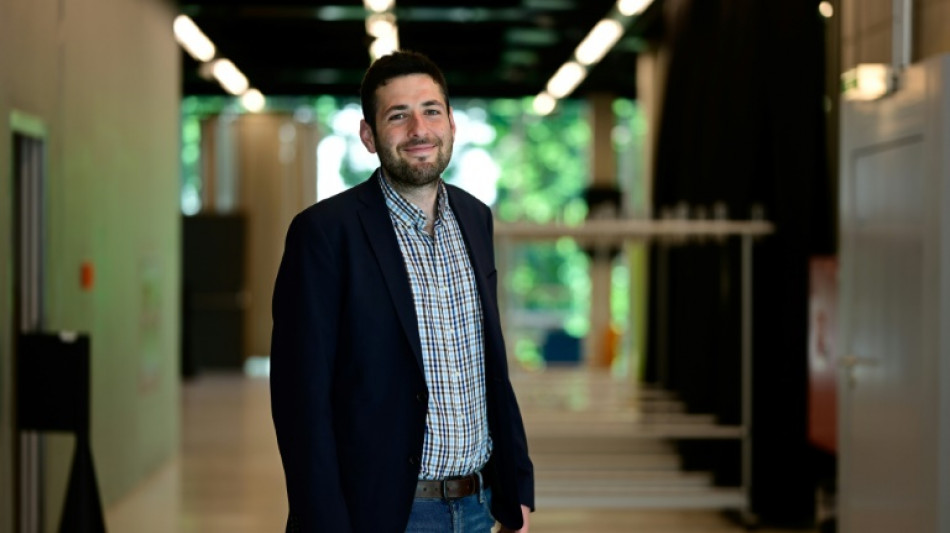
The Syrian refugee who became mayor of a German village / Photo: © AFP

 South African election results renew debate over identity-based voting

 South African voters report smoother local election but declining IEC trust

 Dolly Parton museum and Nashville hotel open after singer’s death

 George and Amal Clooney attend New York political-comedy reading

 British buyers pay substantial premiums for period-home appearance

 Thomas Markle released to house arrest after child-abuse-image charge

 Dawn of War 4 developers chose Adeptus Mechanicus for tactical variety

 Italy face unbeaten South Africa in Turin Nations Championship match

 ChatGPT interactive interface feature tested across six custom tools

 Freshways milk-price cut deepens pressure on UK dairy farms

 Labour and National remain virtually tied as New Zealand vote count advances

 The Good Daughter adapts Karin Slaughter thriller with Rose Byrne and Meghann Fahy

 Heavy-lift drone evacuates wounded Ukrainian soldier from frontline kill zone

 Morrison says West Brom recovered after pressure from successive derby losses

 Britain considers 2027 state visit for Ukraine’s Zelensky

Ryyan Alshebl fled war-torn Syria in 2015, arriving on the Greek island of Lesbos after a harrowing four-hour journey on a rubber boat.
Eight years on, he is the mayor of a German village.
"It was dark and cold and there was not a single light to be seen on Lesbos," he recalls.
"A few hours ago we had been in a normal Mediterranean town in Turkey. The environment had transformed with the cold and dark, and of course the feelings of fear that go with such a journey."
Alshebl, then barely 21, was among a huge wave of refugees who arrived in Europe that year.
After landing in Greece, he made his way through Macedonia, Serbia and Croatia by public transport and on foot, taking 12 days in total to reach Germany.
He eventually ended up at a refugee centre at Althengstett, a rural region near the Black Forest.
"In the shared accommodation, where you cannot expect more than a bed, a roof and some food, for which you are still thankful, you can only do one thing: get back on your feet quickly and invest rapidly in your own future," he said.
Alshebl soon learned to speak German fluently -- "if you are in the countryside you have no other choice" -- and landed a traineeship as an administrative assistant at Althengstett town hall.
He earned German citizenship in 2022, a prerequisite for anyone who wants to stand in local elections in Germany.
- 'Taking responsibility' -
Now 29, he will take up his post as mayor of Ostelsheim, a village near Althengstett, in June.
He is believed to be the first Syrian from the wave of refugees who arrived in Germany in 2015-16 to be elected to a political post.
Alshebl was joined by four friends on his journey to Europe. But he left behind his parents and one brother, though a second brother had already moved to Germany on a student visa.
He said his experience of fleeing Syria and having "to take responsibility not only for (myself) but also for the environment" had given him the drive to go into politics.
"To take on this responsibility at such an age, you learn a lot. Of course, it creates a new person, a new personality," he said.
Alshebl ran as an independent candidate in the election, winning 55.41 percent of the vote.
But he is also a member of the Greens, "because climate protection is very important" to him.
His victory is all the more striking given that Ostelsheim, a village of 2,700 people, is a traditionally conservative community.
Situated among a cluster of hills, the village is surrounded by rolling fields lined with dry stone walls and hedges.
The far-right Alternative for Germany (AfD) party harnessed anger over the influx of asylum seekers in 2015-16 to win votes and ultimately enter parliament for the first time.
- Openness -
But Alshebl said he has not seen right-wing extremism personally.
Alshebl believes he was elected because he listened to the people's concerns -- from childcare to digitalisation issues.
He admits to not really "feeling anything" on hearing he had won the election in March as he was "overwhelmed".
But as congratulations poured in from around the world, it became clear that his story was "bigger than a mayoral election in a small community".
Alshebl believes the fact he triumphed against two other local candidates who grew up in the area says a lot about the mentality of the voters.
"It is a sign that people did not count the origin, but the qualifications. It is a sign of openness to the world," he said.
Alshebl's parents, a schoolteacher and an agricultural engineer, belong to Syria's Druze minority, but he describes himself as not religious.
He has "mixed feelings" about Syria, which he has not been able to visit since living in Germany.
"It is the country where you were born and raised... You long for the people you grew up with," he said.
"But I am happy that I got this chance to live here at all" when others have not, he said.
E.Schubert--BTB