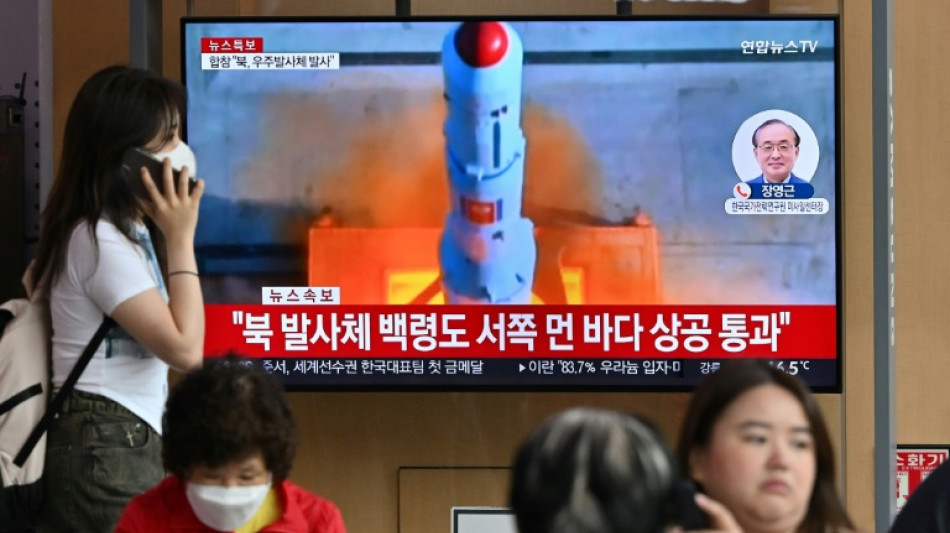
North Korea spy satellite crashes into sea / Photo: © AFP

 AI data centre supplier Zhongji InnoLight slips on Hong Kong debut

 Eurozone economy grows despite Middle East war

 Singapore group will develop 'most promising' Ebola vaccine

 BMW profit down a third as carmaker plans job cuts

 Newcastle boss Eddie Howe leaves club: reports

 Japan quake toll hits 34 as survivors struggle in heat

 Seoul extends losses as most Asian markets drop, oil rises again

 New Zealand top diplomat draws Chinese embassy complaint in racism row

 Eggs back in India school meals after outcry

 Gambling.com Group Is Now Grandstand

 South Korea coach Hong grilled by MPs over World Cup flop

 Nolan's 'Odyssey' boosts sales of mythology tales in UK

 'It's exhausting': southwest Japan deals with second big quake in 10 years

 Russian strikes kill at least 8, wound more across Ukraine

 Samsung quarterly operating profit up 1,800% on AI boom

 Son at the double as MLS All-Stars beat Liga MX 4-3

 Meet the astronomer digging into the Milky Way's 'fossils'

 French teen fined in Singapore 'straw licking' case

 AI data centre supplier Zhongji InnoLight falls on Hong Kong debut

 South Korea's women web sleuths fight AI deepfake porn

 Rushdie assailant convicted of terrorism charges

 Australian regulator says Telegram breached online safety law

 New Zealand foreign minister in racism row with Chinese ambassador

 Anything but programmable: New cost-efficient EC-power-supply-series for the DIN rail by CAMTEC PS

 Japanese population below 120 million for first time in decades

North Korea attempted to launch a military spy satellite on Wednesday that would monitor the United States, but it crashed into the sea with Pyongyang conceding there had been "serious defects".
North Korea does not have a functioning satellite in space and leader Kim Jong Un has made developing a military spy satellite a top priority for his regime, personally overseeing some launch preparations.
North Korean space authorities said they had "launched a military reconnaissance satellite, 'Malligyong-1', mounted on a new-type carrier rocket, 'Chollima-1'," early Wednesday, the official Korean Central News Agency reported.
But the rocket crashed into the sea "after losing thrust due to the abnormal starting of the second-stage engine after the separation of the first stage during the normal flight," it said.
Authorities will "thoroughly investigate the serious defects revealed in the satellite launch," it said, adding a second test would be conducted as soon as possible.
The South Korean military had earlier detected the launch of the purported satellite, which it confirmed had disappeared from radar and fallen into the sea due to "abnormal flight".
It later salvaged a portion of debris, releasing images showing a large barrel-like metal structure with thin pipes and wires at the bottom, which experts said might be a liquid fuel tank.
Seoul, Tokyo and Washington all slammed the launch, which they said violated a raft of UN resolutions barring Pyongyang from any tests using ballistic missile technology.
Seoul's National Security Council said the launch "whether successful or not (was) a grave violation of UN Security Council resolutions and a serious provocation."
Because long-range missiles and rockets used for space launches share the same technology, analysts say developing the ability to put a satellite in orbit would provide Pyongyang with cover for testing banned intercontinental ballistic missiles (ICBMs).
Soon after the launch, Seoul city authorities sent an emergency evacuation alert to residents, prompting widespread consternation and confusion online, before the interior ministry clarified minutes later it had been "incorrectly issued".
- 'Tremendous insight' -
The recovery of the debris would be very useful for South Korea, experts said.
"Technical experts will be able to gain tremendous insight into North Korea’s proficiency with large, multi-stage boosters from the recovered debris," US-based analyst Ankit Panda told AFP.
Prior to Wednesday's launch, Pyongyang had launched five satellites since 1998, three of which failed immediately and two of which appeared to have been put into orbit -- though signals from those launches have never been independently detected, indicating they may have malfunctioned.
North Korea said Tuesday its new spy satellite would be "indispensable to tracking, monitoring... and coping with in advance in real time the dangerous military acts of the US and its vassal forces".
Criticising US-South Korea joint military exercises, including large ongoing live-fire drills, a top North Korean military official said Pyongyang felt "the need to expand reconnaissance and information means and improve various defensive and offensive weapons", state media reported.
In 2012 and 2016, Pyongyang tested ballistic missiles that it called satellite launches. Both flew over Japan's southern Okinawa region.
Japan briefly activated its missile alert warning system for the Okinawa region early Wednesday, lifting it after about 30 minutes.
-'Irreversible' nuclear power-
"Kim stayed true to his word and launched the spy satellite today," Soo Kim, policy practice area lead at LMI Consulting and a former CIA analyst, told AFP.
"We know that Kim's determination does not end with this recent activity," she said, adding that the launch could be a "foreshadowing of greater provocations, including the nuclear test."
Since diplomatic efforts collapsed in 2019, North Korea has doubled down on military development, conducting a string of banned weapons tests, including test-firing multiple ICBMs.
North Korean leader Kim Jong Un last year declared his country an "irreversible" nuclear power and called for an "exponential" increase in weapons production, including tactical nukes.
"Whether or not North Korea's current satellite mission is a success, Pyongyang can be expected to issue political propaganda about its space capabilities," Leif-Eric Easley, a professor at Ewha University in Seoul.
F.Pavlenko--BTB