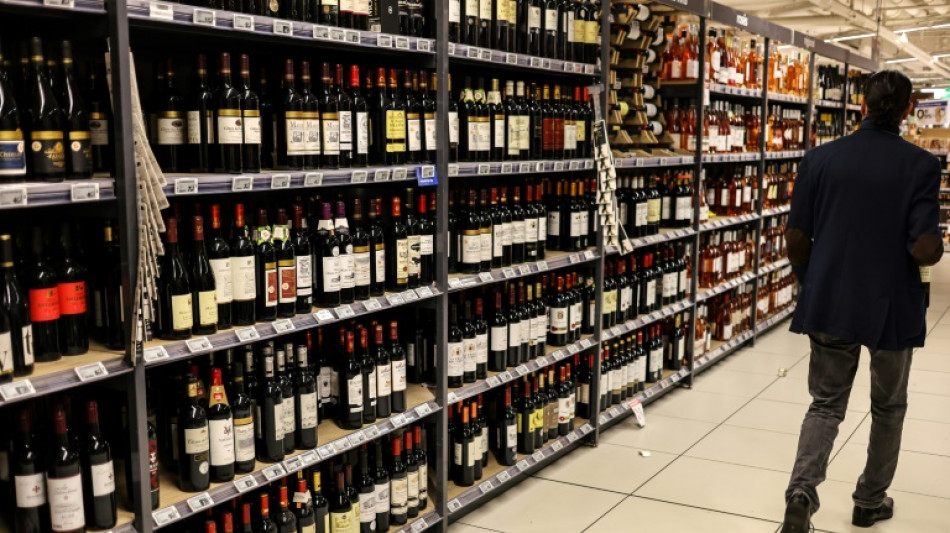
What's in wine? Campaigners want ingredients on the bottle / Photo: © AFP

 AI data centre supplier Zhongji InnoLight slips on Hong Kong debut

 Eurozone economy grows despite Middle East war

 Singapore group will develop 'most promising' Ebola vaccine
 BMW profit down a third as carmaker plans job cuts
 Newcastle boss Eddie Howe leaves club: reports

 Japan quake toll hits 34 as survivors struggle in heat
 Seoul extends losses as most Asian markets drop, oil rises again

 New Zealand top diplomat draws Chinese embassy complaint in racism row
 Eggs back in India school meals after outcry

 Gambling.com Group Is Now Grandstand

 South Korea coach Hong grilled by MPs over World Cup flop
 Nolan's 'Odyssey' boosts sales of mythology tales in UK

 'It's exhausting': southwest Japan deals with second big quake in 10 years

 Russian strikes kill at least 8, wound more across Ukraine

 Samsung quarterly operating profit up 1,800% on AI boom

 Son at the double as MLS All-Stars beat Liga MX 4-3
 Meet the astronomer digging into the Milky Way's 'fossils'

 French teen fined in Singapore 'straw licking' case

 AI data centre supplier Zhongji InnoLight falls on Hong Kong debut

 South Korea's women web sleuths fight AI deepfake porn

 Rushdie assailant convicted of terrorism charges

 Australian regulator says Telegram breached online safety law

 New Zealand foreign minister in racism row with Chinese ambassador

 Anything but programmable: New cost-efficient EC-power-supply-series for the DIN rail by CAMTEC PS

 Japanese population below 120 million for first time in decades

European wines are finally being forced to reveal their ingredients to customers, but only on a website -- not on the bottle. Environmental campaigners are unimpressed.
Wine can contain a wide array of additives to control taste, strength and appearance: sulfur, sugar, egg white, dried fish bladders, enzymes from a pig or cow pancreas, and a range of chemical compounds.
While most of the food and drink sector has been forced to print ingredients and nutritional information on packaging for decades, the alcohol sector has long had a special exemption.
In 2017, the European Commission concluded there was no "objective grounds" for this exception, and new rules -- which come into force on December 8 -- require wines to reveal their contents.
But there is a twist. The wine industry was allowed to come up with their own method of doing so -- and it decided to give vineyards the option of using QR codes that link to a website, thus keeping the ingredients off the bottles.
An activist group, the Transparency for Organic World Association (TOWA), said this is unworkable.
"Can you really imagine getting out your smartphone in the supermarket and scanning several QR codes to compare the additives in wines, and remembering them all to make your choice?" said Olivier Paul-Morandini of TOWA.
The wine industry claims that it cannot be treated like other foodstuffs.
"Wine does not follow a recipe. The grape evolves in function of the sun, of climatic conditions... the ingredients are not the same from one harvest to another," said Ignacio Sanchez Recarte, of the Comite Europeen des Entreprises Vins (CEEV) , which represents the industry in Brussels.
The CEEV said digital labelling is the only realistic way to get all the EU's winemakers onboard (there were 2.2 million in 2020, according to Eurostat). It also means the ingredients are automatically translated into all EU languages.
"The Commission understood the need to provide a level of flexibility that will allow companies to communicate this information in a way that will not disrupt the way we trade," said Recarte.
The CEEV also filed a complaint this month to the European Commission over Irish plans to put health warnings on alcoholic drinks.
- 'List the consequences' -
For TOWA, e-labels show a lack of commitment to the greening of agriculture which the EU claims is a priority.
Organic and natural winemakers say that if a wine needs a QR code rather than a label, it is probably best avoided.
"An organic winemaker who puts very few additional things into their wine can make a label for the bottle, while a conventional winemaker would need a dictionary, so clearly that's why a QR code is necessary," said Julien Guillot, a well-known natural winemaker in Burgundy.
QR codes and e-labels are typical of a system that still greatly benefits conventional farmers using pesticides and chemical fertilisers, who receive the overwhelming majority of the EU Common Agricultural Policy subsidies, according to TOWA.
"We don't need just a list of ingredients. We should have a list of all the consequences of conventional farming and how much they cost," said Paul-Morandini.
"The pollution of soil, water, health and environment all has a price that is paid by consumers and society."
M.Ouellet--BTB