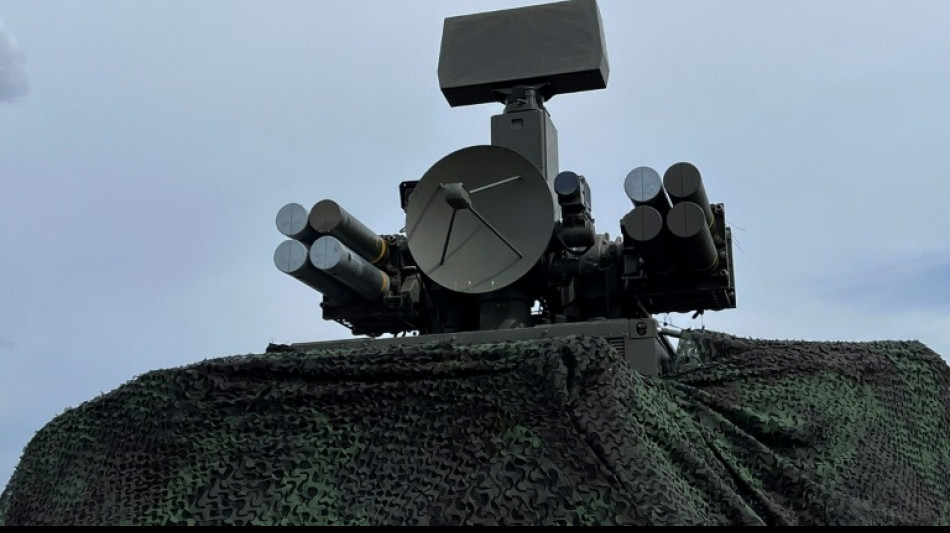
Life and death weigh on Ukraine air defence teams / Photo: © Ukrainian Air Forces, press service of Air Command “Center”/AFP/File

 Atletico complain to FIFA over Barca's Alvarez approach

 MEXC Lists Grvt (GRVT) with $60,000 Worth of GRVT and 10,000 USDT in Airdrop+ Rewards

 Musk plans major Republican midterm spending push: report

 George and Amal Clooney flee French home due to wildfire

 Howe set to leave Newcastle, with Al-Ahli's Jaissle to take over: reports

 Ugandan opposition leader in intensive care: wife

 France firefighters hopeful, as Spain ends national emergency
 Stocks diverge on earnings, as oil steadies

 AI data centre supplier Zhongji InnoLight slips on Hong Kong debut
 Eurozone economy grows despite Middle East war

 Singapore group will develop 'most promising' Ebola vaccine
 BMW profit down a third as carmaker plans job cuts

 Newcastle boss Eddie Howe leaves club: reports
 Japan quake toll hits 34 as survivors struggle in heat
 Seoul extends losses as most Asian markets drop, oil rises again
 New Zealand top diplomat draws Chinese embassy complaint in racism row

 Eggs back in India school meals after outcry

 Gambling.com Group Is Now Grandstand

 South Korea coach Hong grilled by MPs over World Cup flop
 Nolan's 'Odyssey' boosts sales of mythology tales in UK
 'It's exhausting': southwest Japan deals with second big quake in 10 years
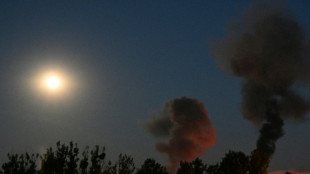 Russian strikes kill at least 8, wound more across Ukraine

 Samsung quarterly operating profit up 1,800% on AI boom

 Son at the double as MLS All-Stars beat Liga MX 4-3

 Meet the astronomer digging into the Milky Way's 'fossils'

The commander of a Kyiv-area air defence team knows what's at stake every time a missile or drone appears on his team's radar: if they miss, people may die.
A potent example came when the team downed a Russian cruise missile and the wreckage revealed it carried an unexploded, nearly half-tonne warhead.
"A lot depends on me and my crew -– to make sure people will sleep peacefully at night," the commander, who uses the call-sign Atlas, told AFP in English.
Air raid sirens and thundering explosions have echoed repeatedly in Kyiv's pre-dawn skies in May, as Russia has stepped up the aerial attacks that have marked its invasion.
But Ukraine's forces, bolstered by Western-provided air defence systems, have recently reported shooting down most of the deadly projectiles.
Atlas, who spoke on condition he be identified only by his call-sign, said the situation is starkly different from a year ago.
He joined the service shortly after Russia's invasion, and said he felt helpless watching on the older machines the military had at that time as missiles and drones streaked toward Ukraine.
"I see just dots on the screen. But later, when they disappeared somewhere, I knew that something (bad) just happened, and most likely, I will read about it in the news," he said.
Things began to change after extremely accelerated training -- one month, instead of four -- on the Crotale air defence system provided by France.
His team shot down its first target, a Shahed explosive drone, in the early hours of January 2, setting off a cheer among them.
"But like immediately we composed ourselves and understood that we need to still be very focused. We can celebrate later," the 37-year-old noted.
- 'Start hunting again' -
He said they have destroyed more than 10 targets since their first shoot-down, but they don't get them all.
"These are very painful moments," he said of misses.
"We saw this target but it went through because something didn't work well."
The barrages keep coming though.
Just on Thursday, Ukraine reported shooting down an entire attack of 36 Shahed drones.
But a day later, a Russian missile struck a medical facility in the central Ukrainian city of Dnipro, killing one person and injuring 23.
"I don't think this is something that normal people should get used to. But this is reality, we live and these people live with that for more than one year already," said Atlas.
Ukraine has also claimed to have downed several Kinzhal (Dagger) missiles –- one of the weapons touted as "invincible" by Russian President Vladimir Putin, as their speed allows them to defy most air defence systems.
Ukraine said it shot down one of the Russian missiles for the first time in early May, using a powerful US Patriot anti-aircraft system delivered to Kyiv in April.
But even downing the missiles does not extinguish their deadly risk –- the debris and warheads can still cause serious destruction when they plummet to the ground.
Atlas said his team tries to predict where the wreckage will fall when they prepare to fire upon a target.
"Sometimes we let it get closer to us, so that we will be sure that debris will not fall on villages or something like that. That may happen and it's very dangerous," he added.
They also face an enemy that adapts to what the Ukrainian forces are doing.
If, for example, Atlas's team shoots down an incoming missile, what he called a "period of quiet" sometimes follows.
"We understand that they know we are there and we have to change position in order to start hunting them again," he said.
J.Horn--BTB