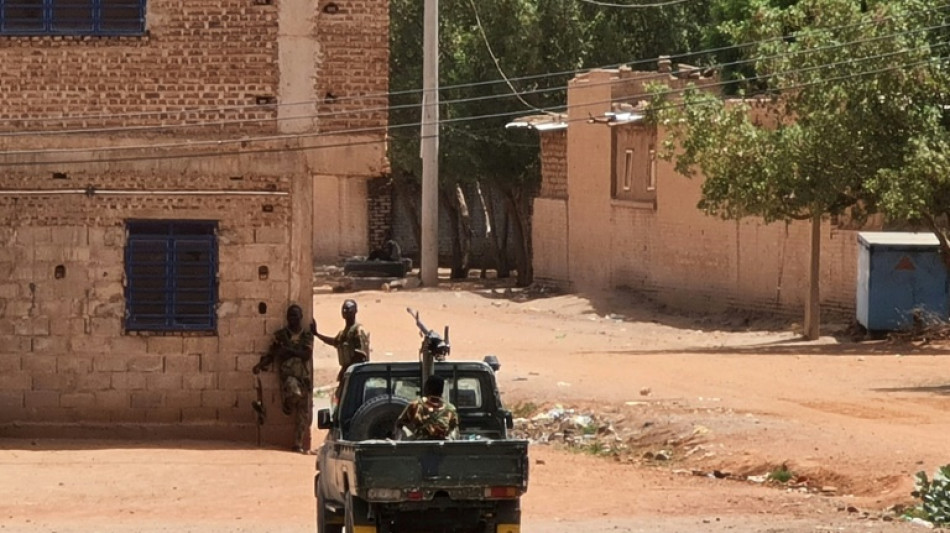
Fighting rages in Darfur as Sudan mediators claim progress / Photo: © AFP

 South African election results renew debate over identity-based voting

 South African voters report smoother local election but declining IEC trust

 Dolly Parton museum and Nashville hotel open after singer’s death

 George and Amal Clooney attend New York political-comedy reading

 British buyers pay substantial premiums for period-home appearance

 Thomas Markle released to house arrest after child-abuse-image charge

 Dawn of War 4 developers chose Adeptus Mechanicus for tactical variety

 Italy face unbeaten South Africa in Turin Nations Championship match

 ChatGPT interactive interface feature tested across six custom tools

 Freshways milk-price cut deepens pressure on UK dairy farms

 Labour and National remain virtually tied as New Zealand vote count advances

 The Good Daughter adapts Karin Slaughter thriller with Rose Byrne and Meghann Fahy

 Heavy-lift drone evacuates wounded Ukrainian soldier from frontline kill zone

 Morrison says West Brom recovered after pressure from successive derby losses

 Britain considers 2027 state visit for Ukraine’s Zelensky

Fierce fighting between rival Sudanese forces rocked on Friday the western region of Darfur, witnesses said, as US and Saudi observers noted "improved respect" for a fragile ceasefire now in its fourth day.
Within minutes of the ceasefire taking effect late Monday -- after weeks of war that has claimed 1,800 lives and displaced more than one million people -- witnesses in the capital Khartoum reported air strikes and gunshots.
The one-week truce is the latest in a series of agreements that have all been systematically violated, with the army and the paramilitary Rapid Support Forces (RSF) accusing each other of more violations this week.
The United States and Saudi Arabia, which had brokered the latest deal, reported "serious violations" since it took effect, particularly on Wednesday.
Washington has threatened sanctions for breaches detected by its "monitoring mechanism", but has not yet targeted either side.
The conflict, which erupted on April 15, pits Sudan's de facto leader General Abdel Fattah al-Burhan against his former deputy, RSF commander Mohamed Hamdan Daglo.
Burhan and Daglo had in 2021 staged a coup that unseated a civilian transitional government but later fell out in a bitter power struggle.
- Medical supplies -
In a joint statement Friday, the mediators "noted improved respect for the agreement" and said they had "cautioned the parties against further violations and implored them to improve respect for the ceasefire on (Thursday), which they did".
There was nevertheless "isolated gunfire in Khartoum", the US-Saudi statement said.
Increasingly desperate civilians have been waiting for brief lulls in fighting to flee or for assistance to flow through as battles have left the capital -- a city of five million -- with intermittent supply of food, water and electricity.
The International Committee of the Red Cross (ICRC) announced Thursday they had finally been able to begin distributing aid to "seven hospitals in Khartoum".
The supplies include "anaesthesia and antibiotics among other medications, dressings, sutures and infusions that can treat hundreds of people severely wounded by weapons", the ICRC said.
An already strained healthcare system has been decimated by the war, with the vast majority of hospitals out of service in Khartoum and in Darfur, which together have seen the worst of the fighting.
The few hospitals that have not been bombed, attacked or occupied by fighters have almost entirely run out of supplies or food.
Conditions are particularly dire in Darfur, on the western border with Chad, a region already ravaged by a brutal two-decade war that erupted in 2003 and saw then president Omar al-Bashir unleash the feared Janjaweed militia to crush a rebellion among ethnic minority groups.
The RSF traces its origins to the Janjaweed.
In El Fasher, capital of North Darfur state, residents reported "battles with all types of weapons" on Friday.
- 'Life and death' -
The fighting across Sudan has killed more than 1,800 people, according to the Armed Conflict Location and Event Data Project.
The United Nations says more than a million people have been displaced within Sudan, in addition to 300,000 who have fled to neighbouring countries.
Even before the conflict began, one-third of Sudan's 45 million people relied on aid to survive.
Now, more than half the population -- 25 million people -- are in need of humanitarian assistance, the UN said.
Halfway through the current truce, civilians eager to flee the violence were still waiting for the humanitarian corridors they had been promised to materialise, forced to ration what little supplies remain.
While soldiers and paramilitaries trade blows and accusations, getting supplies through to civilians "is a matter of life and death", said Alfonso Verdu Perez, head of the ICRC delegation in Sudan.
"Only 20 percent of health facilities in Khartoum are still functioning -- a true collapse of the system right when it's needed the most," he warned.
"Hospitals also urgently need water, electricity and a safe environment for their patients and staff," Perez said, with medical personnel reporting intimidation, threats and attacks by both sides.
S.Keller--BTB