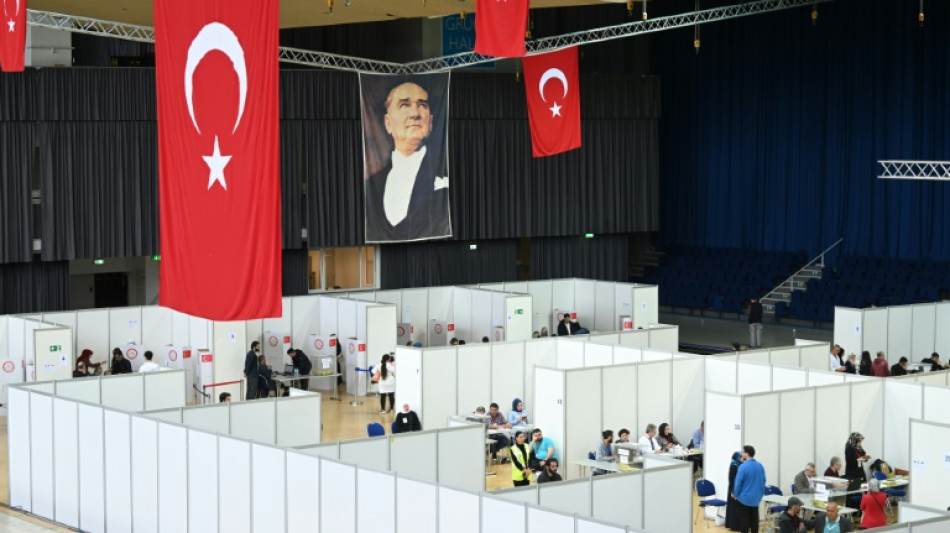
Erdogan backers bullish in his German stronghold / Photo: © AFP

 South African election results renew debate over identity-based voting

 South African voters report smoother local election but declining IEC trust

 Dolly Parton museum and Nashville hotel open after singer’s death

 George and Amal Clooney attend New York political-comedy reading

 British buyers pay substantial premiums for period-home appearance

 Thomas Markle released to house arrest after child-abuse-image charge

 Dawn of War 4 developers chose Adeptus Mechanicus for tactical variety

 Italy face unbeaten South Africa in Turin Nations Championship match

 ChatGPT interactive interface feature tested across six custom tools

 Freshways milk-price cut deepens pressure on UK dairy farms

 Labour and National remain virtually tied as New Zealand vote count advances

 The Good Daughter adapts Karin Slaughter thriller with Rose Byrne and Meghann Fahy

 Heavy-lift drone evacuates wounded Ukrainian soldier from frontline kill zone

 Morrison says West Brom recovered after pressure from successive derby losses

 Britain considers 2027 state visit for Ukraine’s Zelensky

"I voted for Erdogan because he deserves to be re-elected," says Esra Kose, 45, who like the majority of Turkish voters in Germany backs the incumbent president.
Kose, who has lived for nearly two decades in Europe's top economy and wears a Muslim headscarf, cast her ballot for Turkey's ruling AKP party in Essen, in the western industrial region of the Ruhr.
It is the Turkish leader's biggest stronghold in Germany, where the second round of voting began Saturday and lasts until late Tuesday, five days before the run-off election in Turkey.
In the first round in early May, Recep Tayyip Erdogan won more than 75 percent of the vote in Essen, around 10 points above the average of 65 percent in Germany, which has the largest Turkish community abroad with its 1.5 million voters.
"I voted for Erdogan because with him, the country is going in the right direction," said Nevin Toy-Unkel, another voter in Essen.
The 53-year-old AKP supporter grew up in Germany and like many second and third generation Turks in the Ruhr, she is the child of a miner.
The Turkish immigrants in the 1960s known as guest workers "were poorly qualified people, often from rural areas and more conservative than the bourgeoisie in the cities," Yunus Ulusoy, from the Centre for Turkish Studies at the University of Duisburg-Essen, told AFP.
- Attachment to religion -
"And they passed on their values and their attachment to religion to their children," Ulusoy added.
Around the neck of Toy-Unkel, an interior designer based in Marl near Essen, hangs a necklace with the crescent and star of the Turkish flag.
Her father was originally from Konya in central Turkey, another Erdogan stronghold.
In front of the Grugahalle arena in Essen, transformed for the occasion into a gigantic polling station, Turkish flags flap under a radiant sun.
Some voters have donned t-shirts in the national colours and are making the pro-Erdogan four-finger salute.
Music composed in honour of Erdogan wafts through the air -- a show of support "which is normally forbidden near polling stations," Inci Oyku Yener-Roderburg, a researcher at the University of Dortmund, told AFP.
"During the first round, we saw Erdogan's supporters attempt to intimidate those of the opposition parties," said the Turkish political scientist who has observed the elections in Essen as a researcher.
Five people are monitoring the voting here: "two civil servants -- often imams of the Ditib mosques, which are linked to the Turkish state" along with one AKP member, another from the MHP, a formation supporting Erdogan, "and only one member of the opposition party", the CHP.
"As a result, there is a lot of psychological pressure on the latter," she said.
- Free buses -
"Opposition supporters were insulted occasionally or pushed aside in the first round," she said.
Moreover, Erdogan's voters are much better organised in Germany than the opposition.
"Every Friday, during prayers at the mosque, a lot of propaganda can be spread," says Cemalettin Ozer, 52, a resident of Bielefeld near Essen who actively supports the CHP.
Ozer said the AKP backers "receive money from the Turkish state so that they can take voters to the polling stations for free by bus".
"We do everything as volunteers and try with our own cars to drive people to the polls, sometimes 70 kilometres (40 miles) from their homes," he said.
In addition, "many supporters of the Social Democrats (CHP) in Germany have given up their Turkish citizenship" to become German, he noted, meaning they cannot vote.
In Germany, it is difficult to be a dual national although the current centre-left-led government is moving to change this.
Meanwhile "AKP supporters have kept their Turkish passports. Erdogan's party therefore has a larger potential voter base" than the opposition parties, Ozer said.
Despite Erdogan's lead in the first round, the opposition's mobilisation has grown.
"Many people, especially young people who had not voted, have come out for the second round," Ozer insisted.
Accompanied by her mother Esra Kose, who still speaks little German after 19 years in Essen, 18-year-old Feyza Kose cast her ballot on Monday.
Wearing Western clothes and preparing to study physics and mathematics, Feyza said her vote also went to Erdogan.
"He's made the right decisions for the country," she said.
S.Keller--BTB