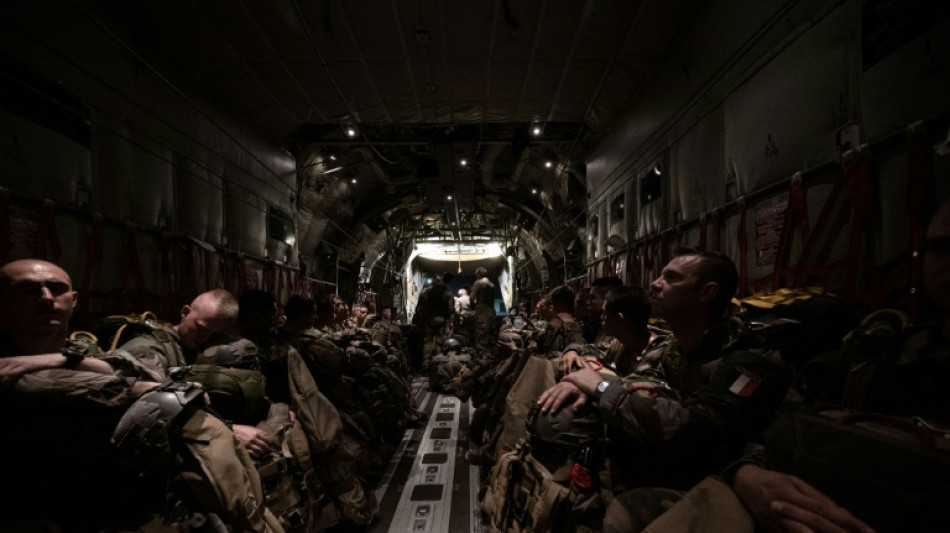
In Niger, France tests out new strategy for Africa operation / Photo: © AFP

 South African election results renew debate over identity-based voting

 South African voters report smoother local election but declining IEC trust

 Dolly Parton museum and Nashville hotel open after singer’s death

 George and Amal Clooney attend New York political-comedy reading

 British buyers pay substantial premiums for period-home appearance

 Thomas Markle released to house arrest after child-abuse-image charge

 Dawn of War 4 developers chose Adeptus Mechanicus for tactical variety

 Italy face unbeaten South Africa in Turin Nations Championship match

 ChatGPT interactive interface feature tested across six custom tools

 Freshways milk-price cut deepens pressure on UK dairy farms

 Labour and National remain virtually tied as New Zealand vote count advances

 The Good Daughter adapts Karin Slaughter thriller with Rose Byrne and Meghann Fahy

 Heavy-lift drone evacuates wounded Ukrainian soldier from frontline kill zone

 Morrison says West Brom recovered after pressure from successive derby losses

 Britain considers 2027 state visit for Ukraine’s Zelensky

It's not yet dawn but dozens of troops from Niger and France's legendary Foreign Legion are boarding a French C-130 military transport plane, each weighed down with gear.
In the green-lit hold, their faces are locked in concentration as the aircraft takes off over the arid Sahel. A few soldiers manage to doze off, their heads resting on their bags or their heavy helmets.
Their mission: to make a parachute jump to take an abandoned military position in Niger not far from the Malian border -- an area where the ruthless Islamic State in the Greater Sahara (IS-GS) is resurgent.
The joint operation is symbolic of the new approach President Emmanuel Macron wants to use for France's mission in West Africa's deeply troubled Sahel.
After nearly a decade, its troops were forced to pull out of Mali -- still fighting an Islamist insurgency -- following a military coup.
The junta then, according to Western governments, called on Russia's Wagner mercenary group for help.
France's exit from Mali has encouraged the jihadists to regain freedom of movement in the border region -- and the parachute operation is aimed at keeping them at bay.
After an hour's flight, the crew announces the countdown for the drop over the Liptako region.
The alarm rings. The aircraft's side doors open. Time to jump.
"Don't stop!" shouts an officer as the paratroopers hurl themselves into the night at a frantic pace, filling the sky with mushrooms of beige silk.
In just one minute, dozens of soldiers have jumped over the sandy expanses of southwestern Niger. The plane, abruptly emptied of its passengers, turns around, heading back to its base near the capital Niamey.
On the ground, the soldiers are about to get to work.
- 'Laboratory' -
The cooperation with Niger is part of a strategy which Paris hopes will show the key lesson from Mali: support local forces by providing the equipment and expertise they need, but don't substitute for them.
"In Niger and everywhere in Africa, the idea is now different from what was done in Mali. Today our help starts with what the partner needs," said the commander of the French forces in the Sahel, General Bruno Baratz.
The pullout last year from Mali brought the curtain down on the long-running Barkhane operation against Islamist militants in the francophone ex-colonial region -- a hugely problematic deployment that left over 50 French troops dead.
Neighbouring Burkina Faso, also led by a junta, this year also pushed out French forces from its territory, a prelude to what the West fears will also be a pivot to Wagner.
It was against this increasingly difficult background that Macron ordered lower-profile operations more specifically tailored to the needs of partner countries.
The new strategy is upheld to the letter in Niger, which has accepted 1,500 French soldiers on its soil to bolster its armies at a time when IS-GS is once again a threat.
Ahead of the jump over Liptako, a commander with the Foreign Legion's 2nd Paratroop Regiment told the assembled troops that the mission would be "hard."
"There's heat, there's the environment, and we don't know where the enemy is. We are counting on you to help us," he said to the Nigerien troops.
"I believe the French army is trying to use Niger as a laboratory for new relationships" in Sahel, and "be a supporter rather than a leader" said Michael Shurkin, director of global programmes at risk management firm 14N Strategies.
"France is convinced it needs to be as discreet as possible," he said.
"France was fighting its own war in parallel to what Malians were doing. Now France is trying to do things differently."
- Niger strategy -
A French military officer, who asked not to be named, said the new strategy still meant a "de-Barkhane-isation" of attitudes in the French armed forces, who grew used to tracking militants in the desert in much more autonomous conditions.
But Niger seems satisfied.
"Today the commanders are from Niger and they master the terrain and the needs. We can only congratulate ourselves. The French bring us the military training, equipment, intelligence and air resources that we lack," Niger's former defence minister Kalla Moutari told AFP.
In Mali, Barkhane notched up undeniable tactical victories against the jihadists.
But the country's political authorities never managed to re-establish control in areas purged of militants. And the Malian army remained fragile, despite years-long efforts to strengthen it.
Cooperation with Niamey, however, is smoother.
"Niger has a particularly effective counter-insurgency strategy," combining population security and the return to the state to disputed areas, Baratz said.
K.Thomson--BTB