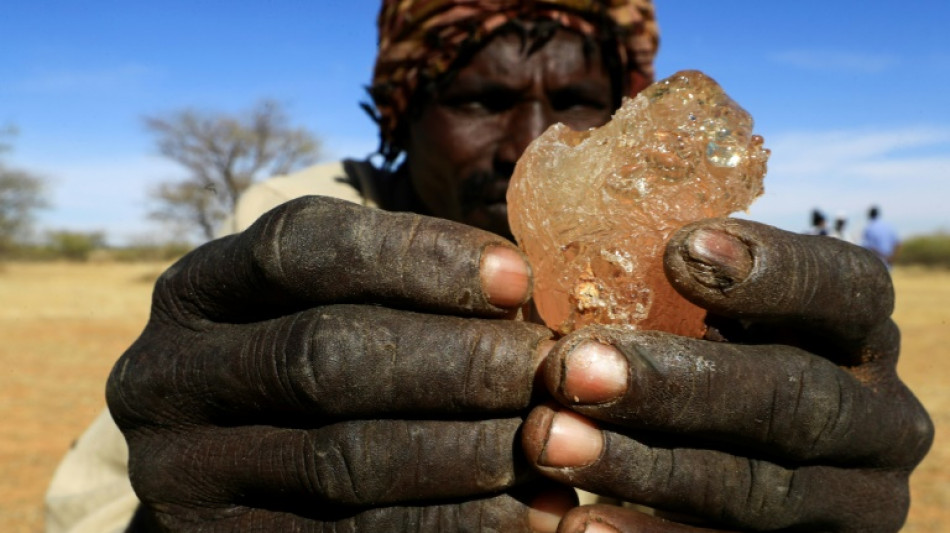
Sudan war hits crucial gum arabic business / Photo: © /File

 French minister defends expulsion order against Russian commentator

 Milei demands expulsion of foreigners expressing 'hate' against Argentina

 UK's highest court to hear Palestine Action's appeal against ban
 Hundreds of migrants swim to Spain's Ceuta territory from Morocco

 'Beginning of the end': Relief but no party as French wildfire winds down

 UEFA says will boycott World Cup over FIFA proposals
 Rashford says final goodbye to Barcelona ahead of Man Utd return

 History-chasing Ryu sets pace at women's British Open
 Italy's Po River valley on drought alert
 France, Spain eye wildfire reprieve as other blazes start up in Europe
 Mammoth bones found on parched bed of Danube in Bulgaria
 Atletico complain to FIFA over Barca's Alvarez approach

 MEXC Lists Grvt (GRVT) with $60,000 Worth of GRVT and 10,000 USDT in Airdrop+ Rewards

 Musk plans major Republican midterm spending push: report
 George and Amal Clooney flee French home due to wildfire

 Howe set to leave Newcastle, with Al-Ahli's Jaissle to take over: reports

 Ugandan opposition leader in intensive care: wife

 France firefighters hopeful, as Spain ends national emergency
 Stocks diverge on earnings, as oil steadies

 AI data centre supplier Zhongji InnoLight slips on Hong Kong debut

 Eurozone economy grows despite Middle East war

 Singapore group will develop 'most promising' Ebola vaccine
 BMW profit down a third as carmaker plans job cuts

 Newcastle boss Eddie Howe leaves club: reports
 Japan quake toll hits 34 as survivors struggle in heat
Sudan's war has left farmers of gum arabic, a vital ingredient for global industry including fizzy drinks, bereft of local buyers but a trade group assures global stocks are -- for now -- sufficient.
The golden blobs of resin tapped from thorny acacia trees are an emulsifying agent used in everything from soft drinks to chewing gum and pharmaceuticals.
Sudan is the world's largest producer of the raw gum which is a major source of foreign currency for the northeast African nation.
The sector has survived repeated conflicts, a warming climate and decades of sanctions.
But now, since war between two generals began on April 15, "producers are grappling with disaster," Adam Issa Mohammed, a gum arabic trader, told AFP in El Obeid, the North Kordofan state capital 350 kilometres (220 miles) southwest of Khartoum.
The city is one of the main local markets for Sudanese gum arabic growers.
Other farming sectors are also coping with a wartime lack of buyers as fuel shortages hinder transport to market, and prices soar.
However, given its importance to Sudan's economy, and the five million Sudanese which the industry supported, the war's impact on gum arabic is particularly significant.
- 'No one is buying' -
Battles between army chief General Abdel Fattah al-Burhan and his deputy-turned-rival General Mohamed Hamdan Daglo have killed around 1,000 people, uprooted more than a million from their homes, and further devastated an already-crippled economy.
The bulk of the conflict has been in the capital Khartoum, parts of which have been reduced to smouldering rubble, as well as the western region of Darfur.
Witnesses have also reported fighting in El Obeid.
Further east, closer to the Ethiopian border, the Gedaref area and its acacia trees have been spared the fighting but gum arabic farmers are still affected.
"We have large quantities we need to sell, but no one is buying because exporters and distributors can't find any transport companies willing to risk their trucks," according to the trader, Adam Issa Mohammed.
A gum arabic producer, Ahmed Mohammed Hussein, said the absence of buyers has led to a price collapse of around 60 percent.
"The price of a tonne has gone down from 320,000 Sudanese pounds to 119,000 ($627 to $233)," Hussein told AFP.
The risk is clear: everything including customs and cargo processing has to go through the war zone of Khartoum.
Truckers who venture onto the road not only risk their lives but spend much of their time scrambling for petrol. Even if they find it, the price per litre is now 20 times what it was before the war.
At the ports, however, it is business as usual, according to Sudan's port authority, which told AFP "imports and exports are operating normally."
But Othman Abdelsalam, an employee of a shipping company in Sudan who has viewed the data, said numbers are down.
He told AFP "exports from Darfur and Kordofan via Khartoum -- particularly gum arabic -– have suffered a strong impact" since the war started.
Sudan's gum arabic belt extends from Gedaref, through Kordofan, across the country to Darfur in the west.
According to the Hamburg-based Association for International Promotion of Gums, which brings together importers, processors and producers, there is no current supply threat to industry users of gum arabic.
"Member companies keep sufficient stocks of gum arabic imported from Sudan and other countries in their warehouses, so that possible interruptions in supply... can be absorbed," it said in a statement.
The group added that Chad and Nigeria are among alternate producers, so "immediate supply bottlenecks are not to be expected because of the current events in Sudan."
Industry players within Sudan or elsewhere could not, however, say how long global stocks can last.
- Global importance -
Sudanese exports accounted for 70 percent of global raw gum supplies, according to pre-war data from AFD, the French agency for development.
Gum arabic exports from Sudan totalled 88,000 tonnes in 2021, earning $110 million, according to central bank figures, the latest official data available.
Mostafa al-Sayyed Khalil, who heads the Gum Arabic Council of Sudan, said his figures show export of 60,000 tonnes in 2022, which he considers an underestimate.
Khalil was not able to project the war's impact.
Even before the conflict, low prices in local markets pushed many farmers to cut down their trees for building materials or firewood. Others left their lands entirely to work in nearby gold mines.
Aly Verjee, a researcher at Sweden's University of Gothenburg, said fighting across Sudan has affected other sectors, leading to the country's "partial deindustrialisation" and a much poorer future.
That leaves gum arabic increasingly crucial.
"If we lose the gum Arabic belt, we'll drown," Khalil warned.
M.Ouellet--BTB