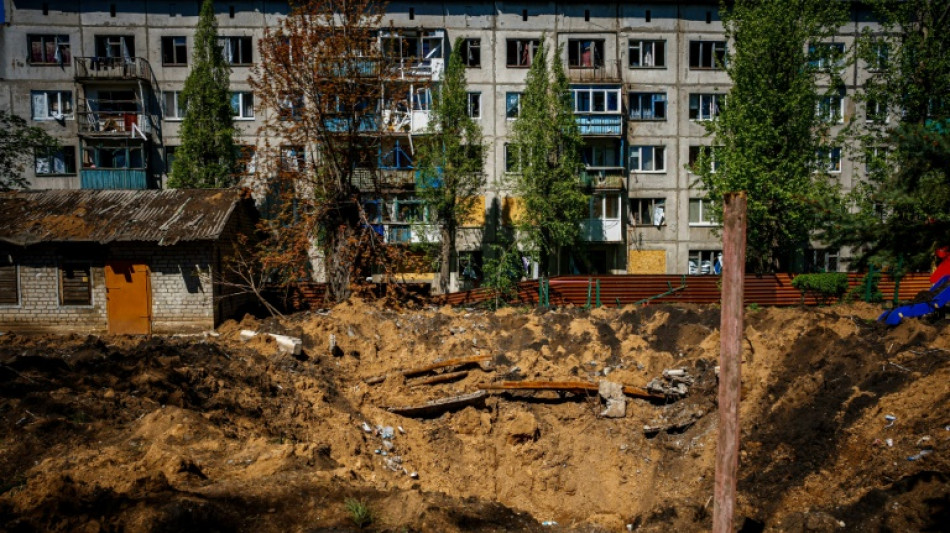
Bakhmut: From 'city of wine and roses' to 'hell on Earth' / Photo: © AFP

 South African election results renew debate over identity-based voting

 South African voters report smoother local election but declining IEC trust

 Dolly Parton museum and Nashville hotel open after singer’s death

 George and Amal Clooney attend New York political-comedy reading

 British buyers pay substantial premiums for period-home appearance

 Thomas Markle released to house arrest after child-abuse-image charge

 Dawn of War 4 developers chose Adeptus Mechanicus for tactical variety

 Italy face unbeaten South Africa in Turin Nations Championship match

 ChatGPT interactive interface feature tested across six custom tools

 Freshways milk-price cut deepens pressure on UK dairy farms

 Labour and National remain virtually tied as New Zealand vote count advances

 The Good Daughter adapts Karin Slaughter thriller with Rose Byrne and Meghann Fahy

 Heavy-lift drone evacuates wounded Ukrainian soldier from frontline kill zone

 Morrison says West Brom recovered after pressure from successive derby losses

 Britain considers 2027 state visit for Ukraine’s Zelensky

The city of Bakhmut, whose capture was claimed by Russia on Saturday and denied by Ukrainian President Volodymyr Zelensky on Sunday, had a population of around 72,000 people before the war.
The city is crossed by the Bakhmutka River in Donetsk region -- one of four Ukrainian regions Russia claimed to have annexed last year without fully controlling them months into its invasion.
Located at the bottom of a valley, the city is particularly difficult to defend from attack.
Once an important rail hub in an area best known for salt mining, the industrial city has been the epicentre of the fighting in eastern Ukraine since last summer that has left much of it in ruins.
The Ukrainian soldiers defending it have defined the battle as "hell on Earth" or referred to it as a new "Verdun" -- the longest battle of World War I.
It was near Bakhmut that AFP video journalist Arman Soldin was killed by rocket fire on May 9 while reporting.
In March, local officials estimated the remaining civilian population at just 3,000 people.
It is thought few if any remain there now.
- 'Road of Life' -
The city is also known for its famous sparkling wine -- whose production has now moved to the Odesa region.
It was called Artemovsk between 1924 and 2016 -- a homage to a Soviet revolutionary nicknamed "Artem".
It was once known as the "city of wine and roses".
A city street nicknamed "Rose Alley" broke a Ukrainian record for having 5,000 roses along it.
For months, just a single road has linked Ukrainian units holding out in the western part of the city with the rest of their forces.
Strewn with burnt-out vehicles, it was has been nicknamed by soldiers the "Road of Life".
When the conflict between Kyiv and Moscow-backed separatists first started in 2014, pro-Russian fighters tried to take over Bakhmut but were pushed back by Ukraine's military in July of that year.
While some experts have questioned the strategic importance of Bakhmut, Zelensky said in March that its capture could leave an "open road" for Russian troops to attack the cities of Sloviansk and Kramatorsk.
When AFP journalists visited the city last month, they found artillery-scarred buildings whose courtyards were littered with twisted metal from bombed playgrounds, glass shards and makeshift crosses over graves of hastily buried civilians.
Some civilians -- often elderly ones -- have refused to leave even though they have been living in basements without water or electricity.
M.Ouellet--BTB