Zelensky huddles with G7 as Ukraine wins access to F-16s

 South African election results renew debate over identity-based voting

 South African voters report smoother local election but declining IEC trust

 Dolly Parton museum and Nashville hotel open after singer’s death

 George and Amal Clooney attend New York political-comedy reading

 British buyers pay substantial premiums for period-home appearance

 Thomas Markle released to house arrest after child-abuse-image charge

 Dawn of War 4 developers chose Adeptus Mechanicus for tactical variety

 Italy face unbeaten South Africa in Turin Nations Championship match

 ChatGPT interactive interface feature tested across six custom tools

 Freshways milk-price cut deepens pressure on UK dairy farms

 Labour and National remain virtually tied as New Zealand vote count advances

 The Good Daughter adapts Karin Slaughter thriller with Rose Byrne and Meghann Fahy

 Heavy-lift drone evacuates wounded Ukrainian soldier from frontline kill zone

 Morrison says West Brom recovered after pressure from successive derby losses

 Britain considers 2027 state visit for Ukraine’s Zelensky

 Arizona Democrats Secure Historic Trifecta with New Legislative Leadership

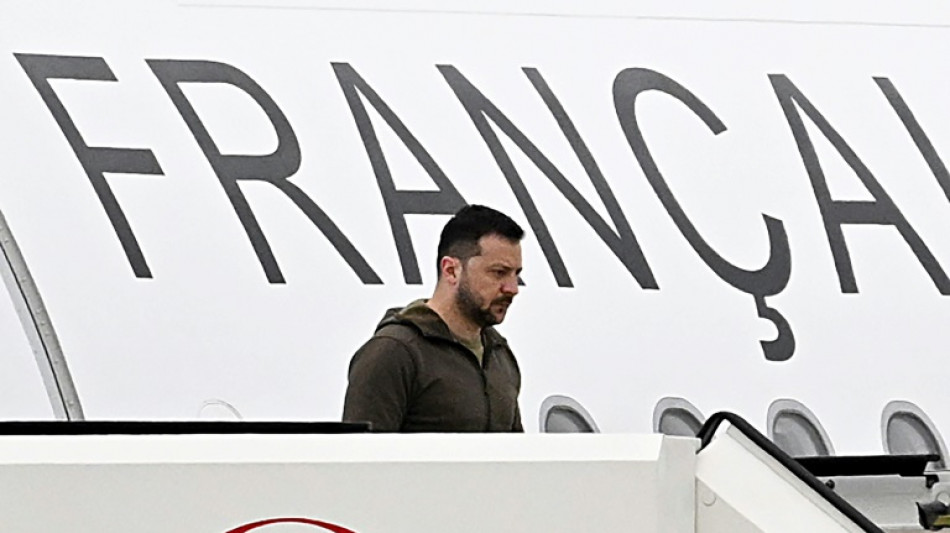
President Volodymyr Zelensky made a landmark visit to Hiroshima for talks with G7 leaders Saturday, after securing long-sought access to advanced US fighter jets for Ukraine's war effort.
Zelensky's surprise summit appearance -- he had been expected to appear by video call -- is his furthest foray from Kyiv since Russia's invasion began 15 months ago.
He arrived significantly buoyed by what he called a "historic" White House decision to allow Ukraine access to F-16 jets, among the most sophisticated materiel yet supplied by the West.
The group of seven rich democracies were huddled in Japan to discuss issues including the need for "constructive and stable" relations with China, which the bloc accused Saturday of "economic coercion".
But it was Zelensky's arrival, and debate about the future of the war in Ukraine, that has dominated the summit.
On landing, Zelensky said the summit would bring "increased cooperation for our victory", and he declared that "today, peace will be closer".
After a bloody winter of fighting that saw Russian gains in the eastern city of Bakhmut, Ukraine's forces have regrouped for a counteroffensive but they remain dependent on the flow of Western weaponry.
Military experts say the aircraft would be a significant upgrade from Ukraine's ageing Soviet-era fleet, offering greater ability to eventually strike targets in the air or on the ground.
They are also a potent symbol of Western support for Ukraine, forestalling any talk of waning interest as the conflict grinds on.
Mick Ryan, a strategist and retired Australian major general, called the decision "very significant".
"F-16s have the sensors and weapon systems that are either equal to, or overmatch, Russian fighters," he told AFP, saying the jets would make life "more difficult" for Russian missile-launching aircraft operating in and around Ukraine.
- 'Deter and defend' -
Until now, US President Joe Biden had effectively vetoed the transfer of US-made F-16s, with officials citing long pilot training times and the risk of escalating the conflict with Russia.
US National Security Advisor Jake Sullivan insisted there had been no about-turn in US policy, and the decision was based on the "exigencies of the conflict".
"We've reached a moment where it's time to look down the road and to say, 'What is Ukraine going to need... to be able to deter and defend against Russian aggression?'"
He added that Ukraine had committed to not using US military equipment to hit targets inside Russia.
"We are going to do everything we can to support Ukraine in its defence of its sovereignty and territorial integrity, and we are also going to proceed in a way that avoids World War III," he said.
With the US veto lifted, Prime Minister Rishi Sunak quickly announced that Britain would "work together with the USA and the Netherlands, Belgium and Denmark to get Ukraine the combat air capability it needs".
Zelensky's trip offers a chance to confer with allies, but perhaps more importantly to woo key unaligned powers also joining the summit, including India and Brazil.
Photos posted online by Prime Minister Narendra Modi's staff showed the pair shaking hands and holding their first meeting since the invasion, which India has declined to condemn.
"There is an opportunity for Zelensky to engage with these non-Western actors, to try to bolster support, or at least weaken what may be seen as ambivalence towards the conflict," Ian Lesser, vice president of the German Marshall Fund think-tank, told AFP.
"And they do matter. They matter especially in terms of sanctions, of course," he added.
Zelensky also met separately with the Italian and British prime ministers, and talks with the French and US presidents are expected.
- 'Militarisation' -
Ahead of Zelensky's arrival, G7 leaders issued a joint statement Saturday denouncing efforts to "weaponise" trade and supply chains, saying they would "fail and face consequences" -- a thinly veiled warning to China.
The bloc said it would also address vulnerabilities in supply chains for "critical goods" like minerals, semiconductors and batteries.
"What we have done over 20 years with China, encouraging development, was right, but maybe we should have been more careful on critical material, supply chains and those elements," an EU official said.
The grouping also warned China against its "militarisation" in the South China Sea and urged Beijing to press Russia to end its invasion of Ukraine.
The bloc insisted however it still seeks "constructive and stable relations" with China.
J.Bergmann--BTB