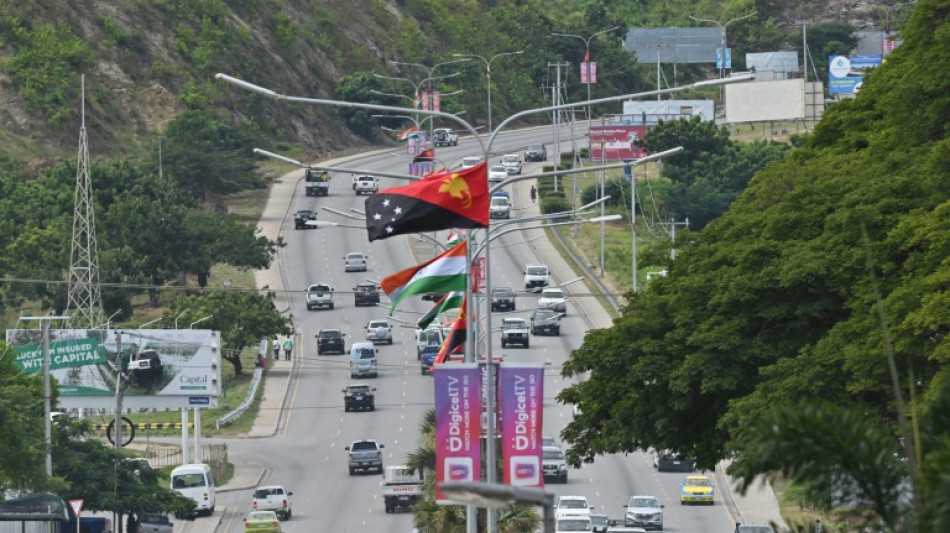
'Friends to all': US-China influence race a boon for Pacific islands / Photo: © AFP

 South African election results renew debate over identity-based voting

 South African voters report smoother local election but declining IEC trust

 Dolly Parton museum and Nashville hotel open after singer’s death

 George and Amal Clooney attend New York political-comedy reading

 British buyers pay substantial premiums for period-home appearance

 Thomas Markle released to house arrest after child-abuse-image charge

 Dawn of War 4 developers chose Adeptus Mechanicus for tactical variety

 Italy face unbeaten South Africa in Turin Nations Championship match

 ChatGPT interactive interface feature tested across six custom tools

 Freshways milk-price cut deepens pressure on UK dairy farms

 Labour and National remain virtually tied as New Zealand vote count advances

 The Good Daughter adapts Karin Slaughter thriller with Rose Byrne and Meghann Fahy

 Heavy-lift drone evacuates wounded Ukrainian soldier from frontline kill zone

 Morrison says West Brom recovered after pressure from successive derby losses

 Britain considers 2027 state visit for Ukraine’s Zelensky

 Arizona Democrats Secure Historic Trifecta with New Legislative Leadership

When the US secretary of state travels through Papua New Guinea's capital next week to meet the leader of the South Pacific nation, it will be on a six-lane highway built by China.
Antony Blinken will be dispatched to meet Pacific leaders at a summit Monday in the place of President Joe Biden, who had planned a historic visit spurred by Beijing's growing regional clout.
On a brief stop in Port Moresby, the top US diplomat will pass sites including a Chinese-built national courthouse, bus stops with Mandarin signs, and even Chinese supermarkets.
That's on top of the billboards of Indian Prime Minister Narendra Modi, who will be in town for his own summit.
The rivalry between the United States and China has brought them to loggerheads in the Pacific -- and their jostle for influence has been a boon for islands like resource-rich and strategically located Papua New Guinea.
"Modi and Biden... even a year ago, you would have thought no way," a Western diplomat in Port Moresby told AFP on condition of anonymity.
"They are everyone's best friend at the moment."
The increased attention being paid to Pacific governments has seen aid, loans and construction project windfalls flow into their coffers to the tune of tens of millions of dollars.
Instead of taking sides between Washington and Beijing, most of them are welcoming all comers and the new diplomatic and economic capital they bring.
"Pacific governments are relishing their place in the sun," said Gordon Peake, a senior adviser for the Pacific Islands at the United States Institute of Peace.
"'Friends to all, enemies to none' is the informal foreign policy mantra of most Pacific nations and they're sticking to it, to great net effect."
- Deal deluge -
Yet Pacific concern about American neglect is real.
Last year Fiji's acting prime minister told Blinken island nations felt like "small dots" to Western leaders flying to meetings where they "spoke about us, rather than with us".
Washington and its Pacific allies Australia and New Zealand have since stepped up, fearful that China will capitalise and mirror its actions in the South China Sea where it has turned several outcrops into military outposts.
That Western alarm has given cautious and self-aware politicians from Fiji to Micronesia an easy opening, with eager world powers dropping financial and diplomatic incentives into their laps.
"There is little doubt that they will accept benefits from China and, particularly, Western powers falling over one another in attempts to secure influence," said Australian National University professor Ronald May.
In the last year the United States has announced new embassies in Tonga and Kiribati, reopened its mission in the Solomon Islands and hosted an unprecedented Pacific summit at the White House.
It has agreed new deals with Micronesia, Palau and Papua New Guinea, the last of which gives American troops access to its ports and airports.
China has also won influence in the region, striking a secretive security deal with the Solomons -- the details of which have not yet been revealed -- and building the host stadium for this year's Pacific Games in the capital Honiara, as well as university dorms and a medical centre.
Beijing sought a sweeping trade and security deal with Pacific nations last year but it was rejected, signalling the islands' wish to not give too much sovereignty away.
- 'Hearts and minds' -
Xi Jinping's government has ploughed ahead regardless of setbacks, striking several bilateral deals with Kiribati and Tonga and steadily growing its reach.
Beijing claims it is just a development partner, asserting its great power status with aid that benefits the region.
But Washington warns China's soft loans could leave Pacific islands wracked with debt and beholden to Beijing.
"The investments are too attractive to ignore but we are also suspicious. If we are not able to repay, they might come and take our properties," said 63-year-old Jamuga Stone, a retired public civil servant in Port Moresby.
The short-term economic benefits being reaped by the island nations in this global charm offensive mean most governments say they won't be forced to pick a side.
Solomons leader Manasseh Sogavare called Australian concern about its security pact with China "insulting".
Papua New Guinea's Prime Minister James Marape has told powers to take their rivalry somewhere else.
Experts warn world powers circling the Pacific they must tread carefully if they want to gain the influence they crave.
"The US's implicit view that Papua New Guinea is potentially a failing state, and China's frequently heavy-handed diplomacy, and often poor quality aid, may have counterproductive effects," said university professor May.
"A generally good historical relationship and generous aid do not always secure the winning of hearts and minds."
A.Gasser--BTB