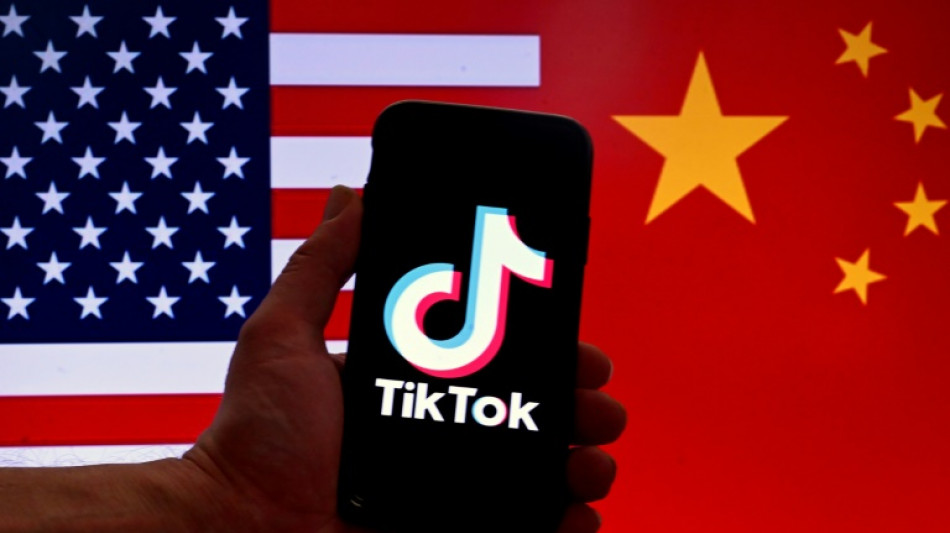
Montana TikTok ban unrealistic and misguided: experts / Photo: © AFP

 South African election results renew debate over identity-based voting

 South African voters report smoother local election but declining IEC trust

 Dolly Parton museum and Nashville hotel open after singer’s death

 George and Amal Clooney attend New York political-comedy reading

 British buyers pay substantial premiums for period-home appearance

 Thomas Markle released to house arrest after child-abuse-image charge

 Dawn of War 4 developers chose Adeptus Mechanicus for tactical variety

 Italy face unbeaten South Africa in Turin Nations Championship match

 ChatGPT interactive interface feature tested across six custom tools

 Freshways milk-price cut deepens pressure on UK dairy farms

 Labour and National remain virtually tied as New Zealand vote count advances

 The Good Daughter adapts Karin Slaughter thriller with Rose Byrne and Meghann Fahy

 Heavy-lift drone evacuates wounded Ukrainian soldier from frontline kill zone

 Morrison says West Brom recovered after pressure from successive derby losses

 Britain considers 2027 state visit for Ukraine’s Zelensky

 Arizona Democrats Secure Historic Trifecta with New Legislative Leadership

A total ban of TikTok in the US state of Montana is set up to face an epic battle in the courts, but many experts wonder whether the law is even technically possible.
Montana is the first US state to ban TikTok, with the law set to take effect next year as debate escalates over the impact and security of the popular video app that is owned by Chinese company ByteDance.
"You would have to build a Great Fire Wall of Montana," said Tarah Wheeler, chief of cyber security firm Red Queen Dynamics and a senior fellow for Global Cyber Policy at the Council on Foreign Relations.
"Maintaining a ban in the state and remaining free of the kind of surveillance you are trying to escape is not possible," she added.
The prohibition will serve as a legal test for a national ban of the Chinese-owned platform, something that lawmakers in Washington are increasingly calling for.
The app is owned by Chinese firm ByteDance and is accused by a wide swathe of US politicians of being under the tutelage of the Chinese government and a tool of espionage by Beijing, something the company furiously denies.
Despite its immense popularity, TikTok faces an ultimatum by the White House that it split from its Chinese owners or stop operating in America.
According to the law, which was signed on Wednesday by Governor Greg Gianforte, a violation takes place each time "a user accesses TikTok, is offered the ability to access TikTok, or is offered the ability to download TikTok."
Montana could not enforce the ban "without doing a whole bunch of other things we don't want the governments of any level in the United States being able to do," said Cyber Threat Alliance chief Michael Daniel.
Causing further trouble, young TikTok fans are likely to take advantage of free virtual private network (VPN) software that lets people disguise where devices are.
Technically adept teenagers in Montana will suddenly use VPNs to be seen logging from other states, Wheeler said, which also introduces vulnerabilities to spyware or malware, which are known to lurk in some VPNs.
- Teens being teens -
While the ban was passed under the auspices of protecting TikTok users in Montana from China snooping, no clear evidence of that has been shown, according to Jason Kelley, acting activism director at internet rights group Electronic Frontier Foundation.
It is the lack of national data privacy law in the United States that leaves users vulnerable, with brokers free to gather and sell internet user information, Kelley noted.
"If China wants data on users, they could just go buy it," Kelley told AFP.
The bill behind the ban mentioned TikTok pranks referred to as "challenges," and one Montana legislator lamented his son taking part in one of those.
"Reading between the lines, I think these legislators are angry that they don't understand the culture of TikTok and how young people use it," Kelley said.
"Montana legislators wanted to do anything to push back on the negative impact of teenagers being teenagers and the influence of TikTok to do stupid things."
And, while the law bans Apple or Google from making TikTok available for download in Montana there are other places online to get apps for Android-powered smartphones.
"There is no chance this law will work, even if it is implemented by TikTok to the extent possible," Kelley said.
The ban will take effect in 2024, but be voided if TikTok is acquired by a company incorporated in a country not designated by the United States as a foreign adversary, the law read.
This was an invitation by Montana legislators for TikTok and the White House to come up with some sort of arrangement that would see the app divest from ByteDance.
But for now, TikTok and possibly users are fully expected to fight the ban in the US courts and possibly all the way to the Supreme court.
"It's almost certain that someone will challenge the ban on using Tiktok," said Lyrissa Lidsky, professor at the University of Florida Levin College of Law.
She noted that the ban will easily be seen to violate fundamental free speech laws in the US where companies are afforded the same rights on speech as individuals.
"The politicians think that this is a successful political strategy whether it's constitutional or not," she added.
W.Lapointe--BTB