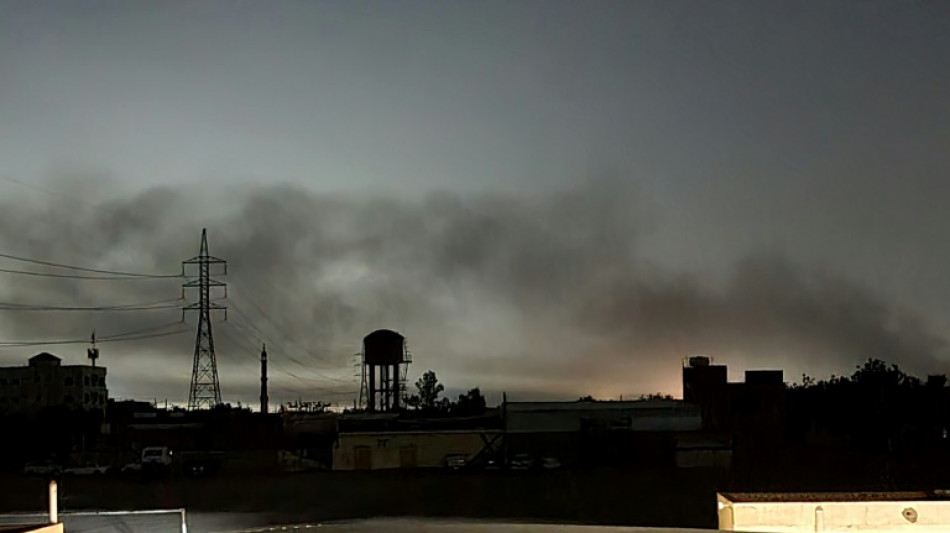
Sudan warring sides make humanitarian promise but no truce / Photo: © AFP

 South African election results renew debate over identity-based voting

 South African voters report smoother local election but declining IEC trust

 Dolly Parton museum and Nashville hotel open after singer’s death

 George and Amal Clooney attend New York political-comedy reading

 British buyers pay substantial premiums for period-home appearance

 Thomas Markle released to house arrest after child-abuse-image charge

 Dawn of War 4 developers chose Adeptus Mechanicus for tactical variety

 Italy face unbeaten South Africa in Turin Nations Championship match

 ChatGPT interactive interface feature tested across six custom tools

 Freshways milk-price cut deepens pressure on UK dairy farms

 Labour and National remain virtually tied as New Zealand vote count advances

 The Good Daughter adapts Karin Slaughter thriller with Rose Byrne and Meghann Fahy

 Heavy-lift drone evacuates wounded Ukrainian soldier from frontline kill zone

 Morrison says West Brom recovered after pressure from successive derby losses

 Britain considers 2027 state visit for Ukraine’s Zelensky

 Arizona Democrats Secure Historic Trifecta with New Legislative Leadership

Sudan's warring parties signed a commitment late Thursday to humanitarian principles in their spiraling conflict but did not yet reach a ceasefire in talks described by US diplomats as difficult.
Representatives of the army and paramilitary forces, whose nearly one month of fighting has killed more than 750 people and displaced thousands, signed the agreement as they kept negotiating in the Saudi city of Jeddah.
"We affirm our commitment to ensuring the protection of civilians at all times, including by allowing safe passage for civilians to leave areas of active hostilities on a voluntary basis in the direction of their choice," the declaration said.
The agreement commits both sides in general terms to let in badly needed humanitarian assistance after looting and attacks targeting aid in the impoverished country, Africa's third largest in area.
The declaration calls for the restoration of electricity, water and other basic services, the withdrawal of security forces from hospitals and "respectful burial" of the dead.
A US official involved in the talks, speaking on condition of anonymity, said a proposal on the table would establish a new 10-day truce, which would lead, in turn, to negotiations on a longer-term end to fighting.
"This is not a ceasefire. This is an affirmation of their obligations under international humanitarian law, particularly with regard to the treatment of civilians and the need to create space for humanitarians to operate," the official said.
"We are hopeful, cautiously, that their willingness to sign this document will create some momentum that will force them to create the space" to bring in relief supplies, she said.
But, she said the two sides remained "quite far apart" in the discussions.
At least 18 humanitarian workers have been killed since the war started on April 15.
Many UN agencies and NGOs announced temporary suspensions of their work in Khartoum and Darfur because of fighting. They later resumed their work in some areas, but still say they face violence.
The UN's World Food Programme said millions of dollars worth of food was looted in Khartoum.
- Move to monitor future truce -
Envoys from the warring generals -- army chief Abdel Fattah al-Burhan and paramilitary commander Mohamed Hamdan Daglo -- have been meeting since Saturday in Jeddah for "pre-negotiation talks" with participation of the United States and the United Nations.
The two sides also agreed for the first time on a way to monitor any ceasefire, officials said.
A second US official said the negotiations were "very tough" and acknowledged that both sides may have ulterior motives through the ceasefire monitoring.
"Candidly, there is some hope on both sides that the other side would be seen as being the perpetrator of violations," he said.
But, he added that the length of time spent in brokering the first step would at least make the ceasefire more "effective" if reached.
Diplomats and experts have questioned whether the two sides want peace or if they are more interested in vanquishing the other.
The conflict erupted when the paramilitary forces, established and groomed by former dictator Omar al-Bashir, refused to be integrated into the army in line with a pathway for a transition to civilian rule.
The United States brokered a temporary truce and threatened sanctions on the warring parties last week after it expired.
Some US lawmakers have voiced alarm that the focus on the two generals essentially sidelines the pro-democracy forces.
"We cannot allow the civilian leadership of the groups that led the brave uprising that overthrew Omar al-Bashir to be shoved aside," Senator Chris Coons, a Democrat close to President Joe Biden, told a hearing Wednesday.
Also Thursday, the United Nations' top rights body narrowly decided to beef up monitoring of abuses in Sudan, expanding the work of an existing special rapporteur.
But the vote was close. The move was led by Western countries, with 18 members of the Human Rights Council in favor, 15 opposed and 14 abstaining.
burs-sct/sw
K.Thomson--BTB