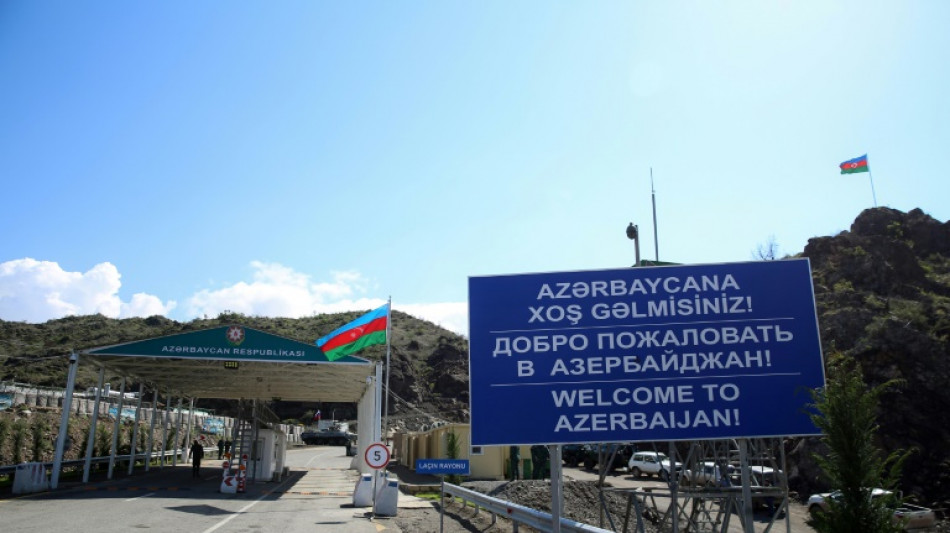
Armenia-Azerbaijan clashes threaten to derail peace talks / Photo: © AFP

 South African election results renew debate over identity-based voting

 South African voters report smoother local election but declining IEC trust

 Dolly Parton museum and Nashville hotel open after singer’s death

 George and Amal Clooney attend New York political-comedy reading

 British buyers pay substantial premiums for period-home appearance

 Thomas Markle released to house arrest after child-abuse-image charge

 Dawn of War 4 developers chose Adeptus Mechanicus for tactical variety

 Italy face unbeaten South Africa in Turin Nations Championship match

 ChatGPT interactive interface feature tested across six custom tools

 Freshways milk-price cut deepens pressure on UK dairy farms

 Labour and National remain virtually tied as New Zealand vote count advances

 The Good Daughter adapts Karin Slaughter thriller with Rose Byrne and Meghann Fahy

 Heavy-lift drone evacuates wounded Ukrainian soldier from frontline kill zone

 Morrison says West Brom recovered after pressure from successive derby losses

 Britain considers 2027 state visit for Ukraine’s Zelensky

 Arizona Democrats Secure Historic Trifecta with New Legislative Leadership

Armenia and Azerbaijan on Thursday blamed each other for an exchange of fire along their restive border, which killed one person and wounded four days ahead of EU-hosted peace talks.
The Caucasus neighbours have been locked in a decades-long territorial dispute over the Nagorno-Karabakh region of Azerbaijan, which has reignited in recent months.
Russia urged the sides to de-escalate tensions after the fatal exchange of fire, but its influence as a power broker in the region has waned since it launched its invasion of Ukraine last year.
Armenia initially said four of its soldiers had been wounded by incoming fire in an eastern region of the ex-Soviet country.
"Azerbaijani forces are shooting artillery and mortars at Armenian positions in the Sotk region" the Armenia's defence ministry said.
Baku meanwhile accused Armenia of a "provocation" that had left one of its soldiers dead.
It said Armenian soldiers had "once again violated the ceasefire agreement" with "large-calibre weapons," referring to an accord from November 2020 that ended six weeks of hostilities.
In Moscow, Kremlin spokesman Dmitry Peskov told reporters Thursday: "We expect a restrained approach from the parties and urge them not to take any actions that could lead to an increase in tensions."
- 'Very little' chance -
Thursday's flare up in fighting comes just days before European Council President Charles Michel is to host Armenia's Nikol Pashinyan and Azerbaijan's Ilham Aliyev for talks in Brussels.
The two leaders had also agreed to jointly meet the leaders of France and Germany on the sidelines of a European summit in Moldova on June 1, according to the EU.
Pashinyan on Thursday accused Azerbaijan of looking to "undermine the talks" in Brussels.
"I have not changed my mind about going to Brussels," he said in his statement -- but there was "very little" chance of signing a peace deal with Azerbaijan at the meeting.
A draft agreement "is still at a very preliminary stage and it is too early to speak of an eventual signature", said Pashinyan.
The European Union-hosted meeting comes after talks in the United States at the beginning of May. After that meeting, US top diplomat Antony Blinken spoke of "tangible progress on a durable peace agreement" between the two sides.
Baku and Yerevan however put out quasi-similar statements following the talks, noting progress but acknowledging that they differed on key issues.
- Decades-long dispute -
The Western mediation efforts come as major regional power Russia has struggled to maintain its influence, part of the fallout from its war in Ukraine.
Armenia has traditionally relied on Russia as its security garantor but Yerevan has grown increasingly frustrated with Moscow.
It has accused Russia of failing to fulfill its peacekeeping role when Azerbaijani activists blocked the Lachin corridor, the only land link to Armenia.
The two countries have gone to war twice over disputed territories, mainly Nagorno-Karabakh, a majority-Armenian region inside Azerbaijan.
Tens of thousands of people have been killed in the two wars over the region.
The first war lasted six years, until 1994. The second, fought in 2020, ended in a Russia-negotiated ceasefire.
Under the Russia-brokered 2020 ceasefire, Azerbaijan is required to guarantee safe passage on the Lachin corridor, which is patrolled by Russian peacekeepers.
In a new escalation at the end of end April, Azerbaijan said it had built a checkpoint on the corridor following "threats and provocations" from Armenia.
Armenia denounced the move as a ceasefire violation said the claims were a "far-fetched and baseless pretext".
A.Gasser--BTB