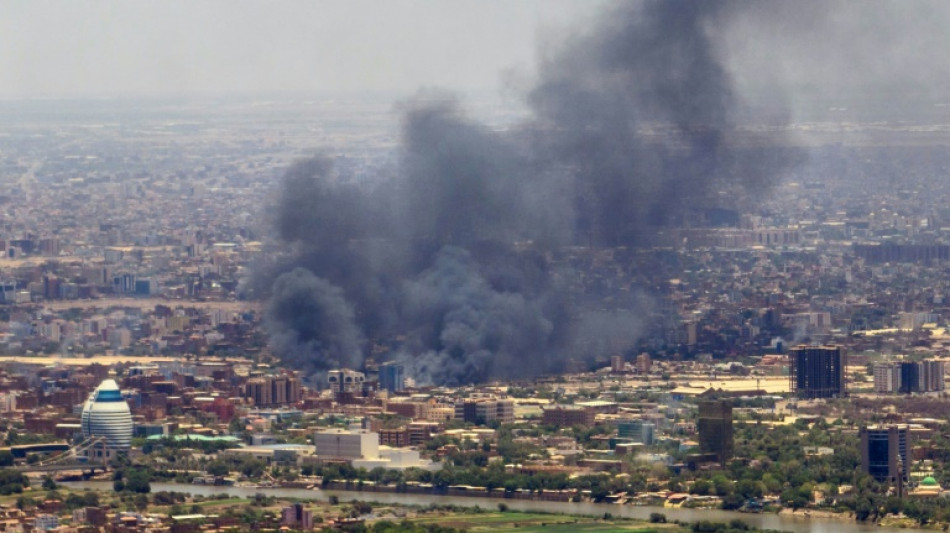
Sudan truce efforts in tatters as fighting rages on / Photo: © AFP

 South African election results renew debate over identity-based voting

 South African voters report smoother local election but declining IEC trust

 Dolly Parton museum and Nashville hotel open after singer’s death

 George and Amal Clooney attend New York political-comedy reading

 British buyers pay substantial premiums for period-home appearance

 Thomas Markle released to house arrest after child-abuse-image charge

 Dawn of War 4 developers chose Adeptus Mechanicus for tactical variety

 Italy face unbeaten South Africa in Turin Nations Championship match

 ChatGPT interactive interface feature tested across six custom tools

 Freshways milk-price cut deepens pressure on UK dairy farms

 Labour and National remain virtually tied as New Zealand vote count advances

 The Good Daughter adapts Karin Slaughter thriller with Rose Byrne and Meghann Fahy

 Heavy-lift drone evacuates wounded Ukrainian soldier from frontline kill zone

 Morrison says West Brom recovered after pressure from successive derby losses

 Britain considers 2027 state visit for Ukraine’s Zelensky

 Arizona Democrats Secure Historic Trifecta with New Legislative Leadership

 Carney Welcomes U.S. Trade Reversal After Democratic Midterm Victory
Gunfire and explosions gripped Khartoum for a 20th straight day Thursday leaving the latest ceasefire effort in tatters, a day after UN chief Antonio Guterres acknowledged the international community had "failed" Sudan.
As the latest ceasefire expired at midnight Wednesday, the regular army said it was ready to abide by a new seven-day truce agreed with South Sudanese mediators, but there was no word from its foes in the paramilitary Rapid Support Forces (RSF).
In Khartoum, witnesses reported loud explosions and exchanges of fire on the streets around dawn.
Deadly urban combat broke out on April 15 between Sudan's de facto leader Abdel Fattah al-Burhan, who commands the regular army, and his deputy turned rival Mohamed Hamdan Daglo, who heads the RSF.
At least 550 people have been killed and 4,926 wounded, according to the latest health ministry figures, which are likely incomplete.
"The UN was taken by surprise" by the conflict, because the world body and others were hopeful that negotiations towards a civilian transition would be successful, the UN chief told reporters in Nairobi Wednesday.
"To the extent that we and many others were not expecting this to happen, we can say we failed to avoid it to happen," Guterres said.
"A country like Sudan, that has suffered so much... cannot afford a struggle for power between two people."
- 'Settlements burnt, destroyed' -
On the day that fighting broke out, the two generals had been due to meet with international mediators to discuss the RSF's integration into the regular army -- a key condition for the transition to democratic rule.
Instead, Khartoum awoke to the sound of gunfire ringing through the streets.
"Every minute of war, more people die or are thrown into the streets, society disintegrates and the state weakens and decomposes a little more," said Khalid Omar Youssef, a civilian minister in the government overthrown by the rival generals in a 2021 coup.
The UN's top humanitarian official, Martin Griffiths, made a lightning visit to Sudan Tuesday to try to negotiate safe passage for aid and aid workers after six trucks laden with food supplies from the World Food Programme were looted on their way to the war-torn western region of Darfur.
He was due to fly on to Nairobi Thursday after a brief stop in Saudi Arabia, his spokeswoman said.
Darfur is still scarred by a war that erupted in 2003 when then president Omar al-Bashir unleashed the Janjaweed militia, mainly recruited from Arab pastoralist tribes, against ethnic minority rebels.
The UN said Darfur civilians were again being armed in the latest fighting.
The Norwegian Refugee Council said violence in the West Darfur state capital, El Geneina, has "resulted in the loss of at least 191 lives".
"Dozens of settlements have been burnt and destroyed, and thousands have been displaced," the rights group said.
Both Griffiths and the UN's Sudan envoy, Volker Perthes, spoke to Burhan and Daglo over the phone about the necessity for aid to reach people, Griffiths tweeted.
UN rights commissioner Volker Turk described the situation as "heartbreaking" and "catastrophic".
He pointed to an air strike by the regular army near a hospital and the RSF using civilian buildings as bases.
- 'African solutions' -
Mediation efforts have multiplied since the conflict broke out, but the regular army said Wednesday that it favoured those of the East African regional bloc IGAD, because it wanted "African solutions to the continent's issues".
It said it was also considering a Saudi-US bid to halt the fighting.
The Arab League is due to meet Sunday to discuss the conflict ahead of an Arab League summit in Saudi Arabia later this month, a diplomat told AFP.
Nearly 450,000 civilians have fled their homes since fighting began, the International Organization for Migration (IOM) said, including more than 115,000 who have sought refuge in neighbouring countries.
Since the overthrow of strongman Omar al-Bashir in a palace coup in 2019, international mediators have sought to bring civilians and the military to the negotiating table.
But in the process, analysts believe, they gave too much credit to Burhan and Daglo, who worked together in the coup that derailed the transition to elective civilian rule.
Writing for the Atlantic Council, Sudan expert Ernst Jan Hogendoorn called on the international community to "begin to strategically apply pressure" by freezing bank accounts and blocking business activities of Sudanese leaders and their forces.
J.Fankhauser--BTB