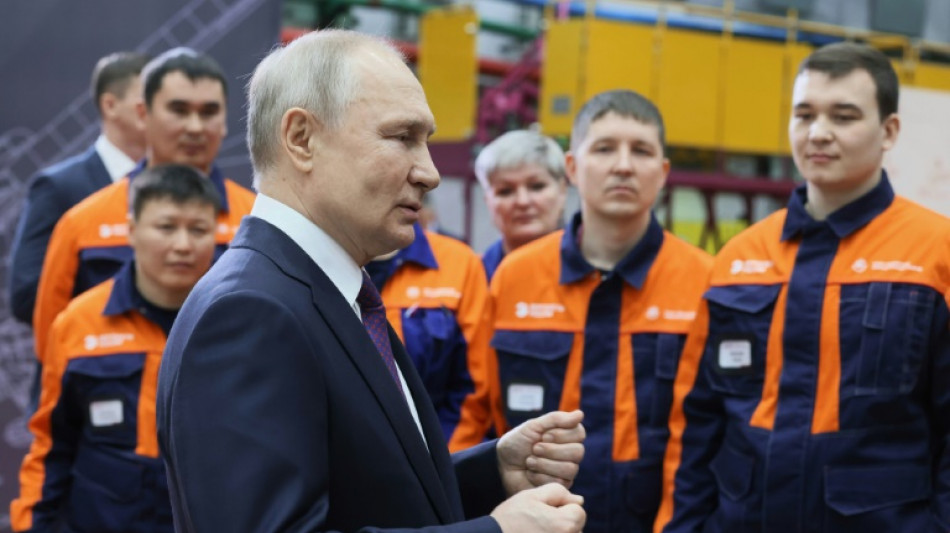
Conflict deepens Russia's demographic crisis / Photo: © SPUTNIK/AFP

 South African election results renew debate over identity-based voting

 South African voters report smoother local election but declining IEC trust

 Dolly Parton museum and Nashville hotel open after singer’s death

 George and Amal Clooney attend New York political-comedy reading

 British buyers pay substantial premiums for period-home appearance

 Thomas Markle released to house arrest after child-abuse-image charge

 Dawn of War 4 developers chose Adeptus Mechanicus for tactical variety

 Italy face unbeaten South Africa in Turin Nations Championship match

 ChatGPT interactive interface feature tested across six custom tools

 Freshways milk-price cut deepens pressure on UK dairy farms

 Labour and National remain virtually tied as New Zealand vote count advances

 The Good Daughter adapts Karin Slaughter thriller with Rose Byrne and Meghann Fahy

 Heavy-lift drone evacuates wounded Ukrainian soldier from frontline kill zone

 Morrison says West Brom recovered after pressure from successive derby losses

 Britain considers 2027 state visit for Ukraine’s Zelensky

 Arizona Democrats Secure Historic Trifecta with New Legislative Leadership

 Carney Welcomes U.S. Trade Reversal After Democratic Midterm Victory
Russia's offensive in Ukraine has aggravated a long-simmering demographic crisis that President Vladimir Putin has struggled to tackle, which could further damage its sanctions-hit economy.
For a country already suffering from a shrinking labour force because of persistently low birth rates, the conflict means even more difficulties that could persist for years.
The mobilisation of hundreds of thousands of men took them off the job market, while prompting many of the most educated parts of the population to flee the country.
"Russia lacks workers," Alexei Raksha, a demographer who previously worked at the Rosstat statistics agency, told AFP.
"It's an old problem, but it has gotten worse due to mobilisation and mass departures," he said.
Russia inherited low birth rates with the collapse of the Soviet Union in the 1990s, when birth rates had halved due to economic hardship and uncertainties over the country's future.
Putin has since tried to push families to have children, heralding "traditional values" as a way to solve what he believes to be an existential crisis.
As part of his efforts to boost population growth, he introduced a financial bonus for a second and every following child.
- Already hit by Covid -
Russian authorities have not given updated estimates of troop losses in Ukraine since September 2022, when the Defence Ministry reported 5,937 dead.
Western estimates suggest around 150,000 dead and wounded on each side.
"We don't know about the exact losses in the military operation, but 300,000 people were mobilised, further reducing the number of young people working," said Natalya Zubarevich, an expert at the Moscow State University.
The battlefield losses come on the heels of a deadly coronavirus pandemic, which "hit Russia hard", demographic expert Igor Yefremov told AFP.
Official figures count around 400,000 deaths from Covid-19, but the actual toll is estimated to be much higher.
Given the shrinking labour force, Russia's low unemployment rate of 3.5 percent is not a healthy sign -- showing instead a shortage of recruits, with various sectors struggling to fill posts.
A survey published on April 19 by the Russian Central Bank confirmed "acute" tensions, particularly in "processing industries", transport and "water supply".
- Will some 'come back'? -
A study last month from the Higher School of Economics said Russia needed to take in 390,000 to 1.1 million migrants every year until the end of the century to avoid population shrinkage.
But some sectors will not be able to compensate the losses of workers, particularly industries requiring high levels of education.
Raksha said the Ukraine conflict triggered two waves of departures, with "many highly qualified people, including IT specialists", leaving Russia.
He estimated that around 150,000 people, including around 100,000 men, quit Russia in February-March 2022, just weeks after the conflict erupted.
After Putin announced a mobilisation for the country in September, Raksha estimates that another half a million left.
A recent law has imposed economic restrictions on draft dodgers, which could encourage those who have fled abroad to settle there permanently.
Still, Zubarevich said more than 60 percent of those who left continue working for Russian companies remotely.
"And some of them will come back," she said.
J.Horn--BTB