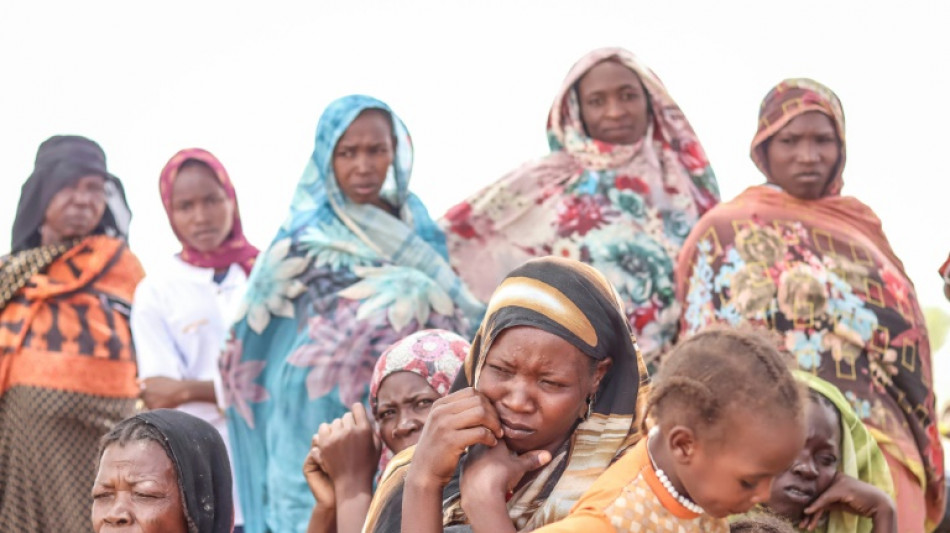
Thousands of Sudanese make perilous trek to safety in Chad / Photo: © AFP

 South African election results renew debate over identity-based voting

 South African voters report smoother local election but declining IEC trust

 Dolly Parton museum and Nashville hotel open after singer’s death

 George and Amal Clooney attend New York political-comedy reading

 British buyers pay substantial premiums for period-home appearance

 Thomas Markle released to house arrest after child-abuse-image charge

 Dawn of War 4 developers chose Adeptus Mechanicus for tactical variety

 Italy face unbeaten South Africa in Turin Nations Championship match

 ChatGPT interactive interface feature tested across six custom tools

 Freshways milk-price cut deepens pressure on UK dairy farms

 Labour and National remain virtually tied as New Zealand vote count advances

 The Good Daughter adapts Karin Slaughter thriller with Rose Byrne and Meghann Fahy

 Heavy-lift drone evacuates wounded Ukrainian soldier from frontline kill zone

 Morrison says West Brom recovered after pressure from successive derby losses

 Britain considers 2027 state visit for Ukraine’s Zelensky

 Arizona Democrats Secure Historic Trifecta with New Legislative Leadership

 Carney Welcomes U.S. Trade Reversal After Democratic Midterm Victory
On donkeys or horses, by cart or by foot, hundreds of Sudanese, most of them women and children, each day cross a small, dry stream to find safety in neighbouring Chad.
As of Monday, at least 20,000 people had found refuge at a makeshift camp in the Chadian border village of Koufroun, according to the United Nations refugee agency UNCHR, which manages their influx along with other UN agencies.
The village lies a few hundred metres (yards) from the border with West Darfur, which with the capital Khartoum is among the worst-hit provinces in the Sudan conflict.
Most of those arriving have come from the Sudanese town of Tendelti, about 20 kilometres (12 miles) away -- the theatre of intense fighting between the forces of army chief Abdel Fattah al-Burhan and the paramilitary Rapid Support Forces (RSF) led by his ex-deputy Mohamed Hamdan Daglo.
Many show up empty-handed -- a sign of a desperate getaway.
The UN says at least 100 people were killed in West Darfur in the past week. The toll may be far higher, but information from the area is lacking.
Some carry belongings and provisions on the arduous trek in the overwhelming Sahelian heat.
They search for shelter under huge but rare acacia trees, under which their predecessors and humanitarian workers have set up makeshift camps.
Scattered in small groups over two square kilometres (about half a square mile), some use garments and veils to provide shade from the merciless sun.
- 'I have nothing' -
Under one of the trees, Mahamat Hassan Hamad had built a room with walls of straw and a roof of plastic sheeting, held up by branches, to provide shelter for himself, his wife and their 11 children.
The 52-year-old tailor arrived in Koufroun two weeks after having fled Tendelti.
Trying to hold back tears, he said, "The RSF attacked early in the morning, they set fire to our homes and destroyed everything in their path. I took my children to cross the border."
"Today, I have no food for my children and no means of work -- my sewing machines were taken by the attackers," he said.
"We have had nothing from the UNCHR, we survive thanks to solidarity from the local people," he said.
Nearby, Hinit Issack Abakar, 17, wearing a black hijab, said, "I had just enough time to pack my diploma, which will help me get into university, and escape with my little brother and sister," she said.
"I don't know where to find my mother and my father, when the fighting began, they weren't at home, I've had no news," she said before crying. "It's very hard to live in a refugee camp without parents."
Achai Idriss, a woman in her 30s, said "I was at the market selling coffee when the fighting started. I had just enough time to collect my belongings and head for the border, like the others."
"Thank heaven, I've been able to get my business going again. I make and sell coffee and the money helps me to make ends meet here."
- Emergency kits -
This desolate spot lies some 800 km east of N'Djamena, the capital of Chad, one of the poorest countries in the world.
Humanitarian workers are overwhelmed by the demand.
The UN children's agency UNICEF is drawing on an emergency stockpile to provide kits with cooking utensils, blankets and mats, said Donaig Le Du, a spokesperson for the agency.
A French-based NGO called Premiere Urgence Internationale has built a makeshift medical post in Koufroun. Three health workers work there daily and offer consultations, prioritising women, children and the elderly.
They see around 100 to 200 people each day, said Ndoumbaye Thertus, the agency's local chief.
"The main pathologies are respiratory illnesses, gastroenteritis and malnutrition," he said.
The humanitarian situation could quickly become catastrophic at Koufroun, aid workers fear.
"The big challenge is supplies -- we need to mobilise donors to provide support," said Jean Paul Habamungu, head of UNHCR operations in eastern Chad.
Thousands more could still arrive in Koufroun or elsewhere in Chad, struggling into the country along the porous 1,300-km border, aid workers say.
O.Krause--BTB