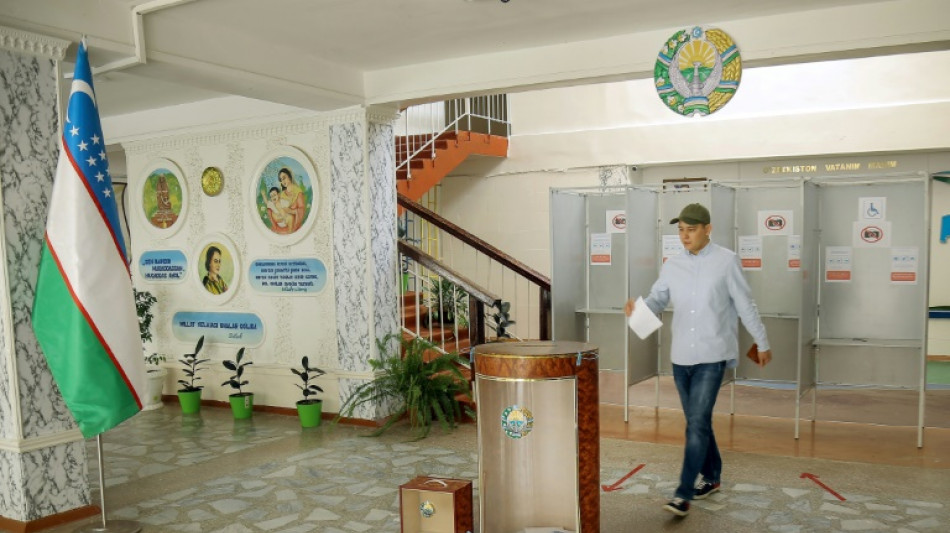
Uzbekistan approves reforms to strengthen president / Photo: © AFP

 South African election results renew debate over identity-based voting

 South African voters report smoother local election but declining IEC trust

 Dolly Parton museum and Nashville hotel open after singer’s death

 George and Amal Clooney attend New York political-comedy reading

 British buyers pay substantial premiums for period-home appearance

 Thomas Markle released to house arrest after child-abuse-image charge

 Dawn of War 4 developers chose Adeptus Mechanicus for tactical variety

 Italy face unbeaten South Africa in Turin Nations Championship match

 ChatGPT interactive interface feature tested across six custom tools

 Freshways milk-price cut deepens pressure on UK dairy farms

 Labour and National remain virtually tied as New Zealand vote count advances

 The Good Daughter adapts Karin Slaughter thriller with Rose Byrne and Meghann Fahy

 Heavy-lift drone evacuates wounded Ukrainian soldier from frontline kill zone

 Morrison says West Brom recovered after pressure from successive derby losses

 Britain considers 2027 state visit for Ukraine’s Zelensky

 Arizona Democrats Secure Historic Trifecta with New Legislative Leadership

 Carney Welcomes U.S. Trade Reversal After Democratic Midterm Victory
Uzbekistan has overwhelmingly approved constitutional changes that will allow President Shavkat Mirziyoyev to remain in power until 2040 in a tightly-controlled referendum, election results showed Monday.
Mirziyoyev, 65, became president in 2016 after the death of dictator Islam Karimov.
Uzbeks voted Sunday on reforms that extend presidential terms from five to seven years, allowing Mirziyoyev to serve two more terms and prolong his time in power.
According to the preliminary results released Monday, the changes were approved by 90.21 percent of votes with a 84.54 percent turnout.
Despite undertaking recent reforms, government critics and rights groups say Uzbekistan remains authoritarian.
Mirzizyoyev has insisted that the overhaul of the constitution will improve governance and quality of life in Uzbekistan.
But he is set to benefit from the changes the most.
Neighbouring Kazakhstan was the first to congratulate the Uzbek leader, with President Kassym-Jomart Tokayev saying the result was evidence of "trust" in his rule and "firm support from the Uzbek nation."
Mirziyoyev has presented himself as Karimov's modern successor. He had served 13 years as a loyal prime minister under Karimov's brutal rule.
He then won two elections, in which international observers say he did not face real competition.
Following Karimov's death, Mirziyoyev spearheaded a series of reforms in Uzbekistan, including a clampdown on forced labour in the country's cotton fields.
After years of being cut off from the world under Karimov's regime, Uzbekistan now wants to join the World Trade Organisation.
But activists say rights abuses persist, and authorities have shown no sign of allowing a political opposition to emerge.
- Voting tightly controlled -
The constitutional changes also include a ban on capital punishment and the protection of human rights for what Mirziyoyev has called a "New Uzbekistan."
But despite some economic progress and social improvements -- such as the criminalisation of domestic violence -- the government allows no dissent.
The adoption of the text was beyond doubt after a one-sided campaign, in a state where the press is still largely controlled.
Two journalists from state media interviewed by AFP claimed on condition of anonymity to have "received instructions to cover Uzbekistan, the referendum and the president in a positive way".
They said censorship strengthened as the election approached.
The government went to lengths to give the vote a veneer of legitimacy, enrolling local celebrities at large rallies and concerts to praise the proposals and the president.
Uzbekistan's population is emerging from a particularly harsh winter marked by shortages of fuel, and is faced with poverty and corruption.
During unrest in July 2022, demonstrations against a constitutional amendment in Karakalpakstan, which would have reduced the autonomy of the vast territory, were put down in a bloody crackdown. Dozens of people were jailed.
That controversial amendment has since been withdrawn.
J.Fankhauser--BTB