The 'end' of Kim Jong Un? What the 'Washington Declaration' means / Photo: © AFP

 New York sues online prediction markets giant Kalshi

 Commerzbank agrees to talks with UniCredit after two-year standoff
 A rumour, a rush: chaos at Morocco border with Spain's Ceuta

 Fornaro Legal Releases Guidance to Help Businesses Maintain Clear Ownership Records During Growth

 Hamas agrees to disarm: what are the challenges ahead?

 Turkey fights to last major blaze inland from Bodrum

 Japan probe made closest-ever asteroid flyby: space agency

 Wildberries: 'Russia's Amazon' targeted by Ukraine

 FIFA plan hit by senior advisor resigning, AFC opposition

 Kosovo war crimes trial opens against fugitive Serbs

 Bodies of four climbers recovered near northern Pakistan avalanche site, police say
 Thousands cross into Spain's north Africa enclave in new migrant crisis

 Noosha Aubel under pressure: Potsdam City Hall caught between going it alone and the nursery scandal

 UK singer Boy George pulls out of musical after pro-Israel song backlash

 Chipmaker Kioxia reports AI-driven 45-fold surge in quarterly net profit

 Wildfire rages on Crete as strong winds hamper firefighting

 Hamas agrees to disarm under Trump plan, but no word from Israel

 Alonso says new Chelsea signing Lacroix has 'winner's mentality'

 US eyes European gas dominance through Balkans

 Sniffer dogs search mall wrecked after Japan quake

 Explosion at coal mine kills 34 in southern Pakistan

 Renowned Nepali climber among 10 missing after Pakistan avalanche

 Ukrainian drones send Crimea's tourism industry into freefall

 Tech rebound fuels record-breaking rally in South Korean stocks
 The last trio: S.Africa's zoo elephants await their fate
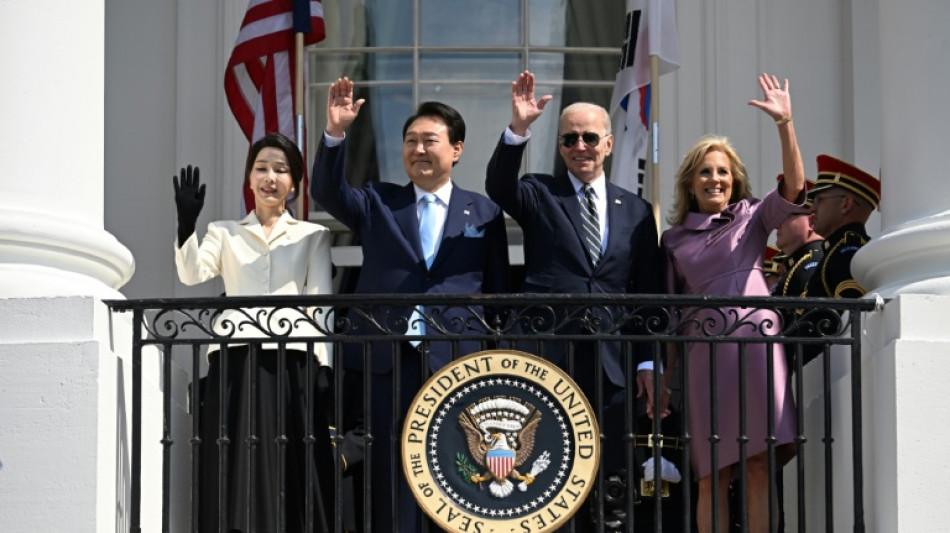
If North Korea uses its nuclear weapons against the United States or its ally South Korea, it would be "the end" of Kim Jong Un's regime, Seoul and Washington announced this week.
The stern threat comes as President Yoon Suk Yeol is on a six-day state visit to the United States, where he and his counterpart Joe Biden discussed ramping up the US security shield for South Korea in the face of the nuclear-armed North's increased missile tests.
But how significant is the tough-sounding statement? AFP takes a look at what we know:
- What is it? -
The Washington Declaration boosts the US nuclear umbrella over South Korea.
It includes the regular deployment of a US nuclear submarine to South Korea -- something that has not happened since the 1980s -- and other measures, including more information sharing in the event of a North Korean attack.
But there are no plans to station US nuclear weapons in South Korea, and some analysts doubt the declaration's practical value.
"It is questionable whether the North would be afraid of a strategic nuclear submarine equipped with an SLBM with a range of more than 7,400 kilometres (4,600 miles)," Cheong Seong-chang of the Center for North Korea Studies at the Sejong Institute told AFP.
The "too long" range of the submarine's missiles mean it may not be able to hit North Korea if it were in South Korean waters, he said.
- Is it significant? -
The state visit undoubtedly "represents a new high-water mark for US-South Korea relations, with the breadth and depth of security, economic, and cultural cooperation on full display", Leif-Eric Easley, a professor at Ewha University in Seoul, told AFP.
US officials described the new arrangement as akin to moves last witnessed when Washington oversaw the defence of Europe against the Soviet Union.
Yoon has been trying to reassure the South's increasingly nervous public about the US commitment to so-called "extended deterrence", where US assets -- including nuclear weapons -- serve to prevent attacks on allies.
A majority of South Koreans now believe the country should develop its own nuclear weapons, surveys show. Yoon has previously hinted Seoul could pursue this option.
- Will Seoul get nuclear weapons? -
Absolutely not. And this could cause problems, experts said.
"One thing was clear: there was an implied agreement that Seoul would not go nuclear," said Soo Kim, Policy Practice Area Lead at LMI Consulting and a former CIA analyst.
"Seoul's nuclear ambitions have been capped."
Gi-Wook Shin, a Korea expert and sociology professor at Stanford University, told AFP that the declaration was "a step forward".
"I don't think this will be enough to appease a South Korean public that has increasingly demanded that Seoul develop nuclear weapons of its own," Shin said.
- What will North Korea do? -
Closer cooperation between its self-declared arch enemies, Washington and Seoul, is bound to concern Kim Jong Un's regime and there could be more missile launches to demonstrate this, experts say.
In public, "North Korea will downplay the message of reassurance by the US regarding nuclear deterrence", Chun In-bum, a retired South Korean army general, told AFP.
But behind closed doors "they will get the message: if they use nuclear weapons it will be the end of the regime", he said.
Having spent decades -- and a huge chunk of the impoverished country's GDP -- on developing his banned nuclear weapons programmes, Kim is not going to change track, experts said.
"It is unlikely that North Korea will give up its nuclear weapons by giving in to these threats," Yang Moo-jin, president of the University of North Korean Studies in Seoul, told AFP.
- What about Trump? -
The major problem with the Washington Declaration is not the agreement itself, but US political dysfunction, which means it could be worthless after the next presidential election there, Karl Friedhoff at the Chicago Council on Global Affairs told AFP.
The potential return to power of former US president Donald Trump is likely to trigger "very serious discussions" in Seoul, he said.
For the US-South Korea relationship "the biggest challenge is something that the alliance doesn't really have any control over: US domestic politics", he said.
"There is serious concern in Seoul about a return of the GOP -- especially Trump -- to the White House. If he wins the election in 2024, that could spark a very unpredictable turn of events in the relationship."
A.Gasser--BTB