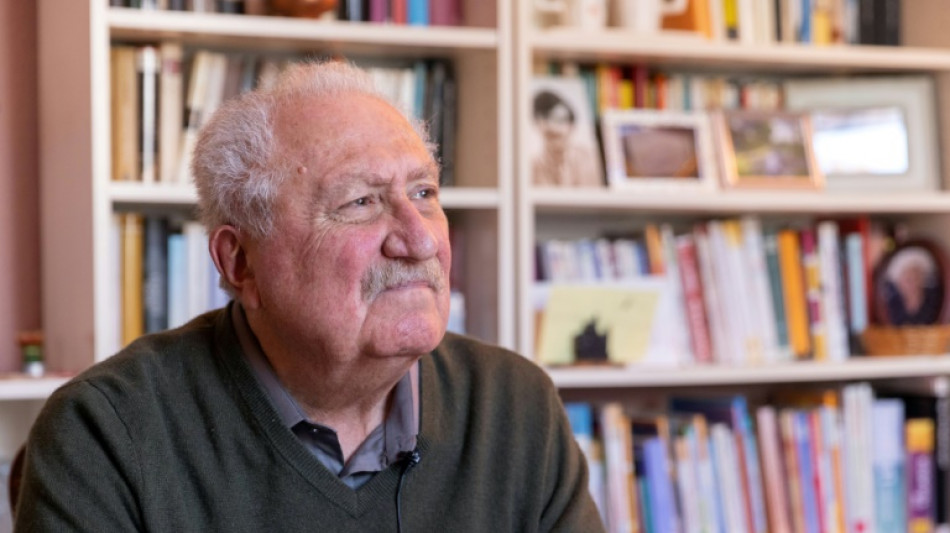
Turks in Germany hope for citizenship law overhaul / Photo: © AFP

 South African election results renew debate over identity-based voting

 South African voters report smoother local election but declining IEC trust

 Dolly Parton museum and Nashville hotel open after singer’s death

 George and Amal Clooney attend New York political-comedy reading

 British buyers pay substantial premiums for period-home appearance

 Thomas Markle released to house arrest after child-abuse-image charge

 Dawn of War 4 developers chose Adeptus Mechanicus for tactical variety

 Italy face unbeaten South Africa in Turin Nations Championship match

 ChatGPT interactive interface feature tested across six custom tools

 Freshways milk-price cut deepens pressure on UK dairy farms

 Labour and National remain virtually tied as New Zealand vote count advances

 The Good Daughter adapts Karin Slaughter thriller with Rose Byrne and Meghann Fahy

 Heavy-lift drone evacuates wounded Ukrainian soldier from frontline kill zone

 Morrison says West Brom recovered after pressure from successive derby losses

 Britain considers 2027 state visit for Ukraine’s Zelensky

 Arizona Democrats Secure Historic Trifecta with New Legislative Leadership

 Carney Welcomes U.S. Trade Reversal After Democratic Midterm Victory
Sener Sargut is from Turkey but has lived in Germany for over six decades, is married to a German woman and speaks the local language fluently.
Yet the 80-year-old does not hold German nationality, as taking up citizenship of his adopted homeland would mean giving up his Turkish passport.
But that could be set to change.
Reforms under consideration could end Germany's restrictive nationality laws and open the door for people from more countries to become dual citizens, including those from the large Turkish community.
"I often thought about getting German citizenship but then I always held off because I would have to give up Turkish citizenship," Sargut told AFP from his home in Frankfurt.
"I did not want to do that."
The pensioner, a founder of TGD, a non-profit group that advocates for Germany's Turkish community, says he is "outraged" that change has been so slow -- but is optimistic it could finally happen.
"It would be a good step, not just for us, but for the country itself," said the father of two, who spent years as head of department at an education centre.
German's coalition government is engaged in talks over the plans and there have been positive signals that an agreement could soon be reached.
- 'Guest worker' influx -
Sargut arrived in Frankfurt in 1959 from Istanbul to study, two years before an agreement was signed paving the way for a huge number of Turks to move to work in Germany.
Germany was still getting back on its feet after World War II and desperately needed labour in many areas –- to rebuild devastated cities, work in shipyards, steelworks and car plants.
As well as Turkey, Berlin struck deals with other countries to bring in so-called "guest workers" on a temporary basis, including Italy, Tunisia and Greece.
About 870,000 Turks went to Germany under the agreement, which ran until 1973. Hundreds of thousands ended up staying, ushering in major social and demographic changes in Europe's most populous country.
The newcomers had few rights in the early days and faced poor treatment, according to Sargut, who got heavily involved in fighting to improve the lot of his compatriots.
The situation improved over the years and many brought family to Germany, but the route to citizenship remained tough.
They had to learn German to a good standard, prove they had integrated into society -- and, crucially, give up their Turkish nationality, heart-wrenching for many who still had strong ties to their homeland.
Former chancellor Angela Merkel's conservatives have for decades been sceptical about lifting barriers on citizenship, arguing that lax rules would not bring about the integration of newcomers into society.
- 'Modern citizenship law' -
But Germany's coalition government -- which took power in 2021 and comprises the left-wing SPD, the Greens and the liberal FDP -- has pledged to forge a new "modern citizenship law".
A draft bill under consideration would open up a path for most foreigners to become dual nationals, generally limited to EU and Swiss citizens at present.
The planned reforms also include lowering the number of years of residency needed for naturalisation to five from eight currently -- and even three in some cases.
To help integrate those from the "guest worker" generation, language requirements -- a stumbling block for some older immigrants who mixed little outside their communities -- would be eased.
The impact on the Turkish community could be potentially huge, affecting up to one million people, according to TGD.
Germany, with a population of around 84 million, is home to some 2.8 million people with a Turkish background, according to statistics.
The planned citizenship overhaul was mentioned in a sweeping agreement signed when the coalition government was formed.
The changes, it said, are aimed at better reflecting the social make-up of modern Germany -- a "diverse, immigrant society".
There are also economic considerations. Europe's biggest economy is trying to attract foreign workers to plug acute labour shortages, and is keen to make itself a more attractive destination.
The FDP had initially expressed reservations about the plans but recently there have been signs of progress.
In a recent interview with RND media group, Justice Minister Marco Buschmann of the FDP outlined some of his party's demands -- but also said he was "optimistic" a deal could be agreed soon.
C.Meier--BTB