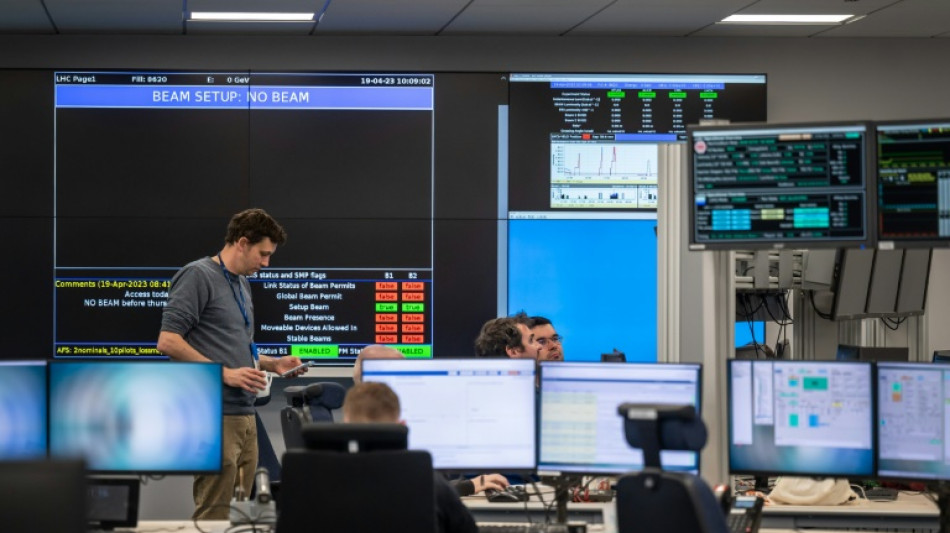
CERN takes first small steps towards giant particle accelerator / Photo: © AFP

 EU grapples with migrant crisis in Spain's N. Africa enclave

 Hungary to shut nuclear plant as heatwave hits central Europe

 Strengthening El Nino 'adding fuel to a planet already on fire': UN chief

 Tech-fuelled rally fizzles as oil prices rise

 Chelsea's Mudryk cleared to play after doping ban appeal

 A side of oysters for France's flat-out firefighters

 England cricket chief Key refuses to rule out Stokes return

 New blazes in Greece as strong winds hamper firefighting

 Springboks star Feinberg-Mngomezulu back for Argentina Test

 Shops closed, businesses quiet as Spain's Ceuta faces migrant surge

 Chelsea fined £10mn, handed suspended transfer ban for breaching agent rules
 Residents defend Spain’s ancient 'El Abuelo' tree from flames

 Forever chemicals and pesticides: what to know

 Spaniard Santi Denia takes over as Czech Republic coach

 EU races to contain new migrant crisis as thousands cross into Spain's N. Africa enclave

 Profits surge at US oil giant amid Iran war supply shock
 Bodies of four climbers found near Pakistan avalanche site: police

 UK court dismisses challenge against new Chinese embassy in London

 Stock markets rally on tech rebound
 Tyla drops Lagos show as South Africa, Nigeria row over immigration

 BP seeks to sell North Sea business as UK faces drilling dilemma

 Pro-Kremlin commentator denounces 'censorship' in France

 AC Milan 'in tears' at death of Italian football legend Baresi

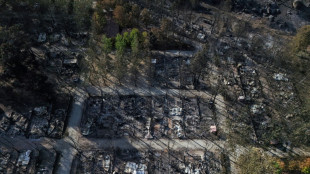 France, Spain assess scorched terrain as new wildfires threaten other regions

 Нооша Аубель під тиском: мерія Потсдама між самостійними кроками та скандалом із дитячими садками

Europe's CERN laboratory has taken its first steps towards building a huge new particle accelerator that would eclipse its Large Hadron Collider -- and hopes to see light at the end of the tunnel.
The Future Circular Collider (FCC) particle smasher would be more than triple the length of the LHC, already the world's largest and most powerful particle collider, constructed in the hope of revealing secrets about how the universe works.
The FCC would form a new circular tunnel under France and Switzerland, 91 kilometres (56.5 miles) long and about five metres (16 feet) in diameter.
"The goal of the FCC is to push the energy and intensity frontiers of particle colliders, with the aim of reaching collision energies of 100 tera electron volts, in the search for new physics," CERN says.
The tunnel would pass under the Geneva region and its namesake lake in Switzerland, and loop round to the south near the picturesque French town of Annecy.
Eight technical and scientific sites would be built on the surface, with seven in France and one in Geneva, CERN engineer Antoine Mayoux told reporters this week.
After carrying out a theoretical analysis, "we are now embarking for the first time on field activities" to study potential environmental issues, he said, with seismic and geotechnical studies to follow.
- Mysteries of the universe -
Once the feasibility studies are completed, CERN's member states -- 22 European countries plus Israel -- will decide in the next five to six years on whether to build the FCC.
The FCC would accelerate electrons and positrons until 2060, and then hadrons until 2090, as it seeks answers to many remaining questions of fundamental physics, with about 95 percent of the mass and energy of the universe still a mystery.
CERN's Large Hadron Collider -- a 27-kilometre ring running about a hundred metres below ground -- has already begun chipping away at the unknown.
Among other things, it was used to prove the existence of the Higgs Boson -- dubbed the God particle -- which broadened the understanding how particles acquire mass, and earned two scientists who had theorised its existence the 2013 Nobel physics prize.
But the LHC, which began operating in 2010, is expected to have run its course by around 2040.
"The problem with accelerators is that at some point, no matter how much data you accumulate, you hit a wall of systematic errors," CERN physicist Patrick Janot said.
"Around 2040-2045, we will have taken away all the substance of the precision possible with the LHC," he said.
"It will be time to move on to something much more powerful, much brighter, to better see the contours of the physics that we are trying to study."
- Opening doors to the future -
Some researchers fear that this huge project will gobble up funds that could be used for other, less abstract physics research.
But others insist that pushing fundamental physics forward is vital for advances in applied physics as well.
"The benefits of our research are extremely important," said Malika Meddahi, CERN's deputy director for accelerators and technology, citing as examples medical imaging and the fight against tumours.
Janot agreed: "The day the electron gun was invented, it was the beginning of accelerators; we didn't know it was going to give rise to television. The day general relativity was discovered, we didn't know it was going to be used to run GPS."
Harry Cliff, a particle physicist at Britain's University of Cambridge, acknowledged that the FCC was an "expensive bit of kit".
But he noted that it would be built by "a large international collaboration of nations working together over a very long period of time".
"Particle physics isn't about discovering new particles -- it's about understanding the fundamental ingredients of nature and the laws that govern them."
- Competition from China -
More than 600 institutes and universities around the world use CERN's facilities, and are responsible for funding and carrying out the experiments they take part in.
However, CERN has some competition: China announced in 2015 that it intended to start work within a decade on building the world's largest particle accelerator.
Michael Benedikt, who is heading up the FCC feasibility studies, told AFP that CERN had more than 60 years of experience in developing long-lasting research infrastructure.
And political stability in Europe helped to "minimise the development risk for such long-term projects", he said.
Meddahi also highlighted Europe's leading position in the field, but warned that "China displays the same ambition".
"Let's be vigilant and be sure that we are not on the verge of a change in this hierarchy," she said.
B.Shevchenko--BTB