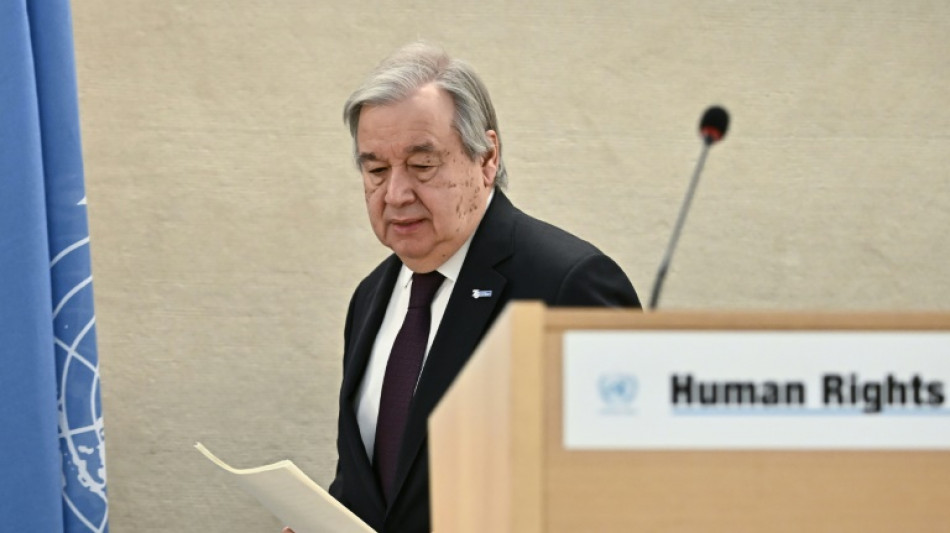
UN chief warns progress on human rights has 'gone into reverse' / Photo: © AFP

 British buyers pay substantial premiums for period-home appearance

 Thomas Markle released to house arrest after child-abuse-image charge

 Dawn of War 4 developers chose Adeptus Mechanicus for tactical variety

 Italy face unbeaten South Africa in Turin Nations Championship match

 ChatGPT interactive interface feature tested across six custom tools

 Freshways milk-price cut deepens pressure on UK dairy farms

 Labour and National remain virtually tied as New Zealand vote count advances

 The Good Daughter adapts Karin Slaughter thriller with Rose Byrne and Meghann Fahy

 Heavy-lift drone evacuates wounded Ukrainian soldier from frontline kill zone

 Morrison says West Brom recovered after pressure from successive derby losses

 Britain considers 2027 state visit for Ukraine’s Zelensky

 Arizona Democrats Secure Historic Trifecta with New Legislative Leadership

 Carney Welcomes U.S. Trade Reversal After Democratic Midterm Victory

 Armenian FM Discusses EU Accountability for Palestinian Rights in Madrid

 Trump and Vance Pursue Secret Diplomacy with Iran Amid Military Pressure

 Classic Car Values Surge: De Tomaso Vallelunga Leads 190% Gain
 Microsoft Ends Oracle AI Computing Rental Deal Amid Cloud Strategy Shift
Respect for human rights has gone into reverse, the United Nations chief warned Monday, calling for a renewal of the Universal Declaration of Human Rights, 75 years after its signing.
Pointing to the war raging in Ukraine, and threats to rights from soaring poverty, hunger and climate disasters, Antonio Guterres said the declaration was "under assault from all sides."
"Some governments chip away at it. Others use a wrecking ball," he told the opening of the UN Human Rights Council's main annual session, describing the disregard and disdain seen for human rights around the world as "a wake-up call".
He said the "Russian invasion of Ukraine has triggered the most massive violations of human rights" being witnessed in the world today.
"It has unleashed widespread death, destruction and displacement," he said.
While the past century has seen astounding progress in human rights and human development, Guterres warned that now, "instead of continuing this progress, we have gone into reverse."
Russia's war in Ukraine loomed large over the meeting, due to last a record six weeks, with calls for unity in condemning Moscow and extending a probe into war crimes in the conflict.
The session comes just days after the one-year anniversary of Moscow's full-scale invasion -- which UN rights chief Volker Turk warned show that 75 years after the world agreed on the universality of rights, "the oppression of the past can return in various disguises."
Turk cited "the old destructive wars of aggression from a bygone era with worldwide consequences, as we have witnessed again in Europe with the senseless Russian invasion of Ukraine".
Following the speeches by the UN top brass, nearly 150 ministers and heads of state and government are due to speak, virtually or in person, during the first four days of the session.
Among them will be the foreign ministers of the United States, China, Ukraine and Iran.
- Walkout? -
Moscow will send Deputy Foreign Minister Sergey Ryabkov to address the council in person on Thursday.
Despite calls from NGOs, observers said it was unlikely there would be a walkout like the one many diplomats took part in when Russian Foreign Minister Sergei Lavrov's video played in the council last year.
Several diplomats suggested that other measures might be taken to convey their disapproval.
"We believe that Russia does not deserve to sit in the room," Ukrainian ambassador Yevheniia Filipenko told reporters. "We will act accordingly."
There is no shortage of other pressing human rights issues for the council to address, with the situations in Iran, Afghanistan, Ethiopia, Syria and Israel on the agenda.
A long line of resolutions will be voted on during the last few days of the session, which is due to wrap up on April 4.
- War crimes probe -
One key resolution will be on extending a high-level investigation into crimes committed in Ukraine since Russia's invasion.
The so-called Commission of Inquiry, which has already determined that Russia is committing war crimes on a "massive scale" in Ukraine, is due to present a comprehensive report to the council in late March.
The commission must "continue its important work, which is of paramount importance for the principles of accountability and justice", Filipenko told reporters Friday.
She said her country was pushing for not only extending but also strengthening the commission's mandate, insisting the "many developments" over the past year "should be reflected".
There is concern, however, that strengthening the text further could cost it votes in the 47-member council, diminishing the sense that the UN's top rights body stands united in its opposition to Russia's actions.
Last year, 32 council members voted to create the commission, with only Russia itself and Eritrea voting against, with 13 countries abstaining.
J.Bergmann--BTB