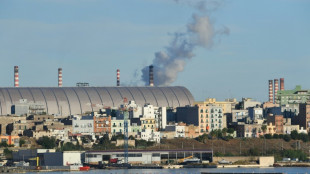
CO2 pollution from fossil fuels to hit all-time high in 2022 / Photo: © AFP/File

 Carrick confident Man Utd can 'work through' tough time

 Mbappe ends Nike partnership to join Swiss brand On

 Liverpool boss Iraola puts Bournemouth love affair on hold

 'A disaster' if Man City do not win says Maresca after flawless start

 Kerry James Marshall: American 'blackness' painter celebrated in Europe

 Spain coach De la Fuente offers 'full support' to people of Ceuta

 Russia seizes assets of Nestle, French firms over West's Ukraine support

 England can build on World Cup 'spirit', says Tuchel

 UNESCO can be 'moderator' in AI debate: chief to AFP

 Infantino 'must go', says German FA vice-president

 Russia seizes assets of Nestle, French firms

 Japan's busiest rail station tests robot bins

 Anthropic says AI systems moving towards building themselves

 Asian stocks boosted by falling oil, yen weakens after BoJ rate hike

 Pakistan court blocks expulsion of Afghan medical college students

 Athletes 'can't take it any more' as Asian Games issues mount

 Allen lights up Bills' new stadium with 41-31 win over Lions

 Afghan medical students in Pakistan hope court stops college expulsions

 AI doomsday warnings unlikely to slow IPOs but questions linger

 ICC eyes China in bid to expand cricket

 Nkunku craving freedom and fun on RB Leipzig return

 Bhutan's traditional archers lose ground to development
 Asian stocks track Wall St rally as oil prices drop

 South Korea makes Asian Games complaint over Japan warlord ceremony

 US aid cuts are killing Kenyan sex workers

Carbon dioxide emissions from fossil fuels, the main driver of climate change, are on track to rise one percent in 2022 to reach an all-time high, scientists said Friday at the COP27 climate summit in Egypt.
Emissions from oil, fuelled by the continuing rebound in aviation, will likely rise more than two percent compared to last year, while emissions from coal -- thought by some to have peaked in 2014 -- will hit a new record.
"Oil is more driven by the recovery from Covid, and coal and gas are more driven by events in Ukraine," Glen Peters, research director at CICERO climate research institute in Norway, told AFP.
Global CO2 emissions from all sources -- including deforestation and land use -- will top out at 40.6 billion tonnes, just below the record level in 2019, the first peer-reviewed projections for 2022 showed.
Despite the wild cards of pandemic recovery and an energy crisis provoked by war in Ukraine, the uptick in carbon pollution from burning oil, gas and coal is consistent with underlying trends, the data suggested.
And deeply worrying, said Peters, a co-author of the study.
"Emissions are now five percent above what they were when the Paris Agreement was signed" in 2015, he noted.
"You have to ask: When are they going to go down?"
- Carbon budget -
The new figures show just how dauntingly hard it will be to slash emissions fast enough to meet the Paris goal of capping global warming at 1.5 degrees Celsius above preindustrial levels.
Heating beyond that threshold, scientists warn, risks triggering dangerous tipping points in the climate system.
Barely 1.2C of warming to date has unleashed a crescendo of deadly and costly extreme weather, from heat waves and drought to flooding and tropical storms made more destructive by rising seas.
To achieve the ambitious Paris target, global greenhouse emissions must drop 45 percent by 2030, and be cut to net zero by mid-century, with any residual emissions compensated by removing CO2 from the atmosphere.
To be on track for a net-zero world, emissions would have to plummet by seven percent annually over the next eight years.
To put that in perspective: in 2020, with much of the world's economy on lock down, emissions fell by only six percent.
Over a longer time frame, the annual rise in CO2 from fossil fuel use has slowed, on average, to 0.5 percent per year over the last decade after climbing three percent annually from 2000 to 2010.
To have a 50/50 chance of staying under the 1.5C limit, humanity's emissions allowance is 380 billion tonnes of CO2, according to the study in Earth System Science Data, authored by more than 100 scientists.
On current emissions trends of 40 billion tonnes a year, that "carbon budget" would be used up in less than a decade.
For a two-thirds chance, the budget shrivels by a quarter and would be exhausted in seven years.
- 'Deeply depressing' -
In recent decades, scientists could usually draw a straight line between CO2 trends and the economy of China, which has been the world's top carbon polluter for about 15 years.
In 2022, however, China's CO2 output is set to drop by nearly one percent for the year, almost certainly reflecting an economic slowdown linked to Beijing's strict zero-covid policy.
Despite having to scramble for alternate sources of energy, including carbon-intensive coal, the European Union is on track to see its emissions fall by almost as much, 0.8 percent.
US emissions will likely go up by 1.5 percent, and India's by six percent.
The annual update also revealed that the ability of oceans, forests and soil to continue soaking up more than half of CO2 emissions has slowed.
"These 'sinks' are weaker than they would be if not for the impacts of a changing climate," said co-author Corinne Le Quere, a professor at the University of East Anglia.
Scientists not involved in the findings said they were grim.
"Global Carbon Budget for 2022 is deeply depressing," said Mark Maslin, a professor of Climatology at University College London.
"To have any chance of staying below the international agreed 1.5C global warming target we need to have large annual cuts in emissions -- which there is no sign of."
M.Furrer--BTB